





Artificial Intelligence
April 09, 2025

For a fintech startup, the "knowledge cutoff" of a standard Large Language Model (LLM) isn't just a technical limitation; it's a liability. Imagine an AI agent attempting to authorize a high-value transaction or assist a user with a "checking account balance" query using data that is six months old. In the world of finance, where every millisecond counts and accuracy is a legal requirement, "guessing" is not an option.
This MCP server case study fintech explores how a scaling digital banking platform moved from fragile, hard-coded API integrations to a robust, standardized architecture using the Model Context Protocol. By leveraging expert MCP server development from Codiste, the startup didn't just give their AI a brain; they gave it real-time eyes into their entire financial ecosystem.
Our subject, a Tier-2 fintech startup specializing in micro-lending and automated wealth management, faced a common roadblock. They had developed highly capable AI agents for customer support and loan underwriting, but these agents were "blind" to live ledger data.
The leadership team realized that to scale, they needed to move away from "duct-taped APIs" and toward a unified standard. They needed a bridge that could connect their AI models to governed, trusted financial information without manual intervention.
Codiste partnered with that startup to initiate MCP server development. The goal was to build a secure, reusable interface that allowed their AI agents to fetch live metadata, run transaction checks, and generate compliance reports through standardized endpoints.
The team deployed an MCP server using the TypeScript SDK, chosen for its balance of performance and developer ergonomics. This server acted as the "Context Broker," sitting between the AI host (Claude 3.5 Sonnet) and the startup’s internal microservices.
Unlike traditional APIs, the MCP server allows for the definition of "Tools" and "Resources."
In fintech, security is the first and last conversation. The MCP server development included:
The deployment of the MCP server case study fintech solution yielded immediate and measurable improvements across the organization’s performance metrics.
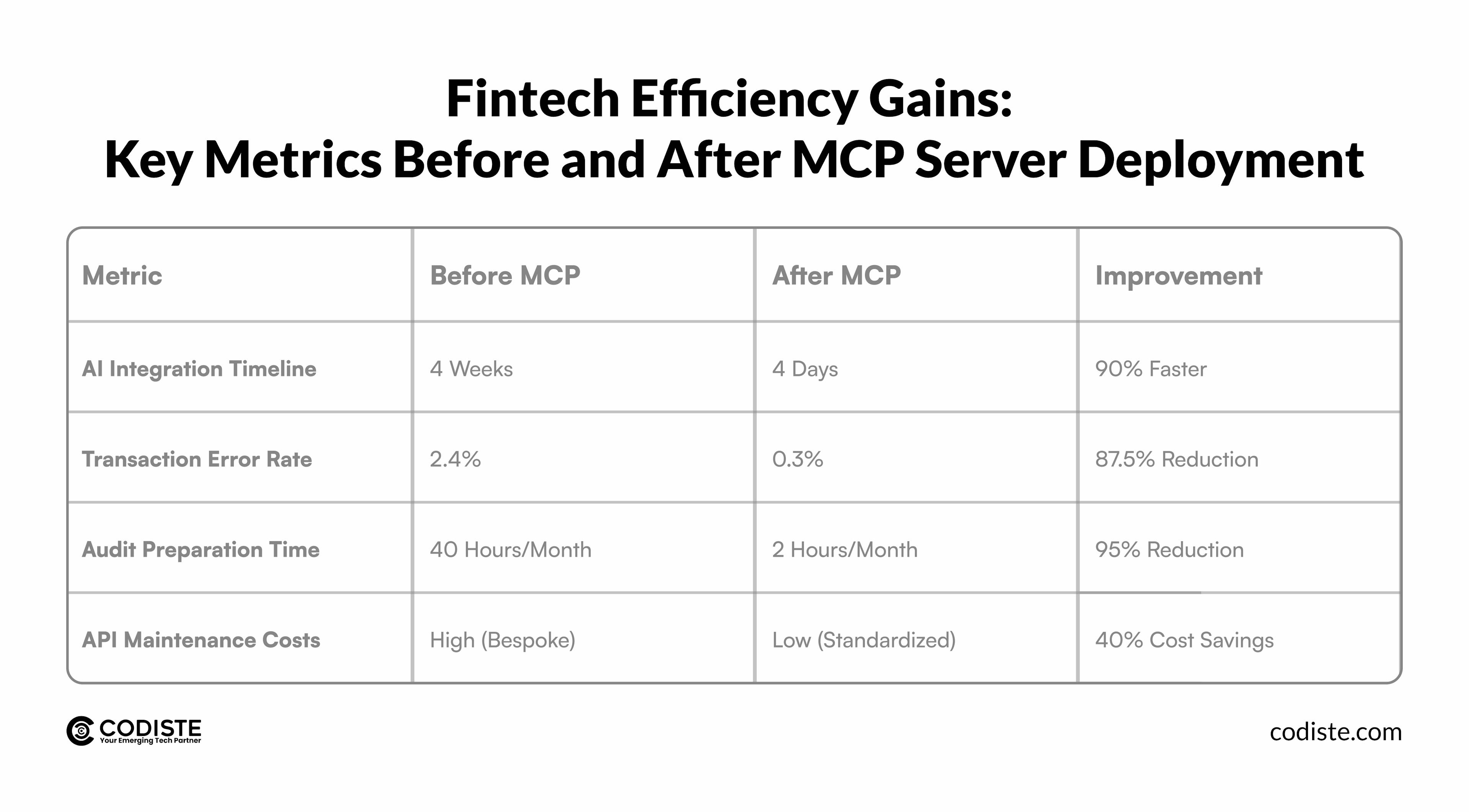
The most visible change was in the customer-facing "Wealth Assistant." Previously, it could only provide general budgeting advice. Post-implementation, a user could ask: "Compare my grocery spending in Q3 vs. Q4 and suggest a savings plan." Because the AI was connected to the live ledger via the MCP server, it could fetch, synthesize, and report these figures in seconds, leading to a 35% increase in App Store ratings within the first quarter.
The Model Context Protocol isn't just another framework; it is a shift toward "Composable AI." For fintechs, this means:
Conclusion: Securing Your Fintech Future
As demonstrated in this MCP server case study fintech, the transition from ad-hoc integrations to a standardized protocol is the "tipping point" for AI scalability. In an industry where trust is the primary currency, providing your AI with accurate, real-time context isn't just a feature it’s a competitive necessity.
At Codiste, we understand that fintech startups operate in a high-stakes environment where compliance and performance cannot be compromised. We specialize in cutting-edge MCP server development, helping you bridge the gap between your proprietary data and the world’s most powerful AI models. Whether you are looking to automate complex underwriting or build the next generation of conversational banking, Codiste is the trusted partner you need to turn AI potential into regulated, audit-ready performance.
Don’t let the "integration tax" slow your innovation. Contact Codiste today for a consultation and let’s build an MCP-driven architecture that scales with your ambition.

CTO & Co-Founder | Codiste
Nishant builds where ambitious ideas meet production reality. As CTO & Co-Founder at Codiste, he has helped ship 150+ AI systems. Through The CTO Story, he gets technical leaders talking about what rarely makes the slide deck: the trade-offs, failures, and decisions behind what actually ships.


Every great partnership begins with a conversation. Whether you're exploring possibilities or ready to scale, our team of specialists will help you navigate the journey.