





Artificial Intelligence
April 09, 2025

The fintech industry has reached a crossroads with generative AI for fintech. While the initial excitement of Large Language Models (LLMs) brought basic chatbots to banking apps, the "black box" nature of these models created a significant barrier. Financial institutions operate on a foundation of strict data privacy and complex legacy systems. Connecting a high-powered AI agent to a core banking system or a sensitive compliance database used to require months of custom API work and significant security risks.
The introduction of the Model Context Protocol (MCP) changes this dynamic entirely. By providing a standardized way for Generative AI to connect to external data sources and tools, MCP allows for a more secure and scalable approach to Agentic AI Finance. This synergy is not just about better performance; it is about building a bridge between the creative potential of AI and the rigid, high-stakes requirements of the financial world.
Before the rise of MCP server development, fintech companies struggled with the "integration tax." Every time a developer wanted to let an AI agent use a new data source, they had to make a custom connector. This process was slow, expensive, and created a massive surface area for security vulnerabilities.
In the fintech space, data is often trapped in silos. Your transaction data might live in one database, while your KYC (Know Your Customer) records are in another, and your real-time market feeds are provided by a third-party vendor. For Generative AI Development to be effective, the model needs a unified way to "see" this data without compromising the underlying security protocols.
Without a standardized protocol, AI agents often hallucinate because they lack real-time context. In finance, a hallucination isn't just a minor error; it is a regulatory nightmare. This is why the shift toward generative AI for MCP is so critical for the next generation of banking apps.
The Model Context Protocol is basically a universal translator. Think about what would happen if every electronic device in the world had a power plug that was shaped differently. You would need a thousand adapters just to stay connected. MCP is the "USB-C" for the AI era. It enables developers to change data sources or models without having to completely redo the integration layer.
When we talk about AI Agent Development in fintech, we are talking about agents that can actually perform tasks like calculating a loan-to-value ratio or flagging a suspicious transaction, rather than just talking about them. These agents can safely query a specific database, use a calculator tool, or look through a secure internal documentation set through a standardized server when they use MCP.
This level of Enterprise AI Integration is what separates a toy from a tool. In a sector where Secure AI Workflows are the baseline requirement, MCP provides the governance layer that fintechs have been waiting for.
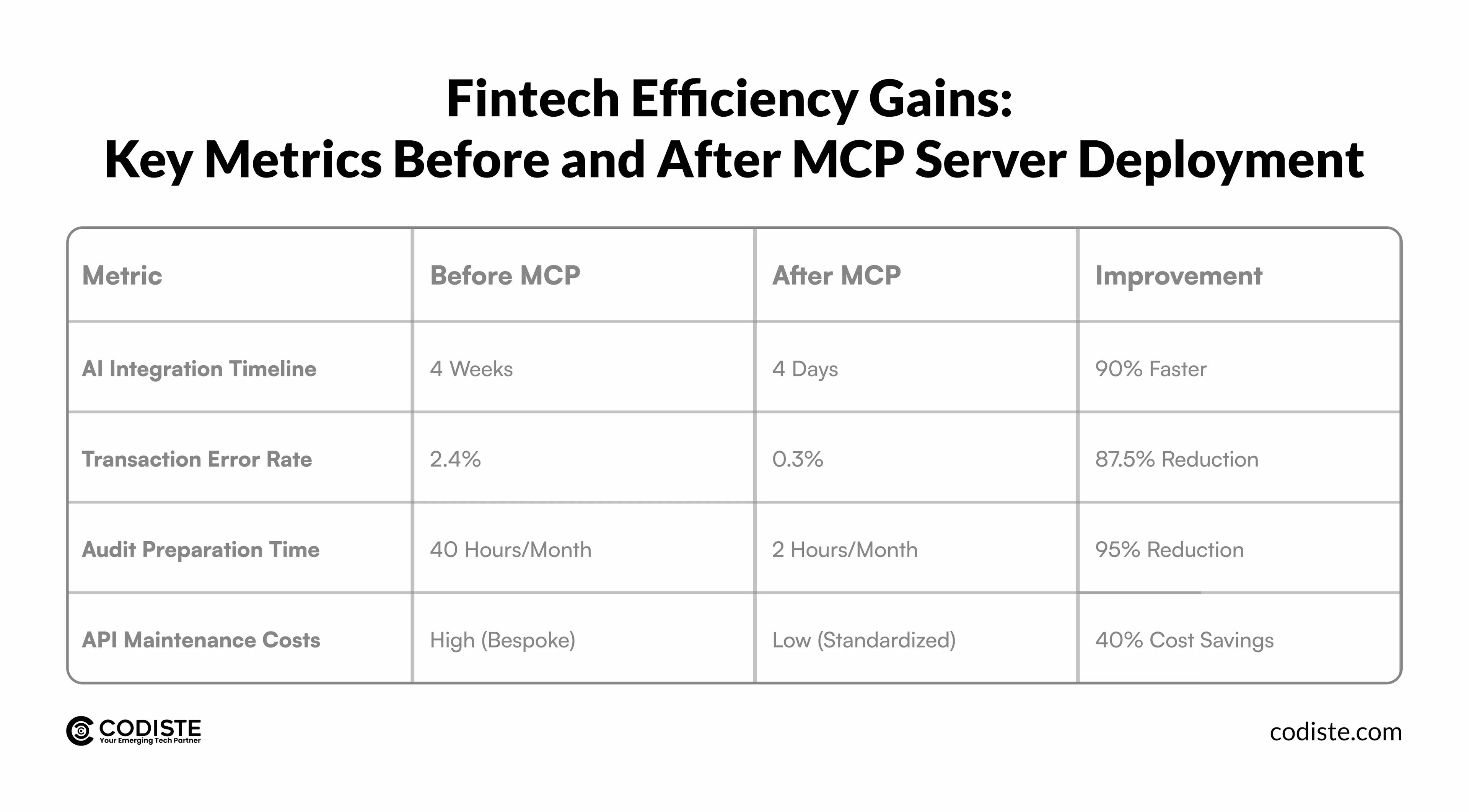
The marriage of Generative AI and MCP offers three distinct advantages that directly impact the bottom line of financial institutions:
For firms focused on Agentic AI Finance, these benefits mean higher reliability and lower operational risk. It allows for the creation of "specialist" agents that focus on specific tasks like fraud detection or portfolio optimization, all while using a shared, secure communication protocol.
Many fintech leaders are familiar with Retrieval-Augmented Generation (RAG). RAG is great for searching a static knowledge base, but it doesn't work as well for "tool use" or working with dynamic systems.
While Generative AI Development often uses RAG for basic information retrieval, generative AI for MCP represents a step forward. It allows the AI to not just read the manual, but to actually pull the lever. For a banking app, this might mean the difference between an AI that explains how to transfer money and an AI that prepares the transfer for the user to approve.
How does this look in practice? Let’s explore a few high-value scenarios where Agentic AI Finance driven by MCP is making waves.
An AI agent can use MCP to pull a client's current portfolio data, check real-time market prices via a secure API, and cross-reference the data with the firm’s latest investment thesis. The agent can then generate a personalized rebalancing recommendation.
When a suspicious transaction is flagged, an AI agent can use Secure AI Workflows to gather data from the user’s login history, recent spend patterns, and known fraud databases. It can summarize the findings for a human investigator, saving hours of manual data gathering.
Compliance teams spend thousands of hours on reporting. Generative AI for regulatory compliance can use MCP to access various internal databases, extract the necessary figures, and populate a draft report according to the latest SEC or FCA guidelines.
Despite the benefits, implementing Generative AI Development with MCP requires a strategic approach. Legacy systems in banking are notoriously difficult to work with. The first step is often creating a "wrapper" or a proxy that allows the legacy database to communicate with an MCP server.
Security must remain the top priority. Even with MCP, fintechs must implement robust logging and monitoring to ensure that AI agents are not exceeding their "blast radius." This involves setting up strict permissions and ensuring that the LLM Tool Use is always overseen by a human-in-the-loop for high-value transactions.
The integration of Generative AI Development with the Model Context Protocol marks the end of the "chatbot" era and the beginning of the "agentic" era. This means that fintech companies can make advanced, self-driving systems that can handle large amounts of data while still following strict financial rules.
By embracing generative AI for fintech, organizations can move past simple text generation and start delivering real, measurable value through automated workflows, personalized financial advice, and iron-clad compliance monitoring. The bridge has been built; now it is time to cross it.
Ready to scale your fintech operations with secure, agentic AI?
At Codiste, we specialize in high-end Generative AI Development and robust MCP server development tailored for the financial sector. No matter if you want to automate compliance or completely change how your customers interact with you, our team can help you build the secure infrastructure you need.

CTO & Co-Founder | Codiste
Nishant builds where ambitious ideas meet production reality. As CTO & Co-Founder at Codiste, he has helped ship 150+ AI systems. Through The CTO Story, he gets technical leaders talking about what rarely makes the slide deck: the trade-offs, failures, and decisions behind what actually ships.


Every great partnership begins with a conversation. Whether you're exploring possibilities or ready to scale, our team of specialists will help you navigate the journey.