





Artificial Intelligence
November 03, 2023

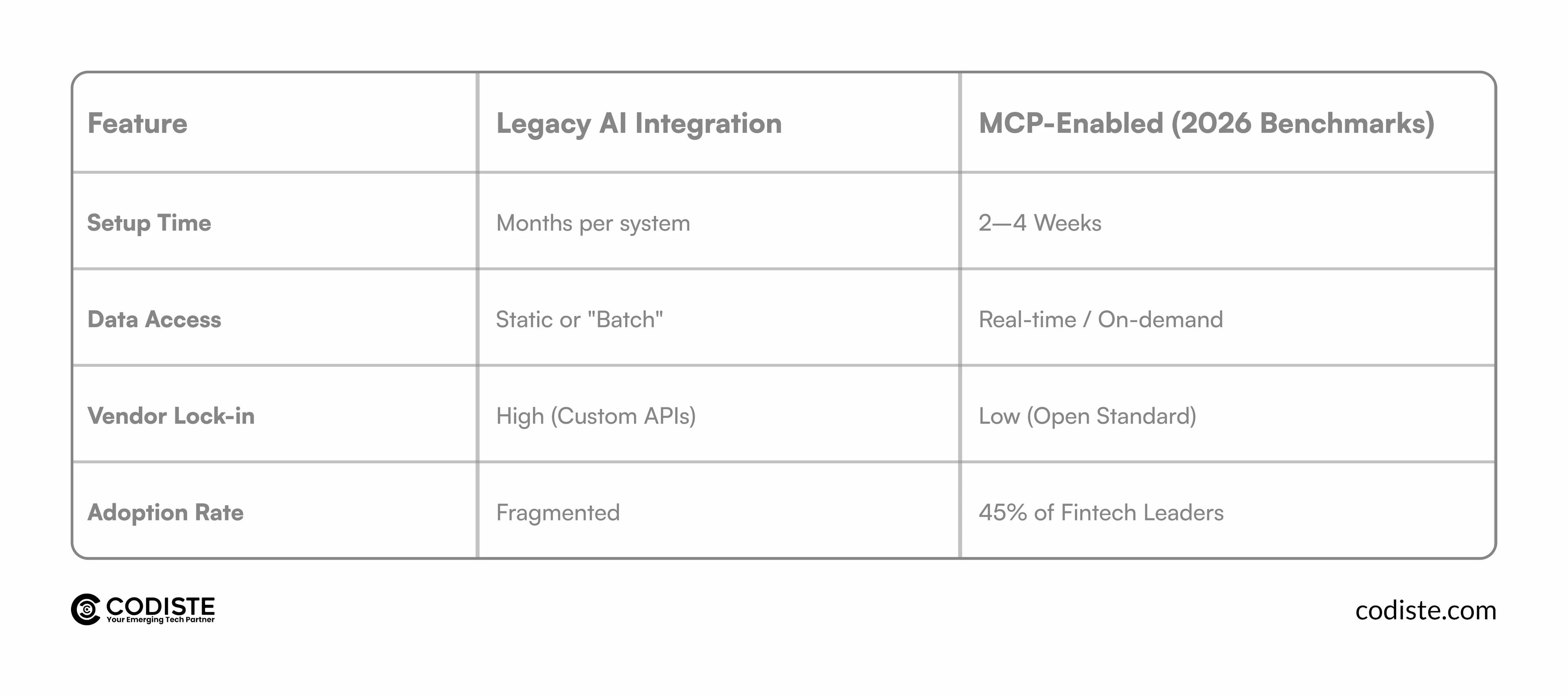
The fintech landscape in 2026 is no longer defined by who has the most data, but by who can make that data "speak" to their intelligence layer in real-time. For the modern C-suite, the challenge has shifted from basic digitizing to sophisticated AI workflow automation finance strategies. Yet, a persistent barrier remains: the "M×N" integration problem. Every time you want to connect a new Large Language Model (LLM) to a proprietary financial database or a legacy ERP, you face a month-long development cycle.
This is where the Model Context Protocol (MCP) changes the ROI equation. By standardizing how AI agents access data, MCP transforms brittle, custom-coded connections into a universal "USB port" for enterprise intelligence. When combined with advanced machine learning financial services, Model Context Protocol (MCP) doesn't just improve efficiency, it unlocks Fintech Strategic Value that was previously trapped in silos.
In previous years, AI in Fintech often meant isolated chatbots or narrow fraud detection models. Today, the focus is on "Agentic AI" systems capable of reasoning, planning, and executing complex workflows. However, an agent is only as good as its context. If a banking agent cannot see a customer’s real-time transaction history across fragmented systems, its advice is at best generic and at worst risky.
The integration of AI/ML + MCP for C-level leaders provides a framework for "Context-Awareness." MCP server development allows your firm to expose specific "tools" (like credit scoring or KYC verification) to any AI model securely. This means your Chief Technology Officer (CTO) stops building bridges and starts building value.
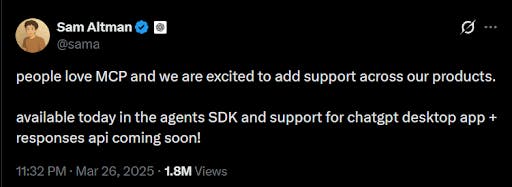
The strategic importance of MCP was cemented in early 2025 when OpenAI officially joined the ecosystem. Highlighting the shift from static tools to dynamic agents, Sam Altman shared on X that people love MCP and that OpenAI is excited to add support across their products.
This was not just a technical update. It was a signal to the C-suite that the "M×N" integration problem, where every new model requires a new custom bridge to your data, is over. By adopting MCP, your fintech firm is not just "using ChatGPT." You are building on a unified global standard that industry leaders have positioned as the backbone of the 2026 AI workforce.
To realize true Fintech Strategic Value, AI must move beyond the back office and into the revenue-generating heart of the business.
Standard chatbots often fail because they lack "memory" or access to real-time ledger data. By utilizing an AI development service to build MCP-powered agents, banks can offer personalized financial wellness advisors. These agents can look at a user’s 12-month spending pattern, correlate it with current market inflation, and suggest a high-yield savings adjustment, all in a single conversation.
Compliance is often the largest "tax" on fintech innovation. AI workflow automation finance systems can now use MCP to pull data directly from transaction logs and cross-reference them with evolving SEC or GDPR mandates. This turns "audit-ready" from a goal into a continuous state.
Machine learning financial services can analyze market sentiment, but they rarely have the "user context" to make it relevant. MCP bridges this. An AI agent can pull a client’s risk tolerance from a CRM and their current portfolio from a brokerage engine to suggest real-time rebalancing during market volatility.
For a CEO or Chief Risk Officer (CRO), the biggest fear is not that AI will fail, but that it will succeed too well at the wrong thing. Enterprise AI governance is natively supported by the MCP architecture.
AI pioneer Andrej Karpathy has noted that as models get smarter, the bottleneck is no longer the model itself, but the "context engineering" around it. In his view, the competitive advantage for firms in 2026 is the ability to fill the model's "context window" with the right data at the right time.
Because the Model Context Protocol (MCP) defines exactly what "tools" an AI can use, you can set hard boundaries. For example, an AI agent might have the tool to read a customer’s balance, but not the tool to initiate a wire transfer without human-in-the-loop (HITL) approval. This "sandboxing" of capabilities is essential for Generative AI compliance in highly regulated sectors.
One of the core AI ML strategic roadmap for C-Suite priorities is explainability. MCP provides a clear audit trail. You can see exactly which data point (resource) the AI requested and which tool it executed to arrive at a specific recommendation. This transparency is vital for maintaining trust with both regulators and customers.
Transitioning to an MCP-native architecture requires a shift in how you view your tech stack. It is no longer about "buying an AI tool." It is about "building an AI-ready environment."
Identify where your most valuable data lives. Is it in an on-premise SQL database? A SaaS CRM? Connecting LLMs to enterprise financial data starts with identifying these "Context Sources."
Partner with an experienced AI development service to build lightweight servers that act as the interface between your data and the models. This is the stage where MCP server development pays off, as these servers are reusable across all future AI projects.
Start with a high-impact, low-risk pilot such as internal research automation or automated customer support for non-transactional queries. Use the resulting data to refine your AI/ML + MCP for C-level reporting metrics, focusing on time saved and accuracy gained.
The era of isolated AI experiments is over. As Sam Altman and the leadership at OpenAI have signaled by adopting the Model Context Protocol (MCP), the future belongs to "Agentic" systems that are deeply integrated into enterprise data. By prioritizing an AI/ML + MCP for C-level strategy, you ensure your firm is not just a consumer of AI, but an architect of it.
This is the only path to sustainable Fintech Strategic Value, turning your proprietary data into a real-time competitive weapon. Ready to bridge the gap between your financial data and the next generation of AI? Codiste specializes in high-performance MCP server development and machine learning financial services that turn complex data into strategic assets.

CTO & Co-Founder | Codiste
Nishant builds where ambitious ideas meet production reality. As CTO & Co-Founder at Codiste, he has helped ship 150+ AI systems. Through The CTO Story, he gets technical leaders talking about what rarely makes the slide deck: the trade-offs, failures, and decisions behind what actually ships.


Every great partnership begins with a conversation. Whether you're exploring possibilities or ready to scale, our team of specialists will help you navigate the journey.