





Blockchain
July 07, 2025

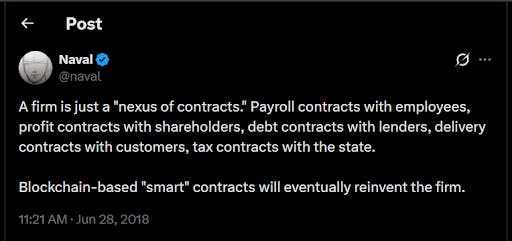
In a 2018 tweet, entrepreneur Naval Ravikant stated, "A firm is just a 'nexus of contracts.' Payroll contracts with employees, profit contracts with shareholders, debt contracts with lenders, delivery contracts with customers, tax contracts with the state." He concluded that Blockchain-based "smart" contracts will eventually reinvent the firm.
That reinvention is happening now, but not just through smart contracts. The true transformation lies in combining the immutable trust of the Blockchain with the adaptive intelligence of AI. However, this union faces a critical bottleneck: AI agents, no matter how powerful, are often data-blind to the real-time, complex, and siloed data living on a Blockchain ledger or in external financial APIs. This gap cripples the potential for AI in Fintech Platforms to execute sophisticated, automated actions like real-time fraud detection, dynamic risk assessment, or autonomous DeFi trading.
The solution is the Model Context Protocol (MCP). The MCP server in Blockchain acts as the crucial, secure, and standardized middleware. It is the missing link that translates a natural language AI request, say, "What is the collateral ratio of DeFi position X?" into a structured EVM RPC call, securely retrieves the on-chain data, and formats it for the AI-Powered Blockchain Banking agent to act upon instantly. This article dives deep into the architecture, use cases, and transformative ROI of MCP in Blockchain integration.
The Model Context Protocol (MCP) is a standardized way for AI models, especially Large Language Models (LLMs), to safely and systematically access external tools and data sources. Think of it as a universal USB-C for AI: a single, clear interface that lets an AI agent work with anything from a relational database to an EVM MCP server endpoint without having to be retrained or tailored for each API or data format.
The Model Context Protocol establishes a three-part architecture that simplifies blockchain mcp integration github efforts and ensures security:
This structure is what makes MCP in Blockchain so powerful for AI in fintech:
The deployment of an MCP drastically accelerates the shift to autonomous, intelligent financial operations. By giving AI agents actionable context, businesses can achieve automation and risk management previously thought impossible.
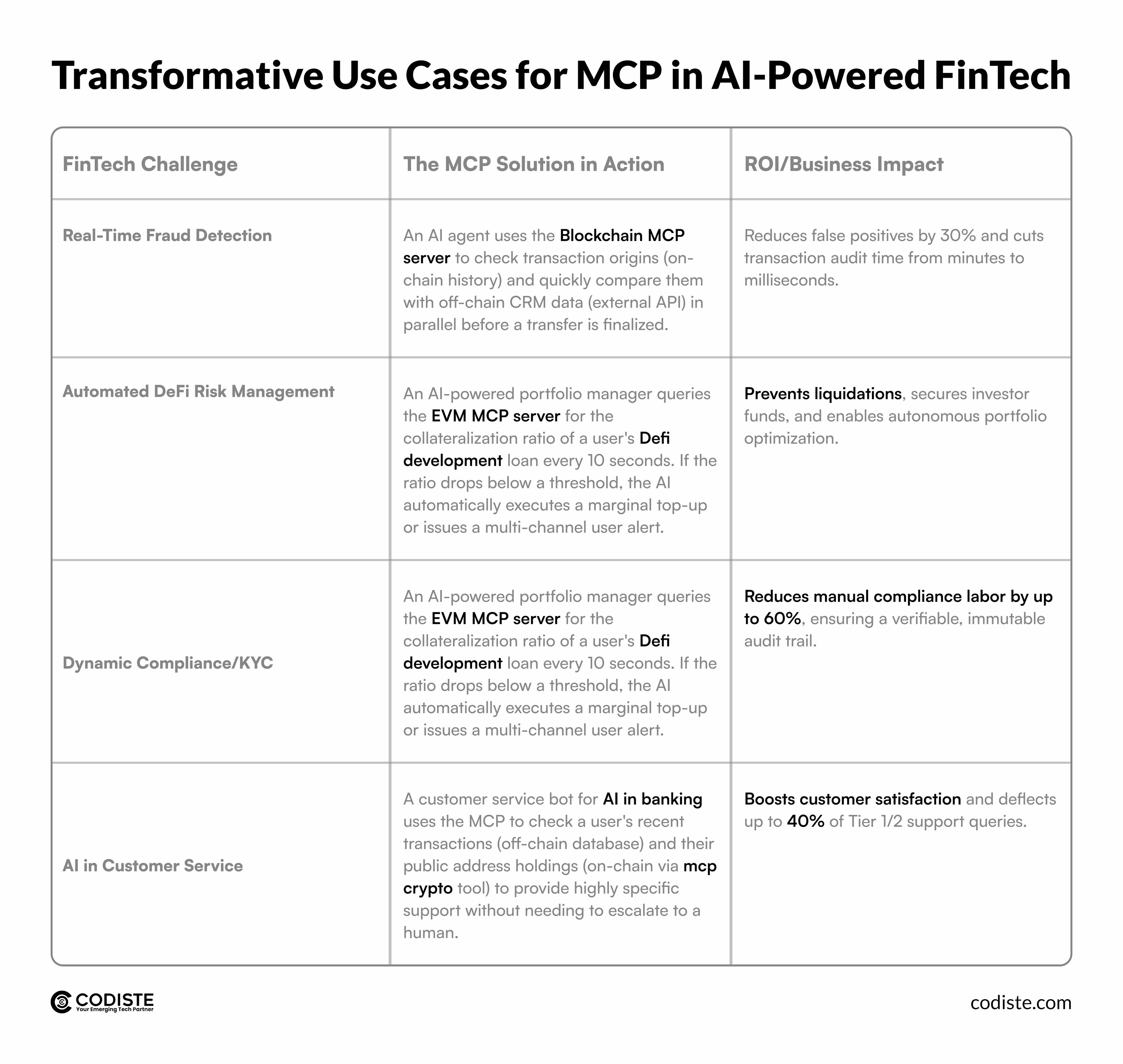
This seamless integration, facilitated by the MCP, moves the financial firm closer to Naval's vision: an institution where contracts, smart and traditional, are autonomously managed by intelligent systems, dramatically cutting overhead and human error.
CTOs and developers, the key to unlocking this potential is understanding the technical layer of Blockchain MCP integration. An MCP server designed for the EVM (Ethereum Virtual Machine) environment, such as a dedicated EVM MCP server, provides a suite of pre-built tools that abstract away the complexity of raw RPC calls.
An EVM MCP server exposes APIs that an AI can call using simple, structured prompts. These are the tools that give the AI its "hands" on the blockchain:
The MCP server handles the translation layer:
This abstraction significantly lowers the bar for developers looking to create AI-Powered Blockchain Banking applications, as the AI development team can focus on the intelligence layer. At the same time, the MCP handles the complex, low-level interaction with the blockchain.
Ready to transform your financial platform with autonomous, intelligent systems?
Request a consultation with Codiste's AI and Blockchain architects to explore a custom MCP deployment for your organization.
The synergy of AI and Blockchain Infrastructure with MCP is no longer a future trend; it is the current standard for competitive AI in banking and FinTech.By using this architecture, you can be guaranteed that your platform is flexible, safe, and able to make data-driven decisions.
To fully leverage this potent trifecta, you want a partner with extensive knowledge in enterprise-grade system integration, blockchain, and artificial intelligence.
Codiste specializes in designing and implementing customized MCP solutions tailored to your unique financial requirements, whether that means connecting your current ERP systems to a private ledger or creating a robust EVM MCP server for DeFi.
By partnering with Codiste, you gain a strategic advantage:
Don't let the complexity of data integration limit your AI strategy. Choose a partner that can build the bridge.
The future of finance, as glimpsed in Naval’s vision of a “reinvented firm,” relies entirely on the ability to automate and intelligently manage the "nexus of contracts." This requires a level of autonomy that traditional systems cannot provide. The Model Context Protocol (MCP) server is the technology that solves the last-mile problem of Blockchain + AI integration. It moves the AI from being a passive data analyst to an active, autonomous operator capable of making real-time, high-stakes decisions based on immutable on-chain data and diverse off-chain context. CTOs seeking to implement AI-Powered Blockchain Banking and future-proof their infrastructure, mastering MCP in Blockchain is the competitive necessity of this decade.

CTO & Co-Founder | Codiste
Nishant builds where ambitious ideas meet production reality. As CTO & Co-Founder at Codiste, he has helped ship 150+ AI systems. Through The CTO Story, he gets technical leaders talking about what rarely makes the slide deck: the trade-offs, failures, and decisions behind what actually ships.


Every great partnership begins with a conversation. Whether you're exploring possibilities or ready to scale, our team of specialists will help you navigate the journey.