
Artificial Intelligence
October 19, 2026
Codiste builds the evaluation layer for AI agents. We catch failures before deploy and monitor quality in production, so you can ship changes with confidence, not hope.
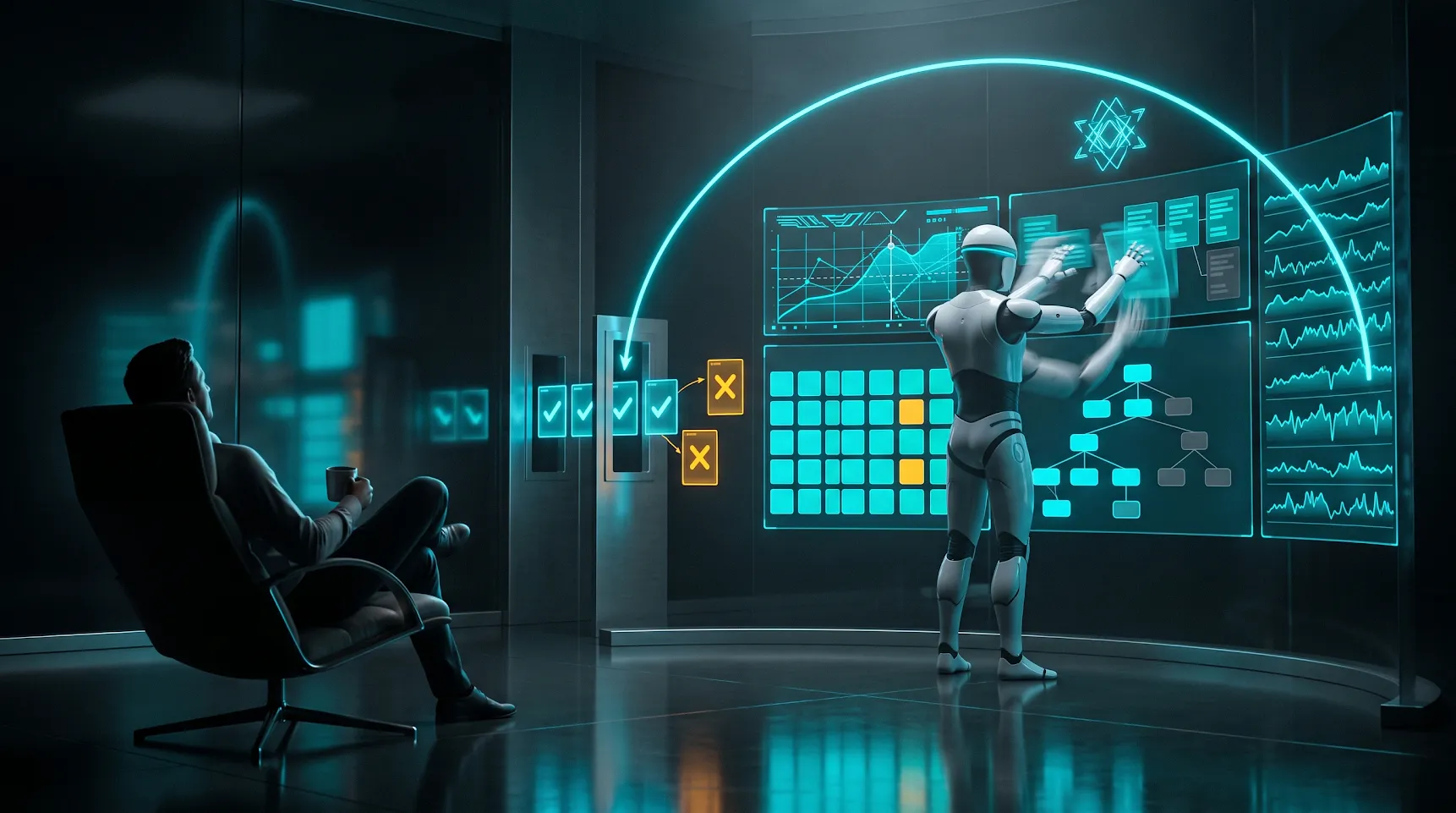










The gap between a demo that impresses and an agent that survives production is measurement. The industry numbers make the case better than we can.
of agentic AI projects will be canceled by 2027, according to Gartner.
of enterprise GenAI pilots show no measurable business impact, per MIT.
success across ten steps is all a 95%-per-step agent achieves. Small errors compound fast.
They drift, misroute, and make things up in ways a dashboard hides until a customer or an auditor finds it first. Standard tests miss exactly the failures that break agents.
A step that is 95% reliable, run ten times in sequence, lands near 60% end to end. Per-step correctness has to be measured, not assumed.
Two connected tracks, not two disconnected tools. The offline gate stops bad changes reaching production. The online track watches what real traffic does once they land.
Runs on every change, against your real agent, before anything reaches a user.
Versioned test suites drive your real agent, with tool edges mocked so runs stay fast and deterministic.
Any change that drops quality below threshold is blocked before merge. Most teams see value here within 2 to 4 weeks.
The break is found against your real agent rather than a stub, so it never reaches a production user.
Runs continuously on live traffic, because real users find what test suites do not.
Once a change ships, we sample live traffic to watch what real users actually trigger.
Scoring runs in tiers so coverage stays high while evaluation spend stays predictable.
Every production failure is written back into the golden datasets on the offline track, so the same problem cannot come back.
The online track writes every production failure back into the golden datasets that gate the next deploy. That single edge is what turns two tools into one system: the gate gets stricter every time production teaches it something new.
An agent can fail at the tool call, at the sequence of steps, or at the final answer. Each needs a different check, so we score all three.
Did it pick the right tool and call it correctly?
Routing, tool choice, argument correctness, and API contract compliance.
Did it take a sensible path to get there?
The right tool sequence, clean error recovery, and correct handoffs between steps.
Did the user actually get what they needed?
Correctness, completeness, hallucination, tone, and brand voice in the final response.
Score only the outcome and you cannot tell a lucky answer from a correct process. Score only the components and you miss whether any of it added up. All three levels together are what makes a score worth acting on.
This is the moat.
Most teams score their agents with an LLM judge and never check whether that judge agrees with a human. So the dashboard turns green while quality drifts, and the number everyone is optimising against measures nothing.
We treat every judge as something that itself has to be tested. We build a human-rated calibration set from your own traffic, measure how closely the judge agrees with it, and tune the rubric until agreement clears the threshold. Deterministic checks handle everything that can be verified outright, so the judge is only asked to rule on what genuinely needs judgement.
human agreement required before a judge is trusted to gate anything.
of checks run deterministically, where a pass or fail is a fact rather than an opinion.
Dialora is Codiste’s own AI voice agent platform, handling live phone calls for telecom, hiring, and business support.
Exactly the kind of high-stakes, multi-step agent that fails quietly, so it is where we pressure-tested this evaluation system before offering it to anyone else.
Bookings, qualification, escalations, and the messy edge cases that only show up on live phone calls.
A "booking confirmed" only counts when the booking actually went through. The agent cannot claim credit for a failed call.
Tone and groundedness scored by judges tuned against human ratings before we trusted a single number they produced.
Take it as a one-time build or an ongoing managed service. Either way, you own the datasets, the harness, and the judges.
We map your agents, rank them by production risk, and define what "correct" means as measurable metrics.
Golden datasets and a runnable harness for your highest-risk agents, wired into CI so regressions never reach production.
Live traffic sampling, tiered scoring to control cost, dashboards, and regression alerts on the channels you already watch.
We measure each judge against human ratings and tune until it clears 80%+ agreement, then keep the loop running.
Timelines flex with the number of agents, how complex their flows are, and how quickly we can get access to your traffic. The phases above assume one high-risk agent to start.
Everything we build is handed over, documented, and runnable by your engineers without us.


All of it is yours. The datasets, the judges, the harness, and the calibration sets stay in your environment and keep working whether or not we stay involved.

Every great partnership begins with a conversation. Tell us which agent or flow causes the most production issues today, and we’ll scope it with you.