





Artificial Intelligence
April 09, 2025

Venture studios face a brutal reality that traditional startups don't. You're not building one company. You're building five, ten, sometimes twenty simultaneously. Each one needs technical execution that doesn't just work but scales fast enough to validate market fit before capital runs out.
The math gets ugly fast. A single failed build can cost $200K–$500K in sunk development costs. Multiply that across a portfolio where 60–70% of concepts never make it past validation, and you're looking at millions in technical risk. This is where tech partners reduce risk for venture studios in ways that internal teams simply can't replicate.
Here's what most studios get wrong. They treat technical partnerships like outsourcing when they should be treating them like insurance policies. The best partnerships don't just deliver code. They absorb the specific risks that kill venture-backed ideas before they can prove themselves.
You know what happens when you rush an MVP to market. Shortcuts in design, features that are hardcoded but should be configurable, and database schemas that break when you reach 10,000 users. For a single startup, that's manageable technical debt. For a venture studio managing multiple builds simultaneously, it compounds into chaos.
Software scalability audit processes catch these problems before they metastasize. A qualified tech partner checks the architecture at every stage, from the first wireframes to the iterations that happen after the launch. They're looking for the specific patterns that cause scaling failures:
The real value shows up six months post-launch. While your competitors are rewriting entire codebases to handle growth, your portfolio companies are adding features. The venture studio framework that actually works treats technical scalability as a first-class citizen from day one, not a problem to solve after product-market fit.
A fintech studio we analyzed was building payment infrastructure for gig economy platforms. The first version was created in eight weeks by their internal team. Quickly. However, the system broke down when the pilot customer wanted to onboard 5,000 workers rather than 500.
The damage:
A proper tech partnership would have caught this in week two with load testing and architectural planning. They've seen this exact failure pattern fifty times before, not because they're smarter.
Let's talk about the talent problem nobody wants to address publicly. You need a senior backend engineer for Company A's API build. Company B needs that same person for a critical integration. Company C just hit a scaling crisis that requires immediate attention. Who gets priority?
CTO as a service for venture builders solves this through resource pooling that no single studio can replicate internally. Instead of fighting over one senior engineer, you get access to a bench of 15–20 specialists who can flex across projects based on actual need, not political considerations.
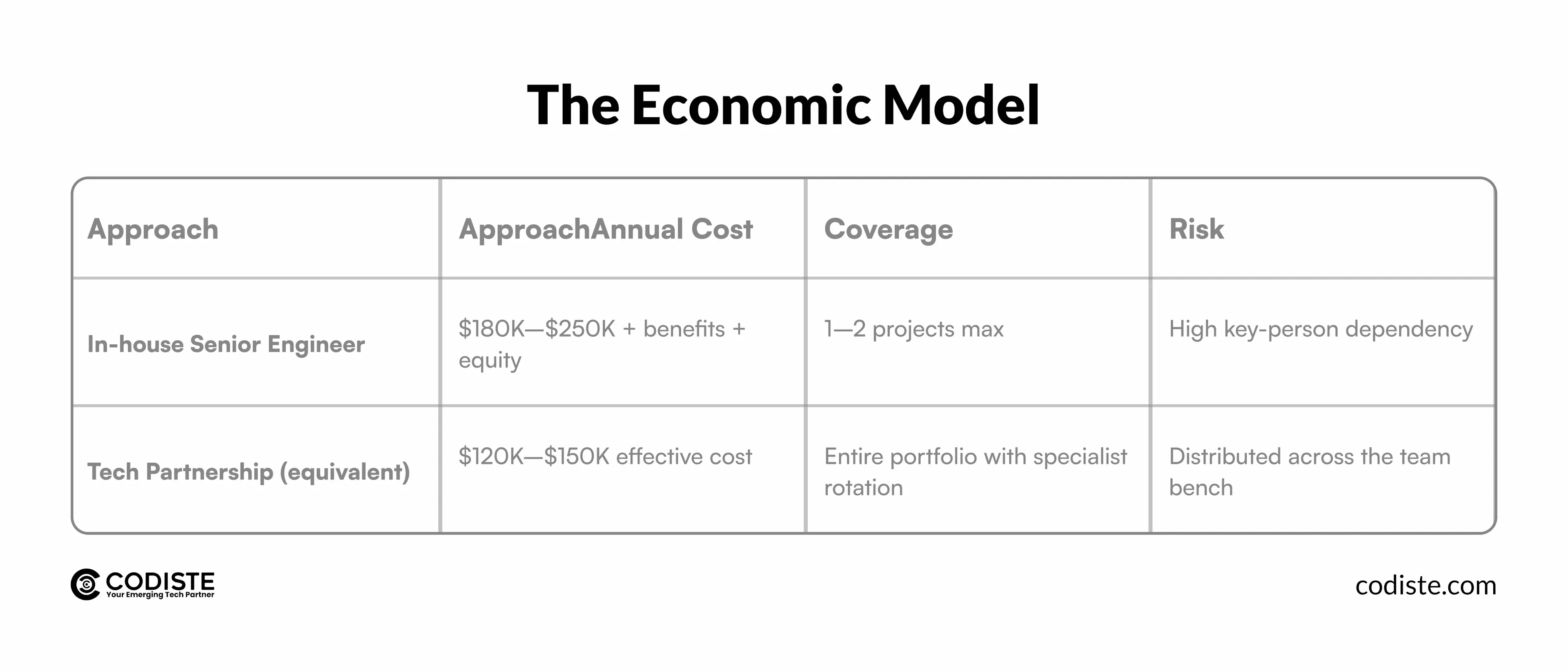
But the real risk mitigation for venture studios comes from avoiding key person dependency. If your only DevOps engineer quits in the middle of a build, it will take you 4 to 6 weeks to find and hire a new one. During that gap:
With a partner, you swap in a new engineer within 48–72 hours because they're already familiar with your infrastructure patterns and development processes.
You've validated demand. You've got early customer commitments. You've built the team. Then development takes four months instead of six weeks, and by the time you launch, two competitors have taken the market share you were going for.
Agile development isn't just a methodology buzzword here. It's the difference between capturing market windows and watching them close. Tech partners who actually understand venture studio dynamics build in two-week sprint cycles with shippable increments, not waterfall timelines that assume perfect requirement stability.
The go-to-market strategies that actually work in venture building require technical flexibility that most development teams don't prioritize:
Here's what this looks like in practice. A healthtech studio was building a patient scheduling platform. Initial customer interviews suggested heavy automation features. Two weeks into development, the tech partner had built enough infrastructure to run a limited beta.
The pivot:
Most startup advice tells you to build scrappy first versions and worry about enterprise requirements later. That advice works fine if you're targeting consumers or small businesses. It's catastrophic if your venture studio evolution focuses on B2B or regulated industries where enterprise buyers won't touch software that doesn't meet baseline security, compliance, and reliability standards.
Enterprise-grade MVP development requires a specific skill set that most startup-focused engineers don't have:
Tech partners who specialize in venture studio work have built these patterns dozens of times. They know how to implement enterprise authentication without adding three weeks to your timeline. They know which compliance shortcuts are actually acceptable in an MVP versus which ones will kill your enterprise sales cycle.
A martech studio learned this the hard way. They built a beautiful analytics platform in eight weeks, demoed it to three Fortune 500 prospects, and got the same feedback from all three: "We can't even evaluate this until you have SOC 2 Type II certification."
The retrofit cost:
A tech partner familiar with enterprise requirements would have built the compliance infrastructure from week one for a fraction of that cost.
The venture studios that scale successfully don't treat each portfolio company as a unique snowflake. They identify repeatable patterns across builds and optimize for velocity on common requirements while preserving flexibility for genuine innovation.
De-risking startup development means maintaining a library of proven technical patterns:
When you start a new build, 40–60% of the technical requirements are variants of problems you've already solved. The question is whether you're solving them from scratch each time or leveraging what's already been validated.
This is where tech partnerships deliver asymmetric value. They're working across multiple studios, seeing patterns you won't encounter until you've built 50+ companies:
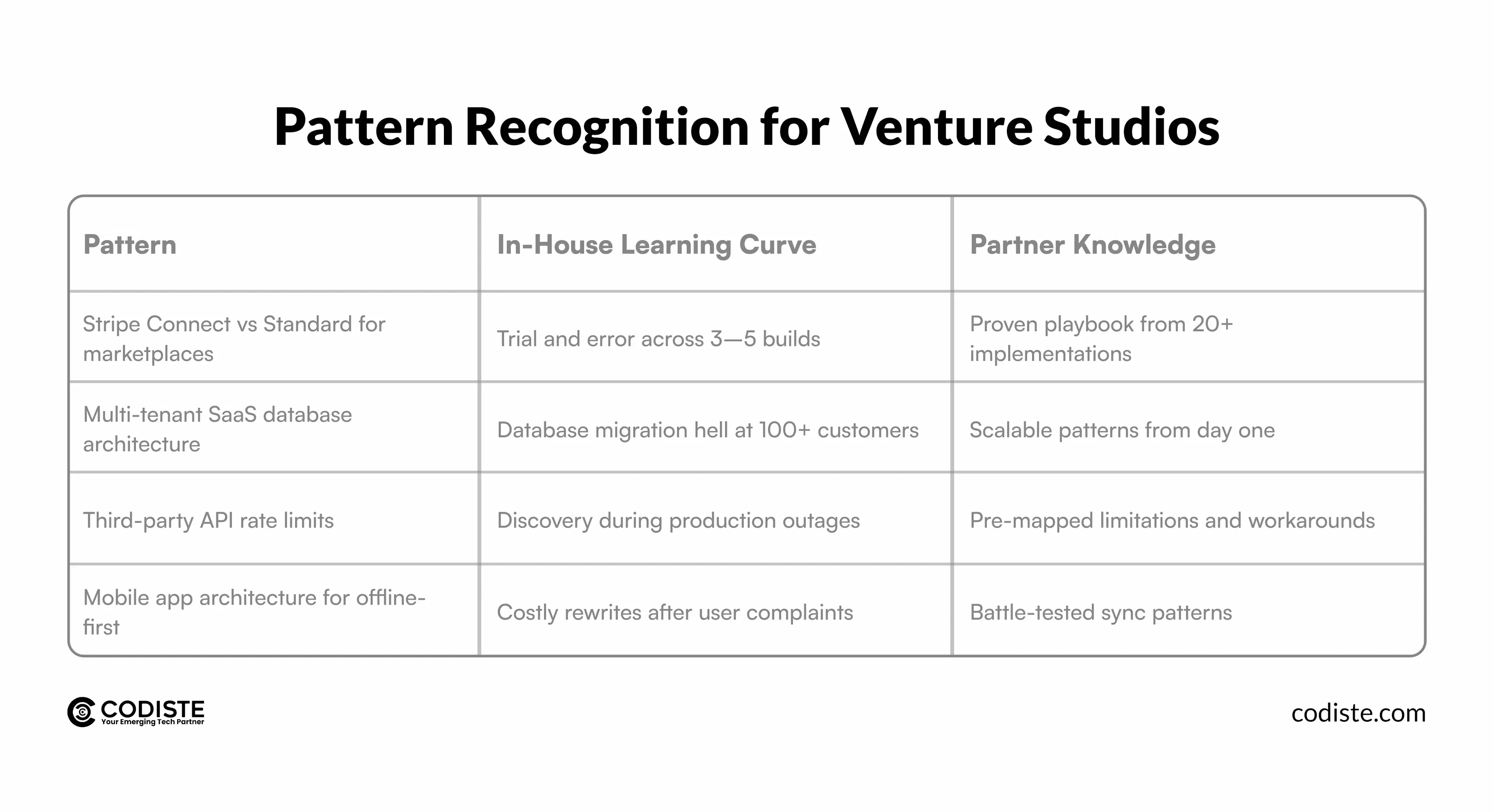
The compound effect is a faster time-to-market across your entire portfolio. Your first build with a tech partner might only be 20% faster than internal development. Your fifth build might be 60% faster because you're leveraging shared components, proven architecture patterns, and pre-built integrations that have already been tested in production.
Strip away the technical jargon, and this comes down to basic venture economics. Your studio's success depends on portfolio velocity and capital efficiency. Every week you shave off time-to-market improves both metrics. Every technical failure you prevent preserves capital for the winners in your portfolio.
How tech partners reduce risk for venture studios isn't about writing better code. It's about shifting failure modes:
It's about converting fixed costs (full-time technical teams) into variable costs that scale with portfolio activity. It's about having access to specialized knowledge (such as enterprise architecture, compliance, and scaling) precisely when you need it, rather than carrying that burden all the time.
The studios that figure this out early build advantages that compound over time:
If you're running a venture studio and technical execution is limiting your portfolio velocity, the conversation you should be having isn't about hiring more engineers. It's about finding tech partners who understand venture studio economics as well as they understand software architecture. Partners who can absorb risk, flex resources, and ship enterprise-grade products at startup speed.
Ready to accelerate your portfolio's technical execution? Codiste specializes in venture studio frameworks that reduce risk mitigation for venture studios and compress timelines. Book a technical partnership assessment to see how we've helped studios like yours ship faster, scale smarter, and turn technical execution from a bottleneck into a competitive advantage. Tech partners reduce risk for venture studios by transforming how you build, not just what you build

CTO & Co-Founder | Codiste
Nishant builds where ambitious ideas meet production reality. As CTO & Co-Founder at Codiste, he has helped ship 150+ AI systems. Through The CTO Story, he gets technical leaders talking about what rarely makes the slide deck: the trade-offs, failures, and decisions behind what actually ships.


Every great partnership begins with a conversation. Whether you're exploring possibilities or ready to scale, our team of specialists will help you navigate the journey.