





Artificial Intelligence
April 09, 2025

Most founders make the mistake of thinking that speed and quality can't go together while constructing an MVP. You can either send something out quickly and broken, or you can spend six months perfecting features that no one asked for. Venture studios have developed a completely different model. They consistently launch minimum viable products in 30 days that actually gain traction, and it's not because they cut corners.
The difference comes down to process architecture. While traditional development teams treat the 30-day MVP timeline like a death march, venture studio projects are designed from day one to compress validation cycles without sacrificing strategic rigor. For founders who can't seem to get their plans off the ground or corporate innovation teams that see their funds disappear, learning about this methodology isn't just interesting; it's the difference between testing a concept this quarter or next year.
Venture studios don't operate like software development agencies. Agencies build what you spec. Studios build what the market needs, and they figure that out within the first week. This distinction reshapes everything about the MVP development process.
A traditional agency takes your requirements document and translates it into code. A venture builder starts by deconstructing your assumptions. They're asking things like, "What's the most dangerous part of this business model?" What feature would stop people from using it if we got it wrong? What can we test with a landing page versus what needs actual software? This front-loaded validation work is why startup studio development timelines stay compressed. By the time engineering starts, half the uncertainty is already resolved.
The other structural advantage is team composition. Studios keep teams that have already been created. Designers who have shipped 20 MVPs, developers who are experts in low-code MVP development stacks, and strategists who know which metrics really show if a product fits the market. When you kick off a venture studio project, you're not interviewing freelancers or onboarding junior devs. You're activating a system that's been optimized through repetition.
Many founders ask: Why not just hire a dev shop? The answer lies in the incentive structure.
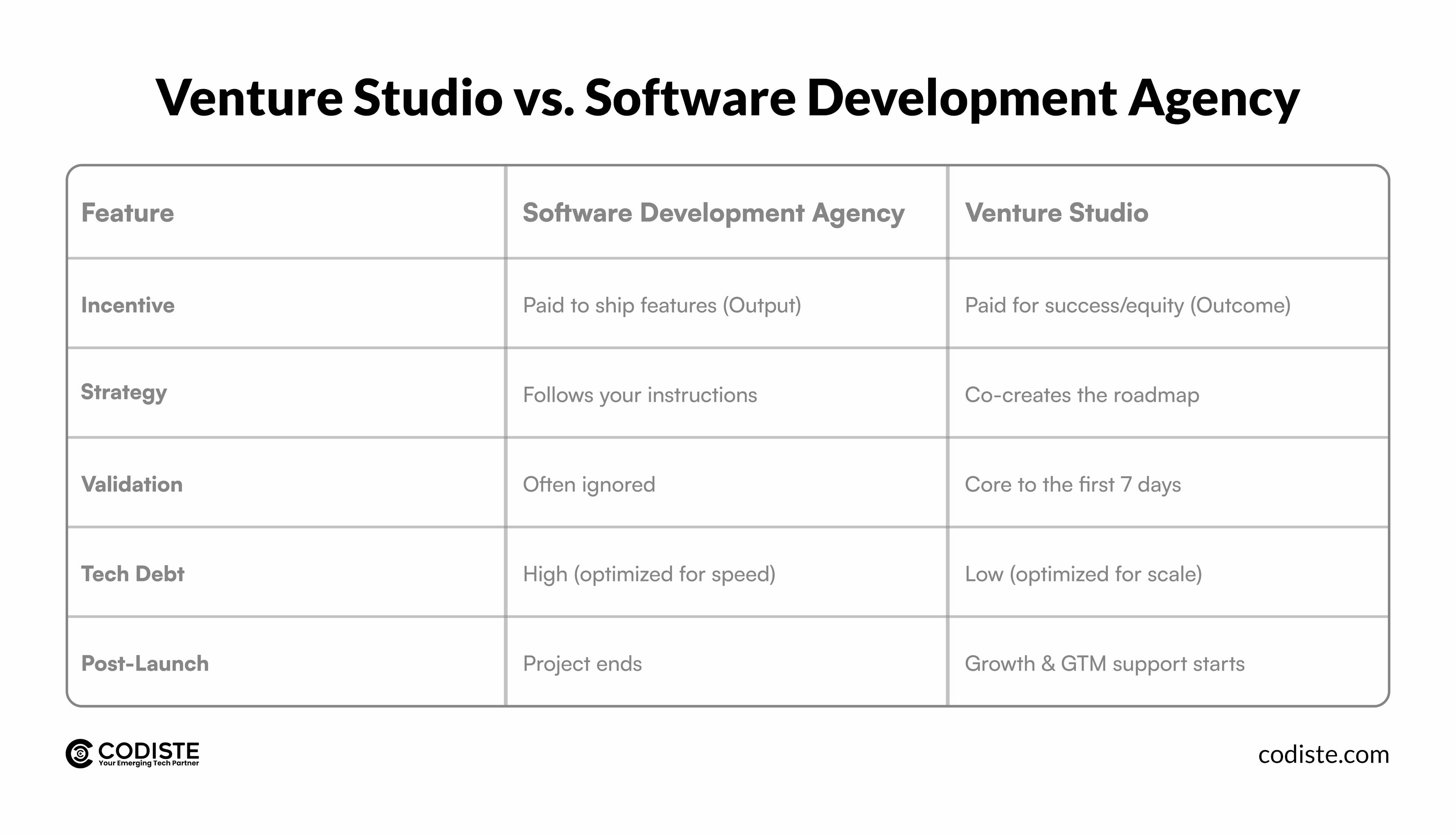
Let's have a look at how this really works. The 30-day MVP development roadmap for entrepreneurs isn't about how fast they can work; it's about making decisions in the right order to cut down on waste.
The first five days determine whether you're building the right thing. Studios run what they call "assumption mapping" sessions. You list every assumption your idea depends on: user behavior, willingness to pay, technical feasibility, and competitive response. Then you rank them by risk and testability.
The goal here isn't to validate everything. It's to identify the 2-3 assumptions that, if wrong, would sink the entire venture. Maybe it's whether enterprise buyers will adopt a tool without IT approval. Maybe it's whether your AI model can process data accurately enough. Whatever it is, week one prioritizes building tests around those specific risks.
Studios also lock in scope during this phase using a framework borrowed from agile development: the must-have/should-have/could-have method. Must-haves are features without which the product literally doesn't function. Should-haves improve the experience but aren't blocking. Could-haves are nice-to-haves that get deferred. The discipline here is brutal; most founders think 80% of their features are must-haves. Studios cut that to 20%.
You have a validated problem hypothesis, a prioritized feature set, and a technological approach that meets the timeframe by the conclusion of week one. This is also when studios make the call on low-code MVP development versus a custom build. If the main value proposition doesn't need proprietary tech, solutions like Webflow, Bubble, or Retool can save development time by 60%.
This is where agile development sprints prove their value. During weeks two and three, studios usually do three 3- to 5-day sprints, each of which ends with a working build that is tested with real users or internal stakeholders.
The major goal of sprint one is to have the core functionality working, which is the one workflow that delivers the main value proposition. This is the ability to make an appointment and confirm it if you're using a scheduling tool. Nothing else. Sprint two adds essential context, user authentication, basic data persistence, and error handling. Sprint three handles integration points and polish that directly impact user trust, like payment processing or data security indicators.
The key difference from traditional agile development is the feedback loop frequency. Studios don't wait for sprint reviews. They're testing daily builds with real users, watching records of sessions, and keeping track of where people drop off. Because this validation happens in real time, course modifications can happen in hours instead of weeks. That afternoon, they redesigned a feature if it confuses users.
During this stage, studios also use AI development tools a lot. AI-assisted coding tools like GitHub Copilot and Cursor make it faster to do boilerplate work. Uizard and Figma are design tools that use AI. AI plugins make several versions of an interface so you may easily try them out. For venture studio projects involving machine learning components, pre-trained models and APIs replace months of training work. The big question isn't "should we use AI?" But "which parts of this MVP need AI and which need human skill?"
It's not about adding features in the last week. It's about getting rid of friction. Studios assess usability with 5 to 10 target users, looking for times when individuals pause, don't understand, or give up on activities. Every friction point gets a repair every 24 hours.
This week also handles the operational scaffolding that determines whether your MVP can actually scale. Analytics implementation, error logging, customer support workflows, and basic documentation. These aren't fancy, but they make the difference between learning from your launch and not knowing what to do.
Studios typically launch to a controlled audience of 100-500 early adopters identified during week one. This isn't a stealth launch. It's a choice to make learning as dense as possible. With small audiences, you can handle the amount of input you get and talk to each user in real time.
Low-code MVP development for venture studios isn't about avoiding real engineering. It's about matching technical complexity to validation needs.
You require custom code if your value proposition is a new algorithm, proprietary data processing, or complicated system interaction. But if you're testing a new business model, service delivery approach, or user experience pattern, low-code platforms let you validate 80% of the concept at 20% of the cost.
Studios use low code strategically.They could use Webflow to make the interface that customers see, Retool to make the admin panel, and Zapier or Make to make the backend logic. With this modular approach, you may subsequently rebuild different parts of the code in a way that works best for what generates traction.
The other advantage is iteration speed. Changing a workflow in a low code platform takes hours. Refactoring custom code takes days. During the critical early validation period when you're learning what users actually want, that speed difference compounds.
That said, studios are ruthless about knowing when to stop. If an MVP built on low code starts gaining serious traction, the technical debt becomes a liability. The right move is often to freeze the low code version and rebuild core components in scalable tech while using the working product to fund development.
Corporate venture building introduces constraints that startup studios don't face. Legal review cycles, following the rules of the brand, and IT security needs. These aren't up for discussion, but if you don't deal with them right now, they can ruin a 30-day timeline.
Smart studios working with corporates frontload compliance conversations. Week one includes IT, legal, and brand stakeholders. The question isn't "can we do this" but "what's the minimum viable compliance that lets us launch and learn." Sometimes that means launching under a subsidiary brand. Sometimes it means accepting more restrictive security requirements but negotiating faster review cycles.
Corporate initiatives also have resources that startups don't, such established client contacts, distribution channels, and credibility. Studios leverage these asymmetrical advantages to develop MVPs that can interact with ecosystems that are already there. A scheduling tool backed by a firm might work with the company's CRM from the outset, making it more secure than a separate startup could ever be.
The cultural challenge is harder to solve. A lot of the time, corporate teams have a hard time with the "permission to fail" approach that MVP development needs. Studios help by changing the 30-day endeavor from a product launch to a controlled experiment. The goal is validated learning, not revenue. This psychological shift unlocks the speed advantages that make the model work.
AI development has become table stakes for modern venture studio projects, but not in the way most people think. Studios aren't building custom LLMs. They're using AI as infrastructure to compress timelines and improve decision-making.
AI consultation during the planning phase helps studios identify which problems actually need AI versus which ones people just assume need it. A well-designed rule-based system often doesn't work better than ML for specific use cases. But studios know how to quickly deploy AI when it really helps.
You can add smart features to an MVP in only a few days using pre-trained models, API-first designs, and composable AI tools. Customer service chatbots, personalized content, and predictive analytics are all things that used to need ML technical teams but now only need to be set up.
The strategic question studios help founders answer is: Does AI solve a user problem, or does it just make the pitch deck more exciting? If it's the former, it goes in the MVP. If it's the latter, it gets deferred until there's an actual demand signal.
The Venture studio model is designed for the "Speed of Thought." By compressing the Minimum Viable Product timeline into 30 days, we prevent the most common startup killer: over-engineering a product that nobody wants.
Whether you are an entrepreneur with a disruptive idea or a leader in Corporate Venture Building, the goal remains the same: launch, learn, and iterate. The Venture studio MVP method gives you the framework, the "Lego blocks," and the Agile development skills you need to get to market before the chance passes you by.
A team that knows how to balance speed with technical integrity is at the heart of every successful launch.
Ready to turn your vision into a reality? Book a consultation with Codiste today to see how our Venture Builder expertise and specialized ai development team can help you build an MVP in 30 days. Let's start your next Venture studio project with a foundation built for scale.

CTO & Co-Founder | Codiste
Nishant builds where ambitious ideas meet production reality. As CTO & Co-Founder at Codiste, he has helped ship 150+ AI systems. Through The CTO Story, he gets technical leaders talking about what rarely makes the slide deck: the trade-offs, failures, and decisions behind what actually ships.


Every great partnership begins with a conversation. Whether you're exploring possibilities or ready to scale, our team of specialists will help you navigate the journey.