





Artificial Intelligence
June 12, 2024

Most CTOs open this decision as a cost comparison. Agency quote on one side, salary plus overhead on the other, spreadsheet in the middle.
That framing produces a defensible-looking answer to the wrong question. You are not choosing between two ways to obtain the same system. You are choosing who is accountable for it in eighteen months, when the model version has moved twice, your product has changed, and the person who understood the prompt architecture has left or moved teams.
Get that right and the cost question mostly answers itself. Get it wrong and the cheaper option becomes the expensive one, quietly, in year two.
So here is the decision tree we actually walk through with prospective clients, including the branches that end in "do not hire an agency."
The first branch, and the one that overrides everything below it.
Core means the agent is part of what customers buy. If you sell an AI-native product and the agent is the product, or the agent is the differentiating feature in a category where competitors are shipping the same thing, this is core. Supporting means the agent makes your operations better without being the thing people pay for: internal support automation, document processing, a sales qualification layer.
If it is core, lean in-house. You cannot outsource your differentiator indefinitely. The learning compounds inside whoever builds it, and if that is an AI agent development agency, the compounding happens somewhere you do not control.
The nuance worth stating: this does not mean never engaging an agency on core work. It means the engagement should be shaped as capability transfer with a defined end, not as ongoing delivery. Bring people in to build the first version alongside your team and leave. If you are two years in and the agency still owns your core agent, something has gone wrong with the plan rather than with the agency.
If it is supported, continue to question two. Most agent work is supporting work, and outsourcing it is entirely reasonable.
Name the person. Not the team, not the function, the person.
If you cannot, that is the answer, and it is not "hire an agency." An agency will build you a system that works on handover day and decays from there, because agent systems need someone re-running evaluations when models change, adjusting prompts as policy changes, and watching cost per run as usage grows. None of that happens without an owner.
If nobody will own it, do not build it yet. Either find the owner or pick a narrower problem someone will care enough to maintain. Hiring an agency to compensate for absent internal ownership is the most expensive mistake in this whole decision, and agencies rarely refuse the work.
If the owner exists, continue.
Not prototyped. Shipped, and operated for at least a quarter.
The gap between a working prototype and a production agent is mostly unglamorous: evaluation harnesses, retrieval quality, guardrails, observability, cost control, and the failure modes nobody anticipates until real users arrive. Teams doing it for the first time consistently underestimate that stretch, and the underestimate is usually two to three times rather than twenty percent.
If no, an agency for the first one is a reasonable purchase, on the condition that knowledge transfer is a contractual deliverable rather than a courtesy. Runbooks, the evaluation suite, and paired working with your engineers. You are buying a working system and the experience of having built one, and the second one should not need us.
If yes, and the other answers point in-house, build it in-house. Your team has the hard-won part already.
This is the branch where the numbers do the work.
Recruiting data for 2026 puts time-to-fill for AI and ML engineers at roughly 60 to 120 days, with senior roles at the top of that range and specialist recruiters reporting faster figures than internal hiring achieves. One 2026 report notes that around 70% of accepted offers draw a counter-offer, which extends the effective cycle further. Then add onboarding before the new hire is productive on your stack.
Realistically, going from "we need this capability" to "the person is contributing" is a four to six month process, and the market is tight enough that it can fail entirely and restart.
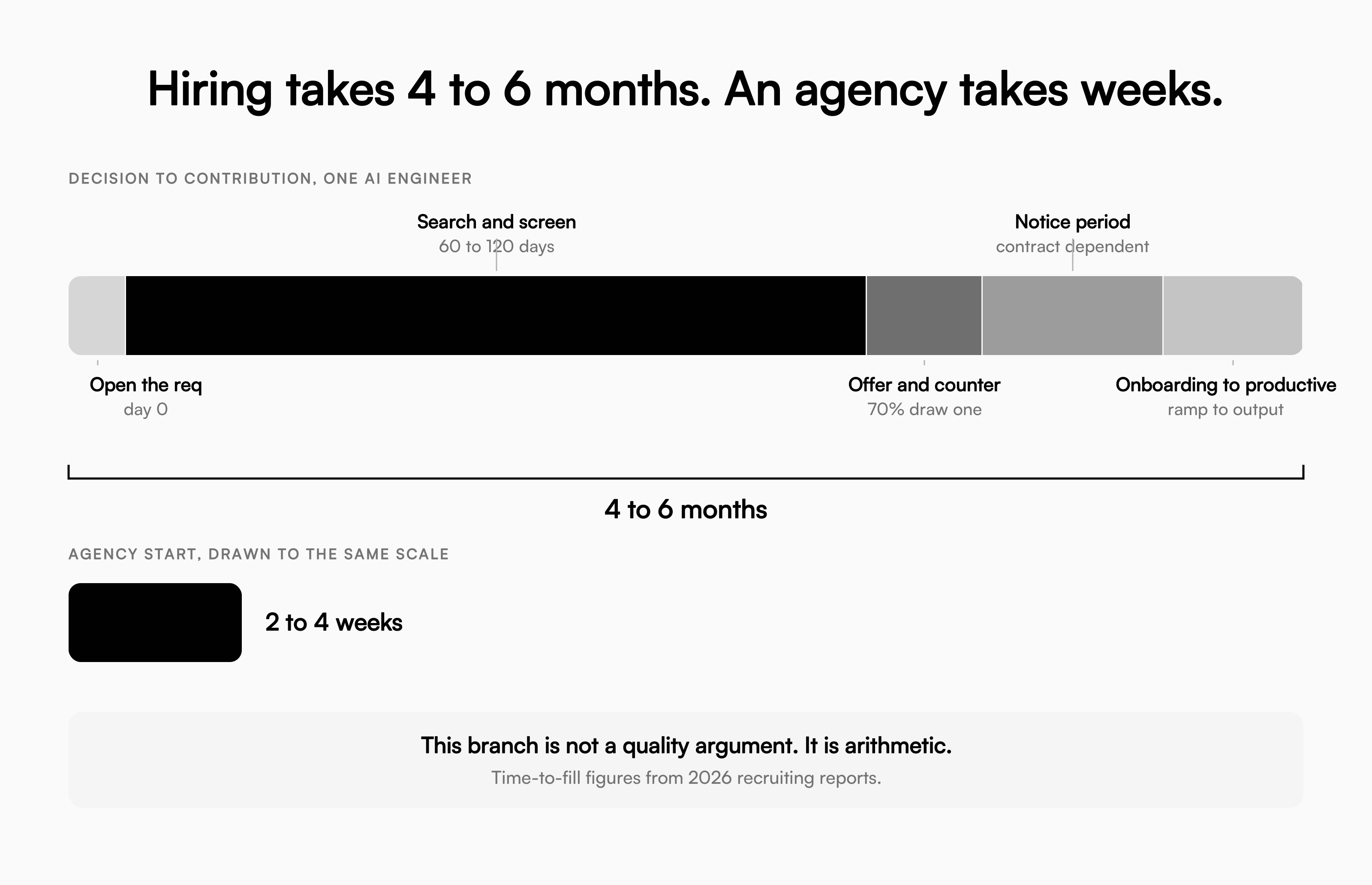
If your deadline is inside that window, an agency is the only option that meets it. That is not a quality argument; it is arithmetic.
If your deadline is beyond it, hiring is viable, and question five decides whether it is wise.
While the numbers are here, the salary is not the cost. Published 2026 figures put the median base for a machine learning engineer at an AI-native startup around $200,000, with senior applied AI roles ranging considerably higher, and LLM and production deployment specialisation commanding a premium of roughly 25% to 40% over generalist ML.
Fully loaded, one analysis puts a mid-level engineer on a $160,000 base at $215,000 to $240,000 a year once payroll taxes, benefits, compute, tooling and management time are counted. Cost-per-hire for mid-to-senior roles is reported at $22,000 to $45,000 on top.
Treat these as directional and note the source bias: much of this data comes from recruiting firms, whose interest lies in emphasising that hiring is difficult. The internal comparison that matters is your own fully loaded rate, not a published median.
The last branch, and the one that determines the shape of the engagement rather than the vendor.
Burst work is a defined artefact with an end: one agent, one integration, a migration, a proof of value. This suits an agency or a specialist freelancer, and paying a premium for speed is rational because the alternative is a permanent hire for temporary work.
Continuous work is a growing surface: several agents, an internal platform, capability other teams will build on. This favours in-house, because the cost of an agency crosses over somewhere in the second year and the knowledge should be accumulating internally by then.
The mixed answer, which is what most companies actually have: agency for the burst that starts it, in-house for the continuity that follows, with the handover designed at the beginning rather than negotiated at the end.
Four pricing models, and the model matters more than the rate.
On absolute numbers, published 2026 ranges put simple single-task agent builds from around $15,000, mid-market builds with real integrations between $40,000 and $150,000, and multi-agent enterprise systems with compliance requirements past $250,000. Integration and safety testing together commonly account for 40% to 60% of a build, which is the line most quotes underweight.
The question worth asking any agency is not the rate. It is what happens in month seven. If the proposal covers the build and goes quiet on ongoing agent support, the model deprecation that arrives six months later is your problem, and you will be paying the same firm emergency rates to solve it.
The freelancer versus agency question comes up constantly, and the useful distinction is not skill. Plenty of freelancers are better engineers than plenty of agency teams. The distinction is what happens around the code: evaluation harnesses, observability, security review, documentation and a handover somebody is contractually obliged to complete.
Hire a freelancer for a well-specified piece of work you can review. Hire an agency when you need a system, an owner during the build, and someone accountable for the transfer. The failure mode of the freelancer route is not bad code, it is a working system with no documentation and no route back to the person who wrote it.
Five things, and they are all visible in the proposal before you sign.
Evaluation as a deliverable. Not "we test thoroughly." A named test set, a rubric, pass thresholds and who re-runs it after a model change. Agencies that skip this ship demos.
A written scope boundary. What they own, what you own, and where it fails if neither of you does. Vague scope favours the vendor, and good vendors write it down anyway.
A named owner on your side, requested by them. An agency that asks who will own this after handover is thinking about your year two. One that does not is thinking about invoicing.
Honest wrong-fit criteria. Firms that describe every use case as a fit have not built enough autonomous AI agents to know where they break. This applies to any agentic AI agency, ours included.
A defined end. Even on a retainer, the engagement should have a version where they leave and things keep working.
If you are evaluating agencies that build custom AI agents, ask each one to describe a project they turned down and why. The answer is more informative than any case study.
A note: this question has two audiences.
If you run an AI agent marketing agency, an AI agent automation agency or a software shop looking to offer custom AI agents for automation to your own clients, the build versus buy decision inverts. Your constraint is not one system; it is repeatability across many clients with different stacks. This is the real market for AI agents for agencies, and it is a different product question entirely.
That is what a white-label AI agent platform for agencies exists to solve, and the trade is real: white-label AI agents give you speed and a supportable base, and you give up the ability to handle the client whose requirements sit outside the platform. The agency scaling challenges here are rarely about sales. They are that every client build is bespoke, so margin never improves with volume. This bites hardest for anyone running an AI voice agent agency, where telephony, latency and per-client number provisioning make bespoke delivery especially expensive. Platform first, custom for the exceptions, is the pattern that survives. Building your own delivery framework only makes sense once you have enough repeat shape across clients to know what to standardise, which is usually later than it feels.
Here is the part that argues against hiring us.
If the agent capability is core to your product, do not outsource it long-term. Not to Codiste, not to anyone. The reason is not quality, it is compounding. Every deployment teaches the team that runs it something about your users, your data and your failure modes. If that team is external, the compounding accrues to them. Two years on, the agency understands your product's hardest problem better than you do, and that is a bad position regardless of how good the relationship is.
There is a structural problem worth naming on the agency side too. Agencies are optimised for delivery, not for year two. The commercial model rewards shipping and moving on, and maintenance work is less profitable and less interesting to staff. Any agency telling you it is equally strong at both should be asked what proportion of its revenue is maintenance, and the honest ones will tell you it is small.
And the failure this whole tree is designed to catch: hiring an agency because nobody internally wants to own the problem. That produces a system that works on handover day and is unowned by month three. The agency cannot fix it, because the missing thing is not capability. It is that no one at your company cares whether this works, and no external team can supply that.
Codiste builds agent systems for teams who have answered question two, and says so when the answer points in-house. If you are weighing this decision, our AI agent development services start with the scoping conversation, and it is a reasonable outcome for that conversation to end in "build this yourselves."

CTO & Co-Founder | Codiste
Nishant builds where ambitious ideas meet production reality. As CTO & Co-Founder at Codiste, he has helped ship 150+ AI systems. Through The CTO Story, he gets technical leaders talking about what rarely makes the slide deck: the trade-offs, failures, and decisions behind what actually ships.


Every great partnership begins with a conversation. Whether you're exploring possibilities or ready to scale, our team of specialists will help you navigate the journey.