You have likely heard the statistic: 95% of generative AI pilots fail. It sounds grim, but the research shows the problem is not technical. It is a measurement problem. Most projects do not fail because the models break.
They fail because they launch without a clear, measurable goal. In fintech, this is where promising AI agent projects go to die.
The solution is focus. Successful pilots stop chasing buzz-worthy sales experiments and start tackling the back office. Fraud, onboarding, and compliance are where the real financial leverage lives.
This is why we built our four-week Discovery Sprint. This is not just another consulting exercise. It is a series of four gates designed to stress-test your idea.
We separate viable projects from those destined to stall, giving you a production-readiness test before you write a single line of code. If a project is not ready for production, it is much better to find that out in four weeks than six months down the line.
Week one: can you name the number that has to move?
The first gate is a single sentence with a figure in it. If the team cannot produce one, the sprint stops here, and stopping here is a good outcome.
The baseline is the deliverable, not the demo
Week one produces a measured pre-deployment baseline: current false positive rate on the alert queue, current median onboarding time, current cost per investigation, current analyst hours per case. Measured from your systems, not estimated in a workshop. This single artifact is what separates a pilot that can prove itself from one that will be argued about.
Picking the intent, and the shape that works
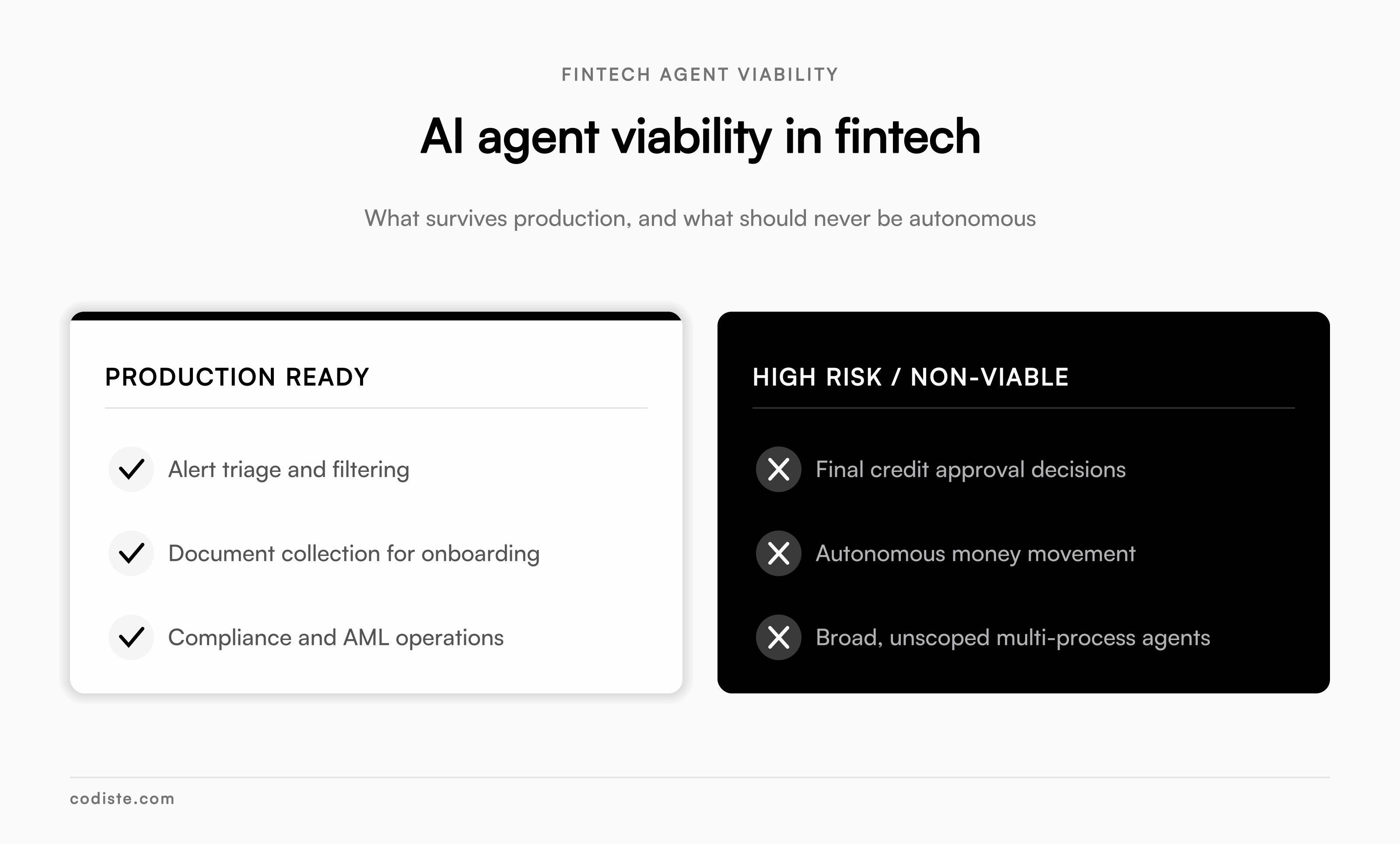
The agentic AI use cases in fintech that survive contact with production share a profile: high volume, repetitive structure, an answer that exists in a system you already own, and a human decision at the end that stays human. Alert triage fits. Document collection for onboarding fits.
Most compliance operations work fits, which is why it is where the credible agentic AI fintech applications cluster. Final credit decisions do not, and neither does anything in agentic payments where the agent moves money on its own authority.
Scope down until somebody objects
Somebody in the room always wants the pilot to cover the harder segment. The right answer is usually no. A narrow fintech AI agent that handles one alert type completely produces evidence; a broad one produces anecdotes.
What week one kills
Projects where the sponsor cannot name a metric, projects where the metric is not currently measured, and projects whose real goal is a board slide. All three fail in production, just more expensively and six months later.
Week two: does the agent have the access it actually needs?
The second gate is technical and unforgiving. An agent that cannot reach the systems holding the answer is a chatbot with better marketing.
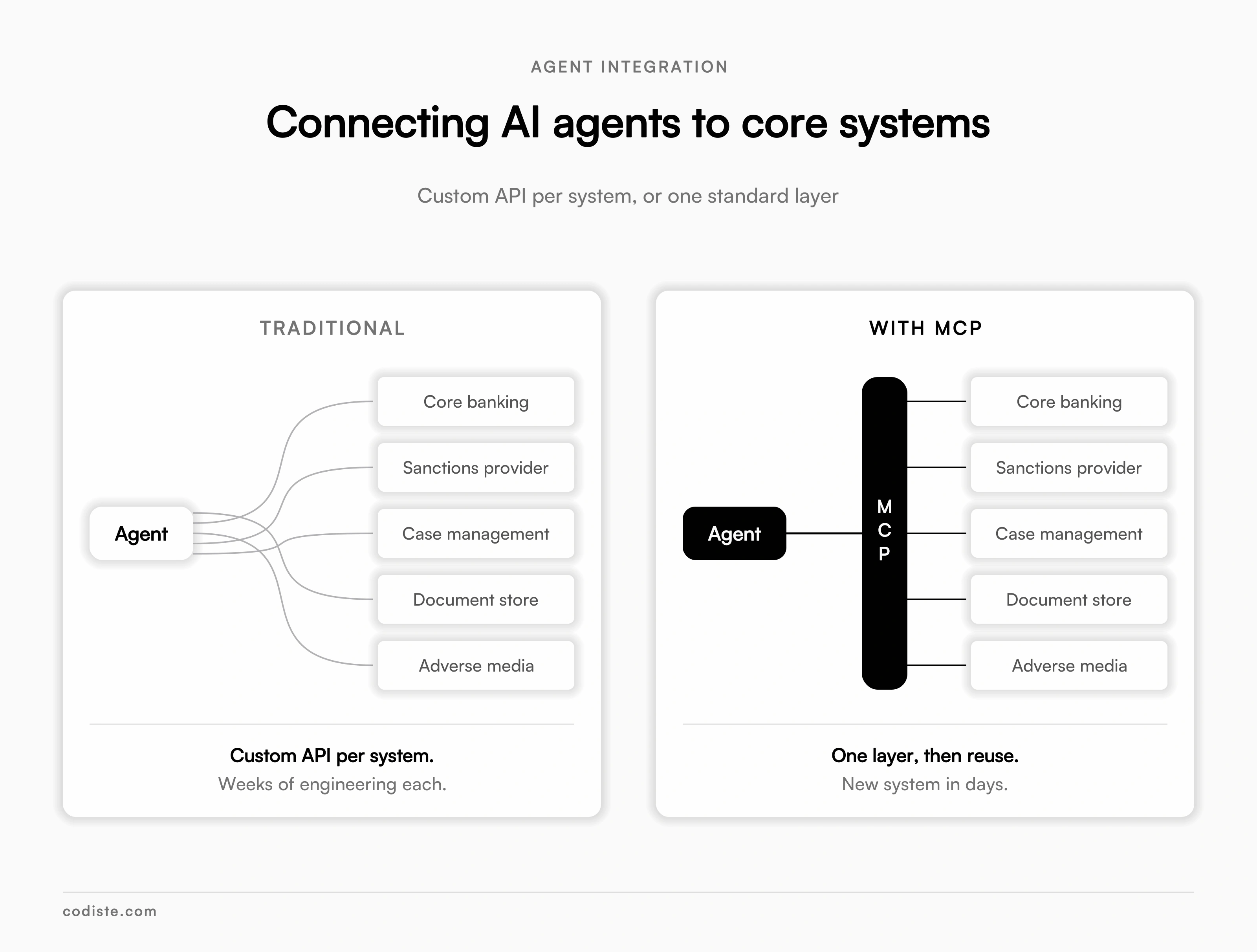
Map the tools before writing a promptList every system the agent must read from and write to: the case management platform, the sanctions screening provider, the core banking record, the document store, the adverse media source. For each one, establish whether an API exists, what authentication it needs, and what latency it returns under load.
Model Context Protocol is changing the plumbing questionModel Context Protocol (MCP) standardises how agents connect to tools and data, which turns a bespoke integration project into a configuration one. For AI agents in fintech operations, where an agent may need six systems to close a single case, that difference is measured in weeks of engineering. Week two establishes which of your systems can be exposed this way and which need custom work.
Where the data problem surfacesThis is the week that reveals whether the pilot is an agent problem or a data problem. Sanctions lists that update on a schedule nobody documented. Customer records split across two systems that disagree. A document store where half the files are scans without text layers. Agents inherit all of it. If the sprint finds this, the honest recommendation is to fix the pipeline first, and our data engineering practice usually runs before the agent works rather than after it.
What kills week two
Any pilot where the required data cannot be reached inside the pilot window. Not delayed. Killed, and restarted when the access exists.
Week three: does it survive the compliance conversation?
The third gate is the one fintechs skip and regulated fintechs cannot. You bring compliance in during week three, not during the pre-production review, because compliance objections are architectural and architecture is expensive to change late.
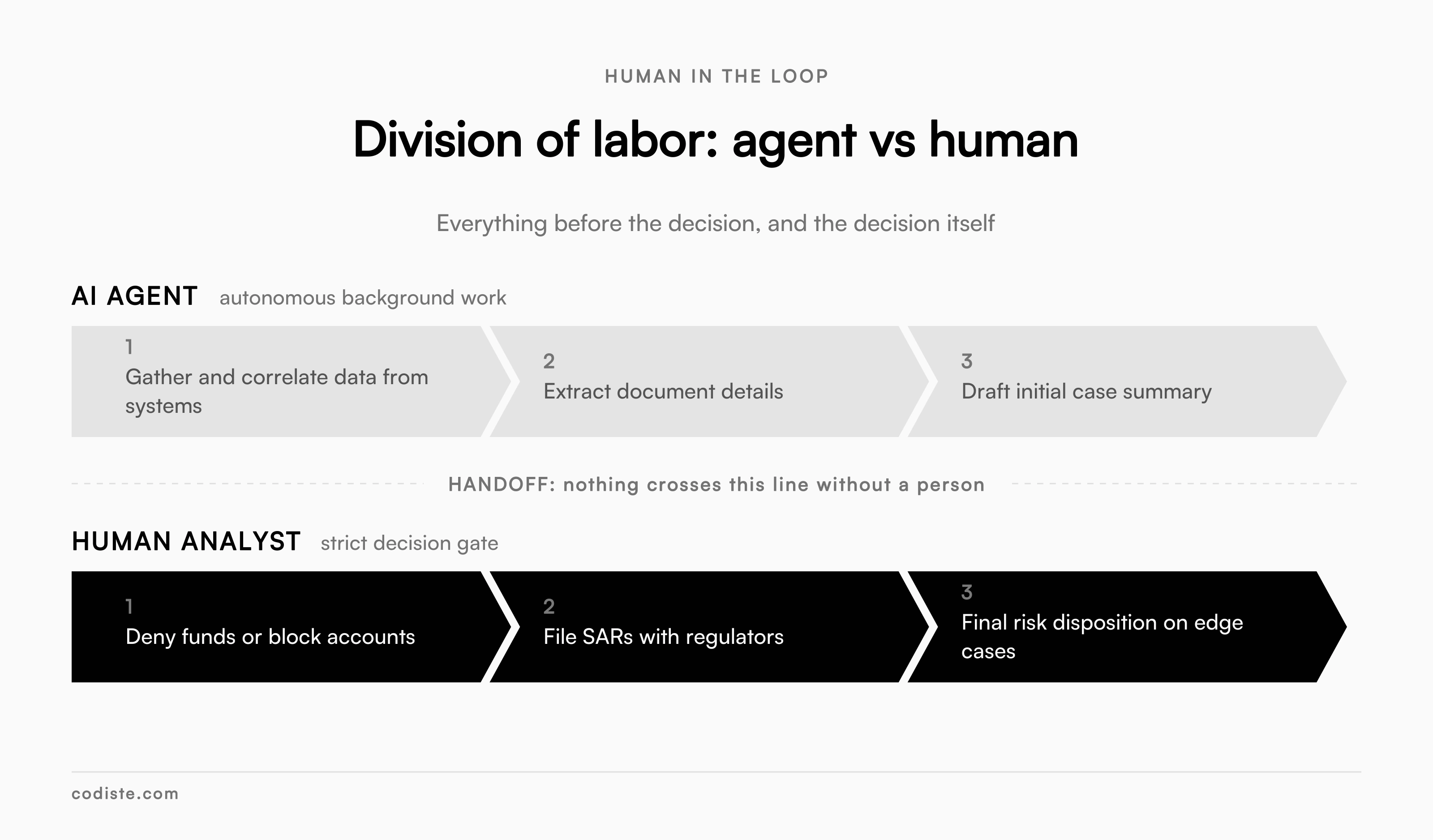
Human-in-the-loop, defined preciselyNot as a principle, as a list. Which actions the agent takes autonomously, which it recommends for approval, and which it must never touch.In practice the boundary lands in a consistent place across AI agents for fintech companies: agents gather, correlate, draft and prepare; humans decide anything that denies a customer money or files with a regulator.
The audit trail is a design requirementEvery retrieval, every tool call, every intermediate conclusion, timestamped and reconstructable.A compliance team's first question about an autonomous system is how you demonstrate why it did what it did in a specific case eleven months ago. Design for that in week three and it costs nothing. Retrofit it and it costs a rebuild.
Explainability against the regulator you actually haveThe Federal Reserve noted in 2026 that AI use in banking rests on governance, risk management, data quality and human oversight, and the Bank for International Settlements has made similar observations about AI in payments. Neither is a prohibition. Both set the terms: the burden is on you to show control, and a system that cannot explain itself cannot be shown.
What week three kills
Pilots whose value depends on autonomy the compliance function will not grant. Better to learn that in week three than after a build.
Week four: can you prove it against the baseline?
The fourth gate is evaluation, and it answers the question week one made possible.
Shadow mode before live modeThe agent runs against real cases in parallel with the existing process, taking no action. You compare its output to what the humans decided. This produces a defensible accuracy number on your own data, which no vendor benchmark can give you, and it produces it without touching a customer.
Evaluate outcomes, not transcriptsAssert on results: did it reach the same disposition as the analyst, did it retrieve the correct record, did it correctly escalate the cases that needed escalating. Multi-agent systems in fintech are non-deterministic, so every case runs repeatedly and the pass rate is the result rather than the pass.
Disagreement analysis is where the value isThe cases where agent and analyst disagree are the sprint's most useful output. Some are agent errors. A meaningful proportion are analyst inconsistencies, which is uncomfortable and worth knowing. Both change the production design.
The go or no-go, written down
Week four ends with a number compared to week one's baseline, a projected effect, and a recommendation. Roughly a third of the sprints we run end in no-go or in a redirect to a different use case. That is the sprint working. How does agentic AI improve fraud detection specifically?
The fraud detection model can stay exactly as it is. What changes is minutes per alert, and at fintech alert volumes that is the whole business case.
Conclusion
Here is the truth that cuts against our own business interests: sometimes, a properly run Discovery Sprint concludes that you should not build anything at all.
You might find that a commercial platform already solves your problem, making a custom build unnecessary. You might discover your data foundation needs another year of work before an agent can stand on it, or that your manual process is too inconsistent to automate.
These are valuable outcomes. It is infinitely cheaper to hear "no" in week four than to realize it in month nine.
Successful pilots are not the ones with the most hype; they are the ones that are tightly scoped, domain-specific, and honest about what they are measuring.
Spending four weeks testing your hypothesis is the most cost-effective insurance policy for your roadmap.
At Codiste, we run this sprint to find the truth before a single line of production code is written. We are happy to tell you when the answer is no. If you have a use case but aren't sure where your baseline stands, our AI agent development services start with that first week.
FAQs
What are common use cases for agentic AI in fintech?+
The deployments reaching production cluster in back-office operations: alert triage and case preparation for fraud and AML, KYC and onboarding document collection with sanctions and adverse media screening, continuous customer due diligence in place of periodic review, reconciliation and exception handling, and internal service agents for risk and operations teams. The shared profile is high volume, repetitive structure, an answer retrievable from an owned system, and a human making the final decision.
How does agentic AI improve fraud detection?+
Mostly by compressing investigation rather than by catching more fraud detection. Detection models flag transactions; the expense is the analyst opening several systems per alert to establish context. An agent gathers those signals, assembles an evidence-backed case file and routes it with a recommendation, cutting minutes per alert. Consultancy-reported figures include around a 50% reduction in time per AML investigation, per EY.
What are the benefits of agentic AI for banks and fintechs?+
Faster onboarding, lower cost per investigation, consistent risk classification across segments, audit-ready documentation generated as a by-product of the work, and the ability to grow volume without proportional headcount. The benefit that matters most in regulated environments is consistency: an agent applies the same standard to case one and case ten thousand, which is a compliance argument as much as an efficiency one.
What outcomes have fintechs seen from AI agent implementation?+
Deloitte reports a large Dutch financial institution cutting onboarding time by 90% and staff workload by 30% across KYC and compliance, and an American institution reducing human IT desk calls by more than half. EY reports roughly 50% less time per AML investigation. Visa reported blocking $40 billion of fraud in FY2023 using capabilities including AI, and the US Treasury reported preventing or recovering over $4 billion in FY2024. Treat consultancy figures as directional, since the institutions are unnamed.
Why do most fintech AI pilots fail to reach production?+
Usually because success was never defined in measurable terms. MIT's NANDA research found 95% of enterprise generative AI pilots delivered no measurable P&L impact, a finding driven substantially by pilots lacking a documented pre-deployment baseline rather than by the technology underperforming. Secondary causes are data access discovered too late and compliance constraints discovered after the architecture was fixed.
How long should a fintech AI agent pilot take?+
Four weeks for discovery and a go or no-go decision, then six to twelve weeks to production for a scoped single use case, depending on integration count and compliance review. Anything promising production in four weeks is either skipping the compliance gate or building something that will not survive it.
What is Model Context Protocol and why does it matter in fintech?+
An open standard for connecting AI agents to tools and data sources through a consistent interface rather than bespoke integrations per system. It matters in fintech because a single case often needs six or more systems, and integration is where most of the build budget goes. MCP does not remove the access and permissions work, but it turns much of the plumbing into configuration.
Nishant builds where ambitious ideas meet production reality. As CTO & Co-Founder at Codiste, he has helped ship 150+ AI systems. Through The CTO Story, he gets technical leaders talking about what rarely makes the slide deck: the trade-offs, failures, and decisions behind what actually ships.
Every great partnership begins with a conversation. Whether you're exploring possibilities or ready to scale, our team of specialists will help you navigate the journey.