
Artificial Intelligence
February 20, 2025
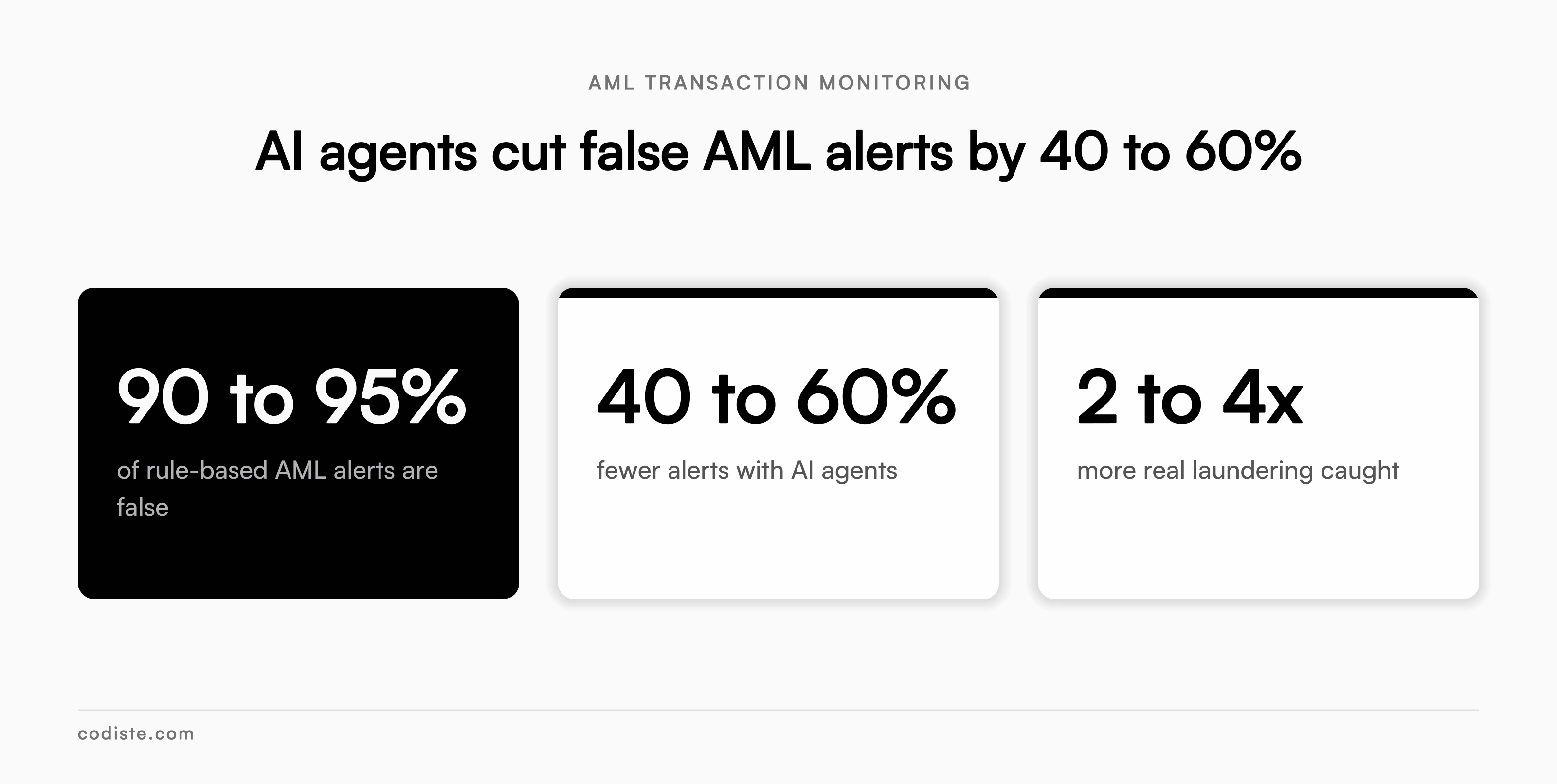
Most AML alerts are wrong. Industry benchmarks put false positive rates in rule-based transaction monitoring between 90% and 95%, which means compliance teams spend the bulk of their time investigating customers who did nothing. The obvious fix, raising thresholds until the queue shrinks, quietly creates a worse problem: real launderers slip through with the noise.
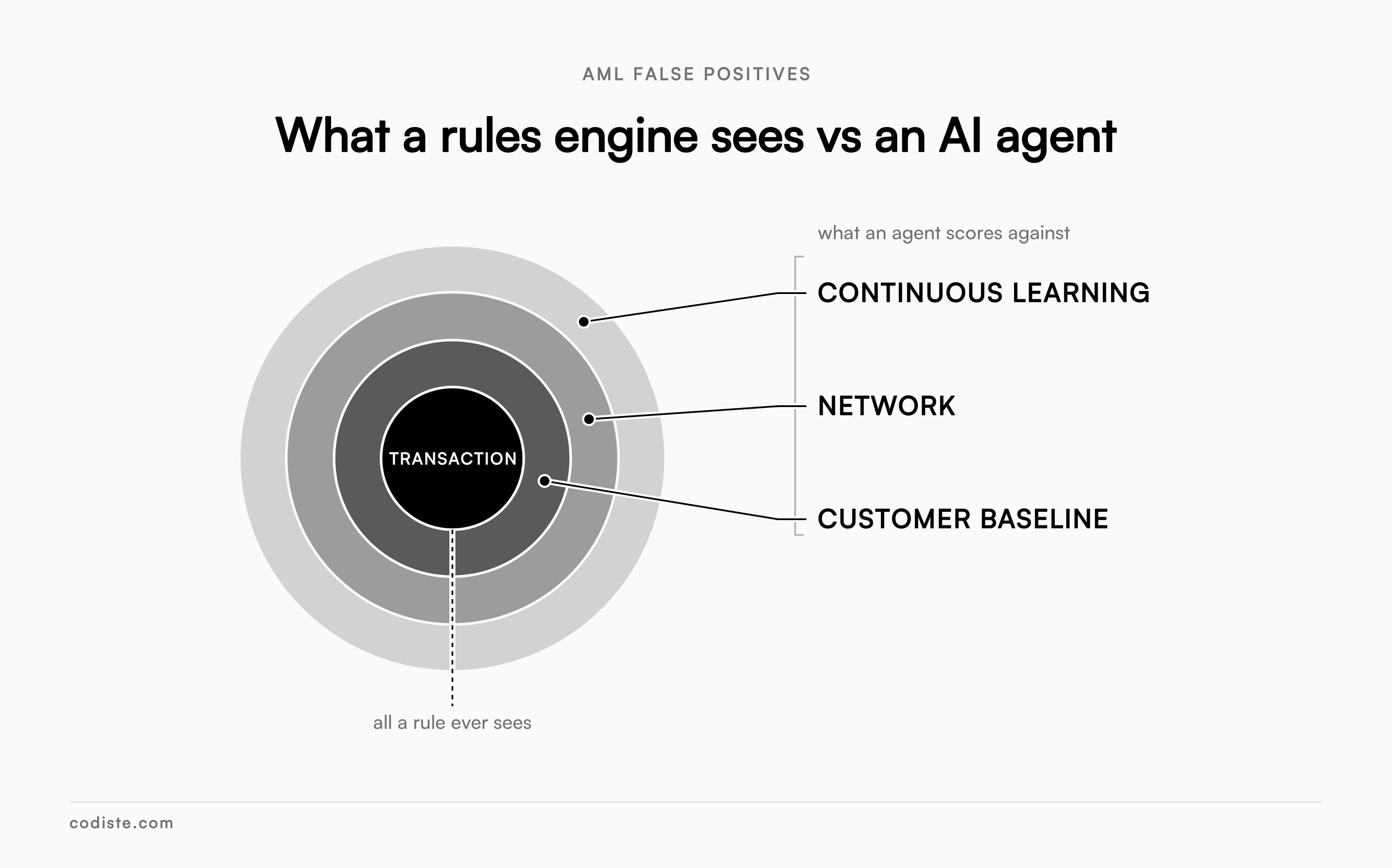
AI agents offer a different path. Instead of checking whether a transaction crossed a fixed line, they score every alert against the customer's history, peer group, and transaction network, then document their reasoning for a human to review. Banks running these systems report 40 to 60% fewer alerts, alongside two to four times more genuine detections in the same system over the same period.
This article breaks down how that works, what it costs, what regulators expect in 2026, and how to adopt it without betting your compliance program on an unproven model.
AI agents cut AML false positives by scoring every alert in full context, the customer’s history, peer group, and network, instead of checking whether a single transaction crossed a fixed line. Done properly, this reduces alert volume by 40 to 60% while catching more genuine criminal activity, not less.
That second half is where most institutions go wrong. Anyone can shrink an alert queue. Raise your thresholds and half of it disappears by lunchtime, along with a chunk of the launderers you were supposed to catch.
The real question is whether a system improves discrimination: telling real risk from noise. Rule-based monitoring fails at exactly this. Industry benchmarks put its false positive rates between 90% and 95%, meaning analysts spend most of their working lives clearing alerts that should never have fired.
Here is how AI agents break that pattern, what the numbers look like in live deployments, and where the approach fails when built badly. Because it can be.
AI agents software systems that investigate autonomously: they monitor transactions, pull context from customer records and networks, score risk, and draft findings for a human analyst to approve. Rules engine flags. An agent investigates, then explains itself.
No serious deployment uses one giant model. The work splits across specialized agents:
The human stays accountable. The agent does the legwork. A 2024 Bank of England survey found 75% of financial firms already using AI, and AML is among the fastest-growing use cases because the legwork is where the cost sits.
Traditional systems fire on fixed rules, flag transfers over $10,000, flag payments to high-risk countries. Rules cannot read context, so a retiree selling a car looks identical to a smurfing operation.
The failure is structural, not a tuning problem:
Danske Bank is the cautionary tale. Before its overhaul, its monitoring reportedly ran at a 99.5% false positive rate. Nearly every alert was noise. The same institution sat at the center of a €200 billion laundering scandal through its Estonian branch. Massive alert volume and catastrophic misses, in the same bank. That’s the see-saw at scale.
They stop asking “did this transaction cross a line?” and start asking “is this abnormal for this customer, compared to similar customers?” Most false positives die at that second question.
Three mechanisms do the work, and they compound:
The reference numbers come from HSBC’s deployment of Google Cloud’s AML AI: roughly 60% fewer alerts, with two to four times more genuinely suspicious activity identified than the rules it replaced. Danske Bank’s rebuild reportedly cut false positives around 50% while lifting detection about 60%.
Fewer alerts and more crime caught in the same system over the same period. That pairing is the only evidence that matters in any vendor’s false positive claim.
Because they improve precision rather than suppressing volume. A threshold change hides alerts; a well-built agent re-sorts them, so true positives rise to the top of a smaller queue instead of drowning in a large one.
This is the section where any executive should slow down, because a missed SAR costs more than ten thousand false alarms. What separates real systems from alert-hiding dressed up as AI:
One honest caveat: a badly trained model can miss things a crude rule would have caught. If your historical analysts systematically under-escalated a typology, your model learns to under-escalate it too. This is why parallel running against the legacy system isn’t optional. It’s the safety net.
The goal, stated plainly enough to put on a slide: not fewer alerts, better-sorted alerts.
The cost case is scale without headcount; the risk case is smaller tail risk. Both show up in numbers a CFO can model.
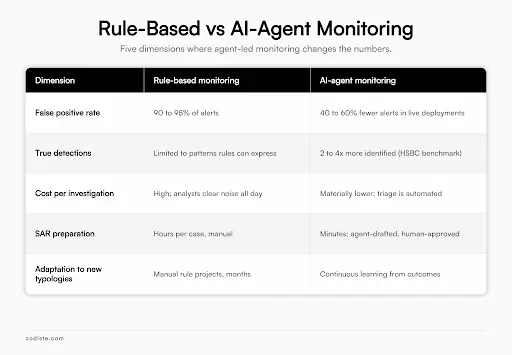
Global financial crime compliance spend runs over $200 billion a year, and alert investigation is its largest operational component. Cut the noise queue in half and you either slow hiring or redeploy analysts onto the complex cases. Either way the CFO sees it.
The risk number is bigger. AML fines have topped $36 billion across the industry over the past decade, and nearly all headline penalties trace to missed activity and unfiled SARs. Not to false alarms. A system that demonstrably raises detection shrinks the exposure that ends up in enforcement actions and newspapers.
Quieter effect: compliance that scales with software stops bottlenecking new markets and products.
Yes, and increasingly they expect it, provided the system is explainable, auditable, and keeps a named human accountable for consequential decisions. What they reject is a black box clearing alerts without a reviewable rationale.
FinCEN and US banking agencies signaled openness to innovative AML approaches in their 2018 joint statement, and examiner comfort has grown since. The Bank of England’s 2024 survey found another 10% of firms planning AI adoption within three years. Through 2025 and 2026 the conversation has moved from “may we use AI?” to “show us your model governance.”
That shift changes procurement. Explainability is a requirement: every cleared alert needs a written rationale an examiner can inspect, model documentation must cover training data and validation, bias testing has to be evidenced, audit trails complete. Institutions treating governance as a first-class deliverable pass exams. The ones that bolt it on afterward do not.
Run agents in parallel with your existing system before you rely on them. This champion-challenger setup measures false positive reduction and detection rate against your live baseline, with zero regulatory exposure while evidence accumulates.
The sequence:
Build versus buy depends on how unusual your risk profile is. Generic platforms fit generic banks. Institutions with distinctive products, corridors, or customer bases usually need tailored agent systems, because a model trained on someone else’s typologies misses yours.
For twenty years AML monitoring forced a bad choice: drown in false alarms or risk missing real crime. AI agents end that trade-off, and the proof is public, in banks that cut alert volume by more than half while catching two to four times more genuine cases.
Hold any system to the standard in this article’s title. Fewer false positives, none of the true ones. Don’t accept a queue that’s merely smaller. Accept one that’s finally sorted by what matters.
Building toward that standard? Codiste designs AI agent systems for transaction monitoring where every cleared alert carries a rationale your examiners can read.



Every great partnership begins with a conversation. Whether you're exploring possibilities or ready to scale, our team of specialists will help you navigate the journey.