
Artificial Intelligence
February 20, 2025
A demo request lands at 6:12 p.m. on a Friday. The routing rule is assigned by territory. The territory field says Chicago, because that was true in 2023, before the company moved its headquarters and its buying committee to Austin. The lead drops into a Midwest rep's queue. She works it Monday at 9:04 a.m.
Sixty-three hours. A competitor called back in four minutes.
Nobody made a mistake. The form worked. The rule fired exactly as written. The rep worked her queue in order. The only thing that failed was a single field that was correct when someone typed it and quietly stopped being correct sometime after.
That is what B2B SaaS sales ops runs on: a warehouse of facts that were true once. Enrichment decides what a record says. Lead routing decides where it goes and how fast. Forecast hygiene decides whether the number you send the board is real. All three inherit the same decay, and all three fail quietly enough that the quarterly post-mortem blames the reps.
Because every sales ops function reads from the same decaying source and none of them re-check it. Enrichment, routing and forecasting are not three problems with three fixes. They are three symptoms of one condition: records that age faster than anyone maintains them.
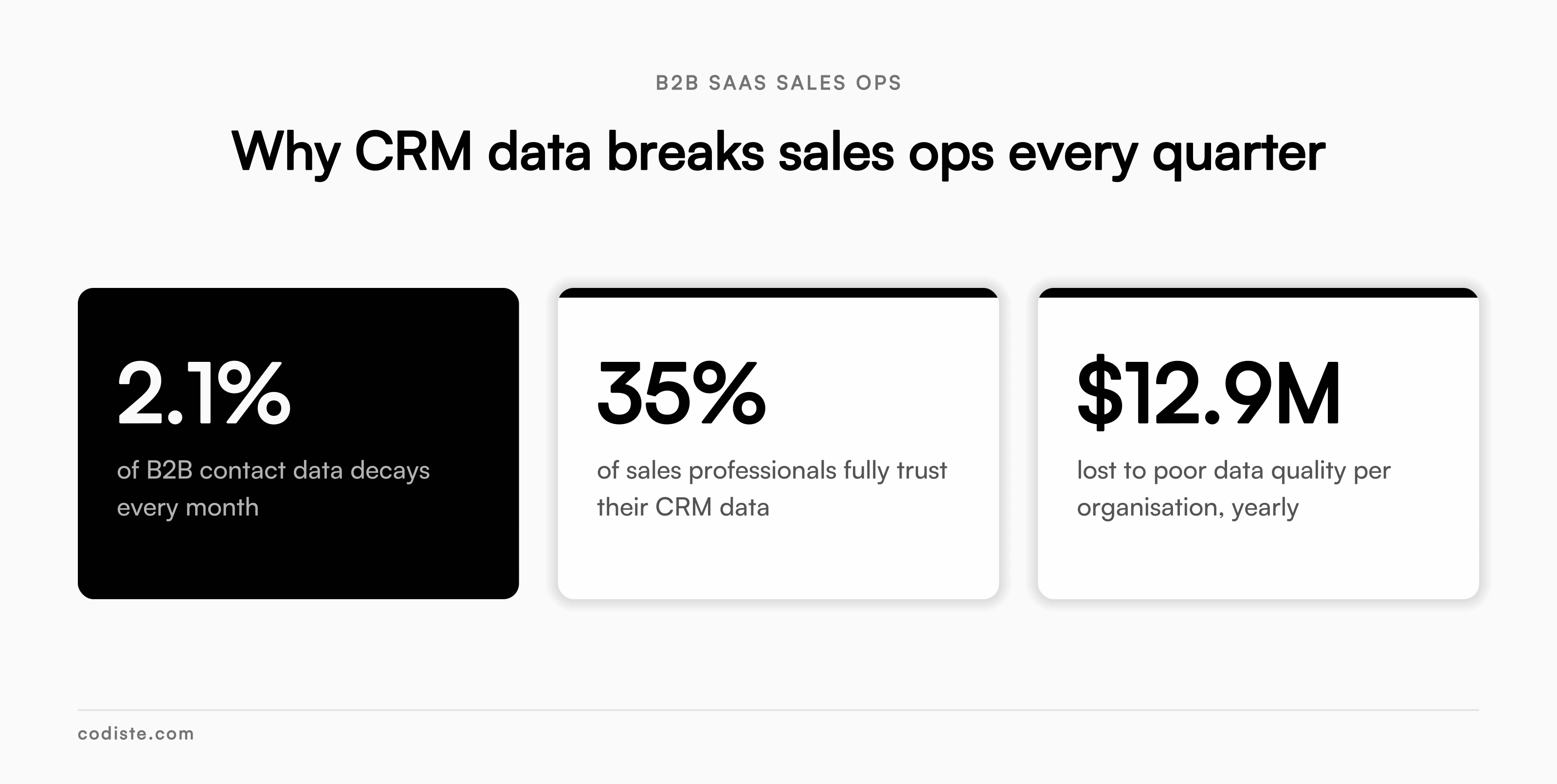
HubSpot's Database Decay Simulation, built on the long-running MarketingSherpa research, puts monthly B2B contact decay at 2.1%, compounding to roughly 22.5% a year. Dun and Bradstreet puts it at 30% to 40% annually and notes the rate accelerates in high-mobility sectors, which is exactly where SaaS sits. Job titles decay fastest of any field.
Gartner estimates poor data quality costs the average organisation $12.9 million a year. That number gets quoted so often it has stopped landing, so here is the version that does: only 35% of sales professionals completely trust the accuracy of their CRM data, and 47% say accuracy is harder to maintain now than it was twelve months ago, per Salesforce's State of Sales research.
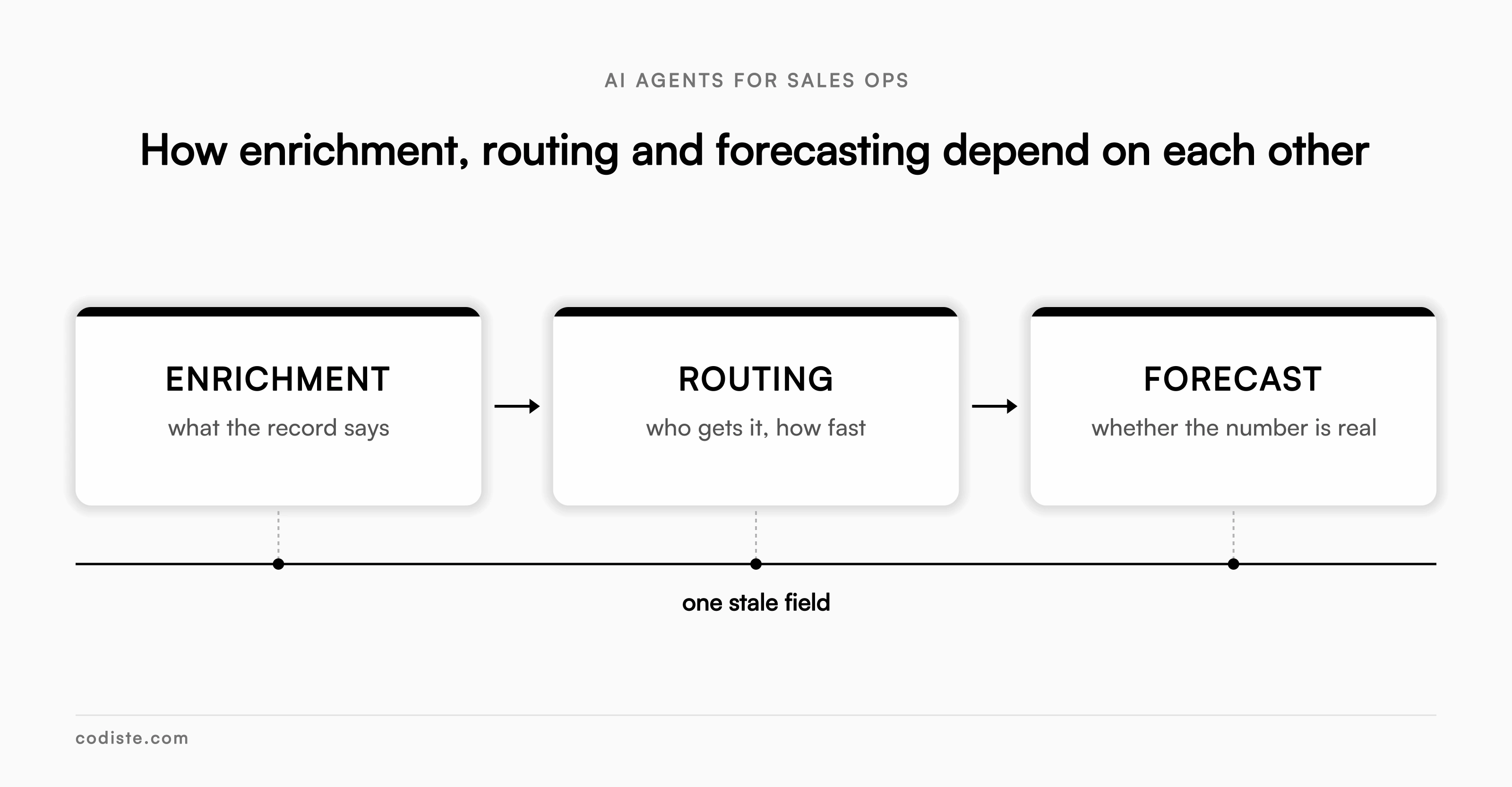
Enrichment decides what the record says. Firmographics, technographics, headcount, funding stage, current title. Each is a claim about the world verified at one point in time.
Routing decides who gets it and when. Territory, segment and account ownership all read from enriched fields. A routing rule is only as good as the field it keys on.
Forecast hygiene decides whether the roll-up is real. Stage, close date and engagement come from reps updating records between calls, under quota pressure, at the end of a long day.
The order matters. You cannot route on a field you have not enriched, and you cannot forecast a pipeline that was misrouted.
Quarterly cleanups fail arithmetically. At 2.1% monthly decay, a database cleaned on 1 January is roughly 6% wrong by April and 12% wrong by July. You are always cleaning a version that no longer exists.
The other standard answer, asking reps to keep records current, collides with how reps spend a week. Salesforce's State of Sales research and a Forrester study covering more than 3,000 reps both land in the same place: roughly 30% of the week goes to actual selling, with CRM data entry, internal meetings and account research absorbing the rest. Ask someone with 30% selling time to spend more of it on data entry and you get what you would expect. One survey found 37% of sales staff admit to entering CRM data they know is wrong.
By running continuously instead of on a schedule, and by writing with a confidence score and a stated reason so a human can audit the work. The useful architecture is three narrow agents rather than one general sales assistant, because each job has a different failure mode and a different tolerance for being wrong. None of these agents talk to buyers. They operate on your records, and their output is a field update, a routing decision or a flag on a deal.
A data enrichment agent's job is not to fill empty fields. It is to keep populated fields honest, which is the harder half. Most CRMs display a decayed record as a valid one, so the failure stays invisible until it surfaces downstream.
Routing is where stale data converts into lost revenue fastest, and the easiest place to prove an agent is working. The MIT and InsideSales Lead Response Management study, led by Dr James Oldroyd across more than 15,000 leads, found that contacting a lead within five minutes made a team 21 times more likely to qualify it than contacting at thirty. A Harvard Business Review analysis of 2.24 million leads found firms responding within an hour were about seven times more likely to qualify.
Then the execution gap. The average B2B lead response time still sits at 42 to 47 hours. A 2024 test of 1,000 B2B SaaS companies found 63.5% never responded to an inbound lead at all, against the 23% Harvard Business Review measured in 2011. Awareness improved. Execution got worse.
A routing agent closes that gap three ways. It enriches the record before the routing decision, so the rule keys on a current field. It detects coverage gaps, the Friday evening submissions a static rule drops into an empty queue, and reassigns instead of waiting.
And it enforces the SLA as a live condition rather than a reported metric. That last one carries most of the weight: Blazeo found teams with a defined SLA respond within fifteen minutes 54.9% of the time, against 29.5% without one. An agent is what makes it hold at 6 p.m. on a Friday.
Forecast hygiene keeps pipeline records accurate enough that the forecast built on them means something. XANT Labs analysed 270,912 closed-won opportunities worth $18.1 billion and found 47% of deals missed forecast by more than half, with the average 90-day prediction off by more than 31%. Gartner reports fewer than 25% of sales organisations achieve accuracy above 75%.
None of that is a modelling problem. It is an input problem, and a forecast hygiene agent works the inputs:
The output is not a better algorithm. It is a pipeline where every deal in the commit can point to the evidence that put it there.
Because the data foundation they sit on is the thing that was broken in the first place. Gartner projects that more than 40% of agentic AI projects will be cancelled by the end of 2027, citing escalating costs, unclear business value and insufficient governance. IDC puts the share of AI pilots that never reach production at 88%. Both attribute failure to data readiness, governance and observability rather than model quality, and RAND's root-cause interviews with practitioners reach the same conclusion.
Here is the version specific to sales ops. An AI tool for sales ops automation pointed at a CRM that is 30% wrong does not fix the 30%. It writes into it faster, with more confidence, and with less human friction than the process it replaced. A rep who mistypes a territory creates one bad record. An agent inferring territory from a decayed field creates four thousand, each carrying an authoritative-looking timestamp. Speed amplifies a bad foundation as efficiently as a good one.
Governance is the other half. Deloitte's 2026 research across 3,235 leaders in 24 countries found only 21% of organisations have a mature governance model for autonomous agents while 74% plan to expand agentic deployment within two years. Intent is running well ahead of controls.
Fix enrichment first, run the agent in suggest mode before it writes anything, and promote it by confidence tier rather than all at once. Routing and forecasting both improve once the fields underneath them are current, which is why the order is not negotiable.
Build versus buy comes down to how standard your motion is. A generic platform fits a generic funnel. Teams with unusual segmentation, a partner-led motion, or product-led signals feeding the same pipeline generally need something built against their own schema, which is the point at which most look for AI agent development services rather than adding a twelfth tool to the stack.
The Friday demo request did not fail because of a bad rep or a bad rule. It failed because one field aged and nothing was watching it age. That is the whole problem, and it repeats at every layer: enrichment writes it, routing reads it, the forecast inherits it.
AI agents help here for an unglamorous reason. They can check every record continuously, which no ops team can, and they can show their work, which no batch job does. Fix enrichment, and the routing improvement is close to free. Fix routing and the forecast starts describing something real.
The failure data is equally clear. More than 40% of agentic projects get cancelled, 88% of pilots never reach production, and the cause is almost never the model. It is pointing an agent at a foundation that was already broken and expecting speed to compensate. Suggest mode first, confidence tiers second, autonomy last.
The test for any tool in this category is simple. If it only fills more fields, it is a faster version of the problem. If it can tell you which fields it does not trust and why, it is doing the job.
Codiste builds AI agent systems for B2B SaaS revenue operations where every enrichment write, routing decision and pipeline flag carries a confidence score and a source your ops lead can audit.



Every great partnership begins with a conversation. Whether you're exploring possibilities or ready to scale, our team of specialists will help you navigate the journey.