





Artificial Intelligence
June 12, 2024

AI agents and chatbots are something that we recently countered people discussing, mixing the two, which did not feel right, and hence, we decided to help people clear the air.
As industry experts, we must let people know and understand the difference between AI agents and chatbots, essential in every marketer or business house's operations and functioning.
Chatbots and AI agents can talk to users, but is it really that simple? Well, dont worry. This article explores how AI agents and chatbots differ from each other and how AI agents transform various fields, going far beyond what regular chatbots can do.
In the following sections, we'll examine what AI agents and chatbots can do, see real-life examples of their use in various jobs, and help you determine which one might be right for your needs. Let's explore what the best choice for you is.
Imagine having software that can mimic human conversations with users, offering 24/7 availability and handling a high volume of basic conversational inquiries simultaneously, leading to rapid response times. This is what a chatbot is.
These digital assistants are increasingly prevalent in customer service, efficiently handling high volumes of repetitive inquiries. Business owners use Chatbots to automate routine tasks, allowing human agents to focus on more complex issues.
The positive aspect of this tool is its faith in predefined scripts and workflows to engage with customers. This allows them to quickly provide answers to common questions and guide users through basic processes.
However, the scripted nature of chatbot interactions proves to be a double-edged sword. While effective for straightforward queries, chatbots often struggle with complex or delicate requests.
This over-reliance on pre-programmed responses can make conversations feel robotic and impersonal. Chatbots may provide irrelevant answers or fail to assist customers with questions outside their limited knowledge base.
While chatbots excel at automating simple tasks, they complement rather than replace human support. Business owners should carefully weigh the pros and cons of using chatbots.
Assess their specific business requirements first, and then consider chatbots for customer service by striking the right balance between automated assistance and personalized human interactions in the age of AI.
Humanity's significant leap forward from traditional chatbots to an AI-powered chatbot is a modern-day AI agent. These agents offer a new level of sophistication, changing how digital interaction happens with agentic AI.
Unlike their humble and more straightforward counterparts, these intelligent systems possess impressive abilities like decision-making, continuous learning, and solving ever-evolving complex narratives from every engagement.
AI agents are loyal digital assistants who respond to your queries and will adapt to your preferences, anticipate your needs, and handle all your complex tasks without breaking a sweat, along with thoughtful responses. That's the essence of an AI agent.
These digital powerhouses can juggle multiple tasks across various domains, making them invaluable for businesses looking to provide top-notch, personalized experiences.
What sets AI agents apart is their autonomy and flexibility. Rigid scripts or limited datasets do not bind them. Instead, they tap into vast knowledge bases, using advanced algorithms to make informed decisions.
This capability allows them to tackle intricate problems and navigate changing scenarios easily.
In customer service, AI agents shine. They can handle complex queries, understand context and details, and even detect human-like cues in a conversation.
The adaptability of AI agents makes them suitable for a wide range of applications. As these AI-powered agents evolve, our digital experiences will be more intuitive, efficient, and personalized than ever before.
The artificial intelligence landscape is evolving rapidly, with AI agents and chatbots being the frontrunners of customer interaction technologies. Although often used interchangeably, they represent distinct approaches to automated communication.
Here are the key differences in the AI agent vs chatbots debate that set chatbots apart from their AI agent counterparts.
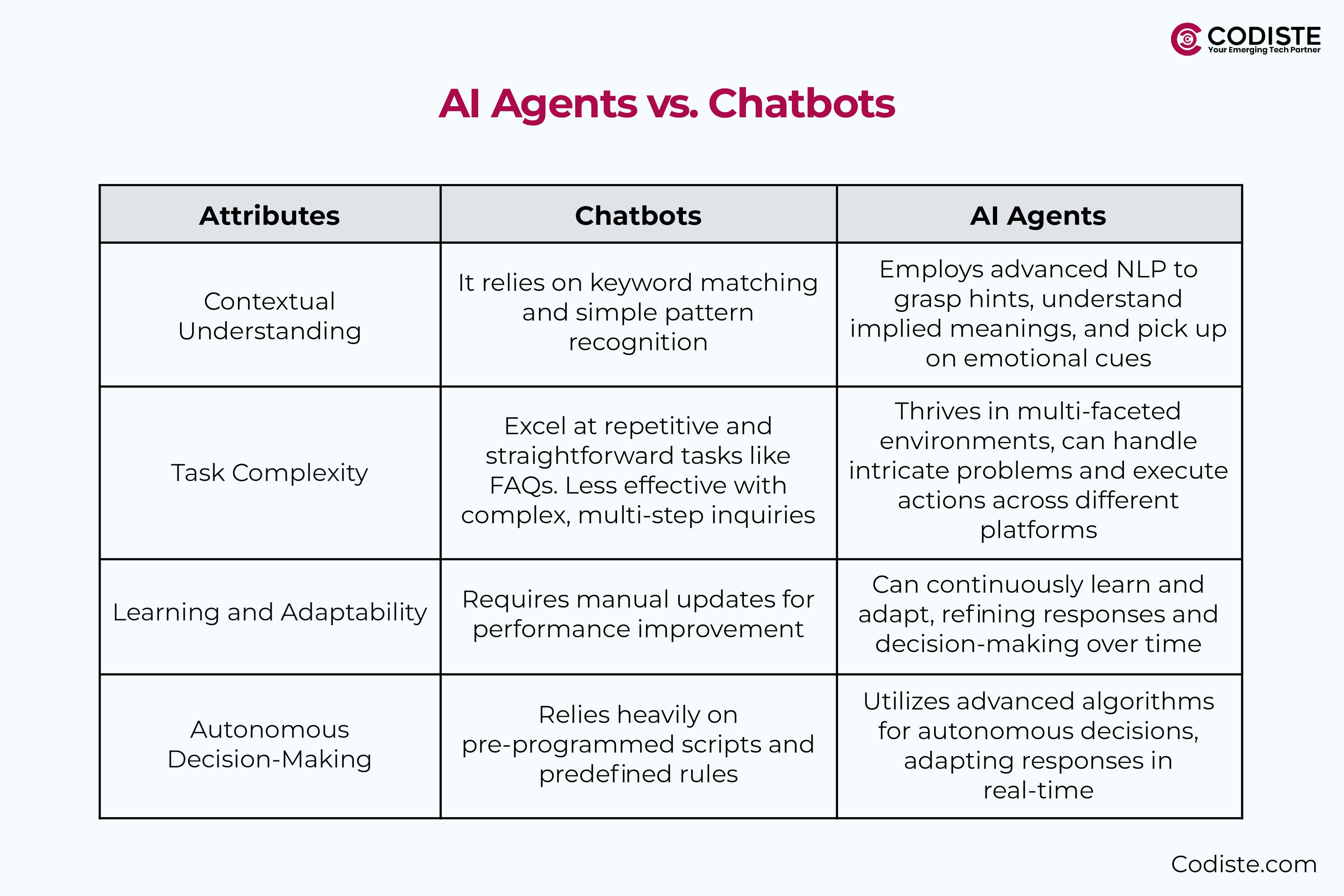
The depth to which these conversational tools can interpret information by recognizing the circumstances, background, and intent in which it occurs.
It involves understanding the words or phrases and the environment, situation, or setting that gives them meaning.
Chatbots typically interpret user inputs based on keyword matching or simple pattern recognition.
AI agents, however, use sophisticated natural language processing (NLP) to grasp the nuances of human communication. They can remember previous exchanges, understand implied meanings, and even pick up on emotional cues, capabilities beyond traditional chatbots' reach.
This enhanced comprehension allows AI agents to maintain coherent, context-aware conversations across multiple interactions.
The tasks that each communication tool can complete vary significantly. Chatbots excel at repetitive and straightforward tasks, such as answering FAQs or guiding users through simple processes, diminishing their effectiveness when faced with multi-step or open-ended inquiries.
On the other hand, AI agents thrive in multi-faceted environments, tackling intricate problems, breaking down complex tasks into manageable steps and executing actions across different platforms or systems.
AI agents are ideal for personalized advice, complex troubleshooting, or multi-stage customer support issues.
Chatbots require manual updates now and then to improve their performance.
AI agents are known for their capacity to learn and adapt continuously, taking something from each interaction and refining their responses and decision-making processes over time.
This self-improvement capability makes AI agents more effective and efficient with continuous use, expanding their knowledge base and honing their ability to assist users.
The most significant distinction lies in decision-making. Chatbots are dependent on pre-programmed scripts, following predefined rules that navigate conversations.
Whereas AI agents use advanced algorithms to make autonomous decisions, allowing them to adapt their responses and handle complex queries in real-time, much like a human would.
The level of autonomy by which AI agents can analyze the context, access relevant information, and formulate solutions makes them valuable in scenarios where flexibility and problem-solving are crucial.
Does Your Business Need Marketing AI Agents? To Know Further,
So comes the big question: what should you choose to use, an AI agent or a chatbot for your marketing or business needs?
This decision can be significant for customer experience and your operations. Let's break down the key factors to consider in the chatbots vs agents call.
Evaluating your Specific Needs: When adaptability and meticulous decision-making are essential, AI agents excel in such environments.
For Example, imagine you're running a complex supply chain operation. In this case, AI agents could analyze multiple data streams in real time to optimize inventory and logistics.
Conversely, chatbots are ideal for efficiently handling straightforward and repetitive interactions like customer service FAQs or basic product inquiries, providing quick, consistent responses to common questions without being expensive.
Budgetary Constraints: AI agents come with advanced capabilities, typically having a higher price tag, a sophisticated infrastructure and requiring continuous maintenance.
Meanwhile, chatbots are generally cost-effective to maintain and use. A well-designed chatbot can easily automate customer interactions for small businesses or startups with limited resources.
Your Long-term Business Goals: Do you want to transform your entire customer service approach or need the basics, like some help with inquiries? An AI agent might be unnecessary if your needs are simple.
However, a chatbot will be a wreck if you aim for advanced personalization and problem-solving assistance.
While chatbots may suffice for simple, routine interactions, AI agents offer sophistication and adaptability that can transform customer experiences.
The choice between the best AI agents and a chatbot ultimately depends on the organization's specific needs and the tasks' complexity.
Remember, this isn't necessarily an either-or decision. Some businesses use both, using chatbots for front-line customer service and AI agents for more complex backend processes. We'll help you simplify further.
Map out the tasks you want to automate and categorize them as simple or complex. If most tasks are simple, lean towards a chatbot.
An AI agent might be worth the investment if you deal with complexity and variability.
The key is aligning your choice with your unique business needs, resources, and aspirations.
Whether you choose an AI agent or a chatbot, the goal is to enhance efficiency and improve customer satisfaction. Take time, research, and select the solution that best fits your organization's unique landscape.
As AI evolves, the differences between chatbots and AI agents become more pronounced. This shift is changing how businesses interact with customers and run operations.
Understanding these nuances matters for technical leaders and developers using AI in their organizations.
AI agents are emerging as problem-solvers that handle complex tasks autonomously. Unlike traditional chatbots, these systems learn, adapt, and make real-time decisions with a near-human interaction level. They will reshape customer service, data analysis, and decision-making across industries.
Tools that enable AI integration are becoming essential, and the ability to use and deploy AI solutions quickly will be a key differentiator.
The future of AI in business is not just automation. It's augmentation. For companies looking to use an AI marketing solution, Codiste offers a platform for creating and deploying AI agents, cutting development time from weeks to minutes and infrastructure costs by up to 80%.

CTO & Co-Founder | Codiste
Nishant builds where ambitious ideas meet production reality. As CTO & Co-Founder at Codiste, he has helped ship 150+ AI systems. Through The CTO Story, he gets technical leaders talking about what rarely makes the slide deck: the trade-offs, failures, and decisions behind what actually ships.


Every great partnership begins with a conversation. Whether you're exploring possibilities or ready to scale, our team of specialists will help you navigate the journey.