




Artificial Intelligence
June 12, 2024
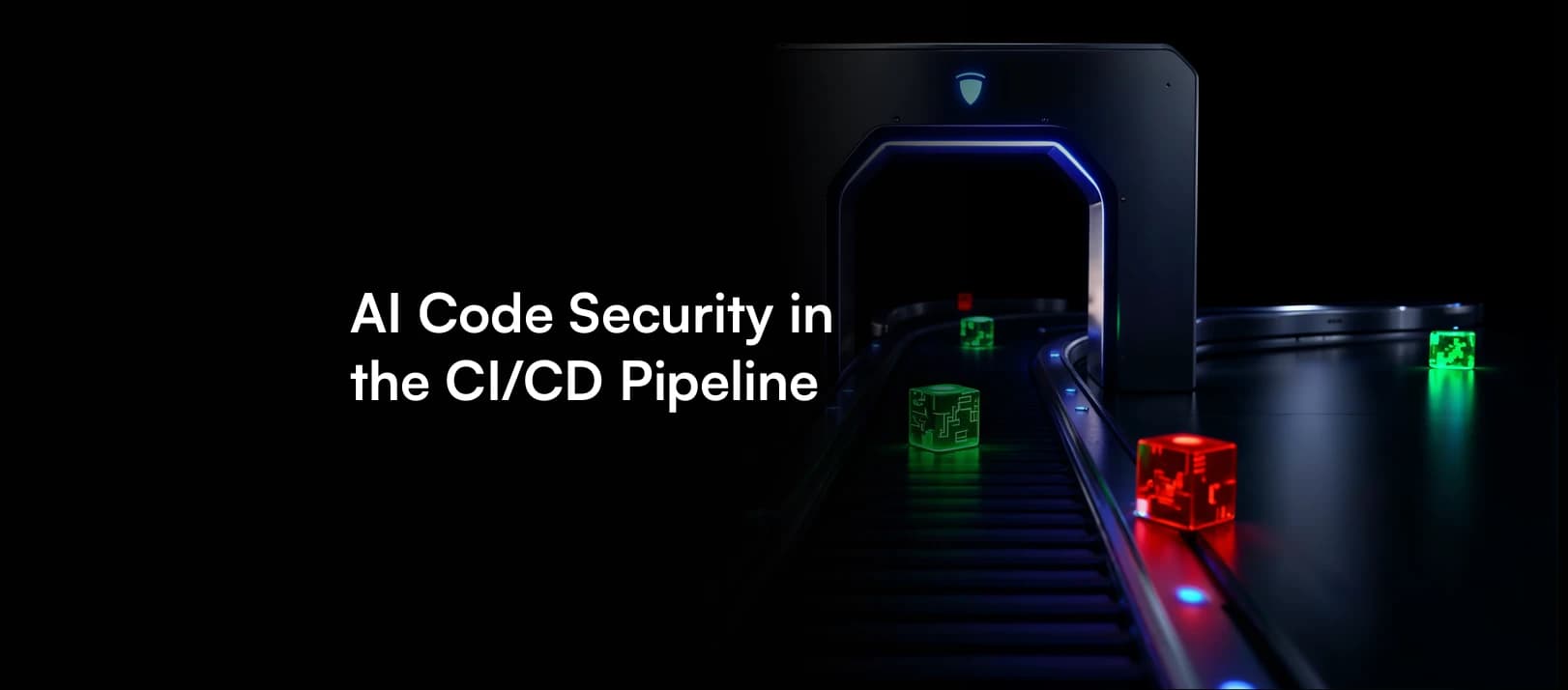
Your senior engineer reviewed the AI-generated pull request for 40 minutes. The API contract violation shipped anyway. That is not a code review failure. AI code security has to be built into the CI/CD pipeline before human review, not layered on top of it.
AI code security in a CI/CD pipeline works by inserting a harness before the pull request review stage. The harness compiles AI output, runs unit tests, and checks code against your internal architecture constraints automatically. Failures route back to the model for self-correction. No developer touches failing code. The gate is structural, not advisory, and scales to any commit volume.
AI-generated code looks identical to hand-written code in your pipeline. That is the problem.
Your static analysis tools, your linting rules, and your security scanners were built for human-written code. They catch syntax violations and known vulnerability patterns. They miss code that compiles cleanly, passes security checks, and breaks an API contract the AI never knew existed.
In 2026, Cycode surveyed 400 CISOs and found that 100% of organizations had AI-generated code in production. Most had no automated mechanism to distinguish it from hand-written code at the pipeline level.
The accountability gap compounds the technical one. A 2026 Aikido survey found that 53% of respondents blame security teams for AI-related breaches. Another 45% blame the developer. And 42% blame whoever merged the pull request. Three groups, zero owners.
Here is the specific failure pattern. The AI assistant generated a module that looked architecturally clean. The senior engineer reviewing it had been at the company for four years and was the person who built the original authentication layer in 2022. She approved the commit. She did not catch the API contract issue because the relevant spec sat in a Confluence page that had not been updated since a refactor in Q3 2024. Nobody flagged it.
That is not a human error. Wrong gate placement.
Shift-left means moving the quality gate before human review. For AI-generated code, that means inserting a harness between the AI tool output and the pull request queue.
The harness runs four steps automatically on every AI-generated commit.
One SaaS platform team that deployed this pattern added a harness running on GitHub Actions triggered on every AI-labelled commit. It added 4 minutes 22 seconds to the average commit cycle. Cost: 4 minutes. Benefit: structural errors removed from the review queue entirely.
That shift changes what your senior engineers spend their time on. Focus on judgment. Let the harness handle structure.
Before the harness gate, a mid-size SaaS team running AI-assisted development saw AI commits move from creation to review in an average of 4.2 hours. Review queues backed up when the AI commit volume spiked. Developers spent increasing time on structural failures that had nothing to do with product logic.
After deploying the harness-integrated CI gate, that structural failure class disappeared from the review queue. Compilation errors, broken API calls, and test failures were caught and self-corrected before reaching any human. Engineers spent their review time on what requires human judgment: architecture decisions, domain-specific security risks, and business logic edge cases.
The 34% post-merge defect reduction comes from gate placement, not better models. Same models, same developers, same codebase. The leverage is structural.
In that first week, the deployed harness caught 14 API contract violations, 8 test failures, and 3 compilation errors that would have reached human reviewers. None of those 25 issues had been caught by the existing SAST scanner. Four minutes per commit, 25 review-stage failures eliminated. That math works at any scale.
This matrix ranks each approach on where failures are caught and whether the architecture holds at scale.
Pro-tip: The problem is not that AI writes bad code. The gate is in the wrong place.
Your codebase is specific. The harness design depends on your tech stack and your internal rule set.
Your AI assistant will not slow down because your pipeline is not ready. The commit volume keeps climbing whether the gate exists or not. Ship the gate before you need it.
Codiste builds CI/CD harnesses for SaaS teams running AI-assisted development at scale. The build starts with your existing pipeline and your actual API contracts, not a generic template. We design the compilation gate, the test routing loop, and the institutional rule set around your specific codebase and stack. Our engineering team has shipped this pattern across SaaS, fintech, and AdTech environments. The result is a gate that enforces your rules on every AI-generated commit before any human touches the review queue.
The first call is a technical walkthrough of your current pipeline and where the harness gate fits.

CTO & Co-Founder | Codiste
Nishant builds where ambitious ideas meet production reality. As CTO & Co-Founder at Codiste, he has helped ship 150+ AI systems. Through The CTO Story, he gets technical leaders talking about what rarely makes the slide deck: the trade-offs, failures, and decisions behind what actually ships.


Every great partnership begins with a conversation. Whether you're exploring possibilities or ready to scale, our team of specialists will help you navigate the journey.