





Artificial Intelligence
November 03, 2023

For a mid-sized acquisitions desk, these aren't just abstract numbers, they're a massive drain on productivity.
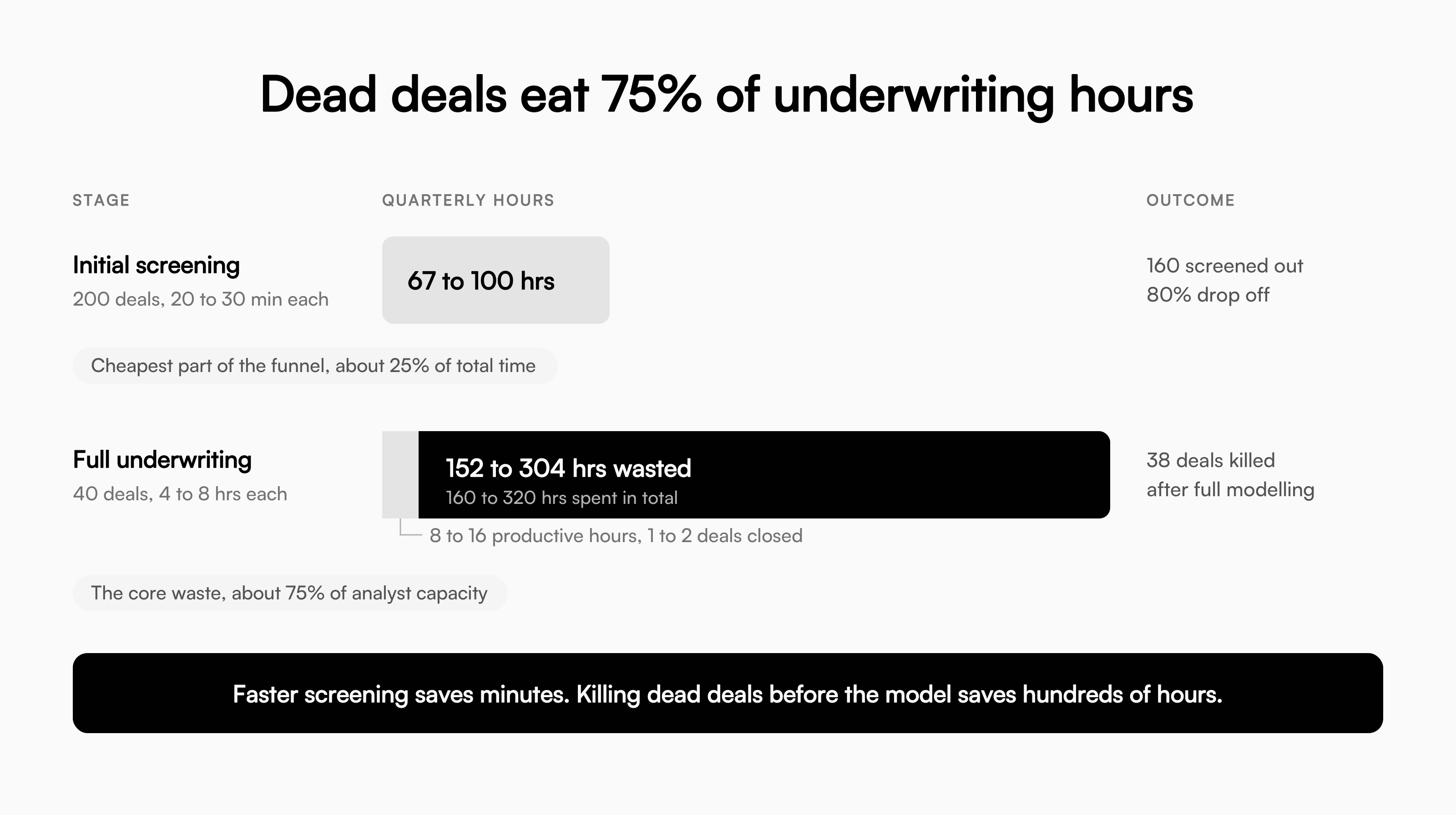
Think about the math: you're likely screening 15 deals a week, spending up to 100 hours a quarter just checking the "buy box." About 80% of those deals die instantly. The survivors move into full underwriting, where things get expensive. Pursuing a deal seriously takes between four and eight hours as you build stress cases and run sensitivities. That's another 300+ hours spent mostly on manual modelling.
By the end of the quarter, your team has burned hundreds of hours-effectively the entire capacity of a full-time analyst just to close one or two deals.
Here’s the real problem with the current AI for real estate underwriting landscape: out of every 40 deals you fully underwrite, 38 will produce absolutely nothing. Yet, those 38 "dead" deals still ate up hundreds of hours of high-value work.
Most AI commercial real estate underwriting tools are sold to help you screen faster, but that's the cheapest part of your funnel. The real waste is in those 38 dead underwrites. To actually transform your real estate investment ops, you need AI agents for proptech investment that attack the waste where it hurts most.
Three activities wear one word and have completely different automation profiles. Most underwriting software prices them as though they were the same job.
Reading an OM against a buy box. High volume, low complexity, and the part vendors have automated most successfully because it is the easiest thing to demo. Worth fixing. It is a quarter of your hours.
Pulling the rent roll, T-12 and operating statement into your model. Document work rather than judgment work, and where AI underwriting real estate tools deliver their most defensible gains. An analyst copying figures from a PDF into a fourteen-tab template is doing something a machine does faster and, with provenance, more consistently.
Assumption setting, stress cases, debt sizing, sensitivities, and the rebuild that follows every changed assumption. Four to eight hours, repeatedly. This is where the 152 to 304 wasted hours sit, and it is the number nobody puts on a slide.
Screening fatigue. An analyst on deal fourteen of the week applies less rigour than on deal two, so the failure is not only wasted hours but inconsistent standards across a pipeline. Consistency is what software is actually good at, and it is undersold relative to speed.
Because the bottleneck is not modelling speed. It is how late the kill decision happens.
A deal that dies at investment committee after six hours of underwriting cost you six hours. The same deal, killed in hour one because a fatal assumption surfaced early, costs you one.
Do that arithmetic too. Cutting model-build time from six hours to four saves two hours on all 40 deals, so 80 hours a quarter. Surfacing the deal-killer in hour one saves five hours on the 38 that die, so 190 hours a quarter. Same technology budget, more than twice the return, and the second version also reaches a decision days earlier on the deals worth pursuing.
The killers repeat, deal after deal, and every one is checkable from documents already in the folder before anyone builds a waterfall. These are the thresholds we typically start from, tuned per client and asset class.
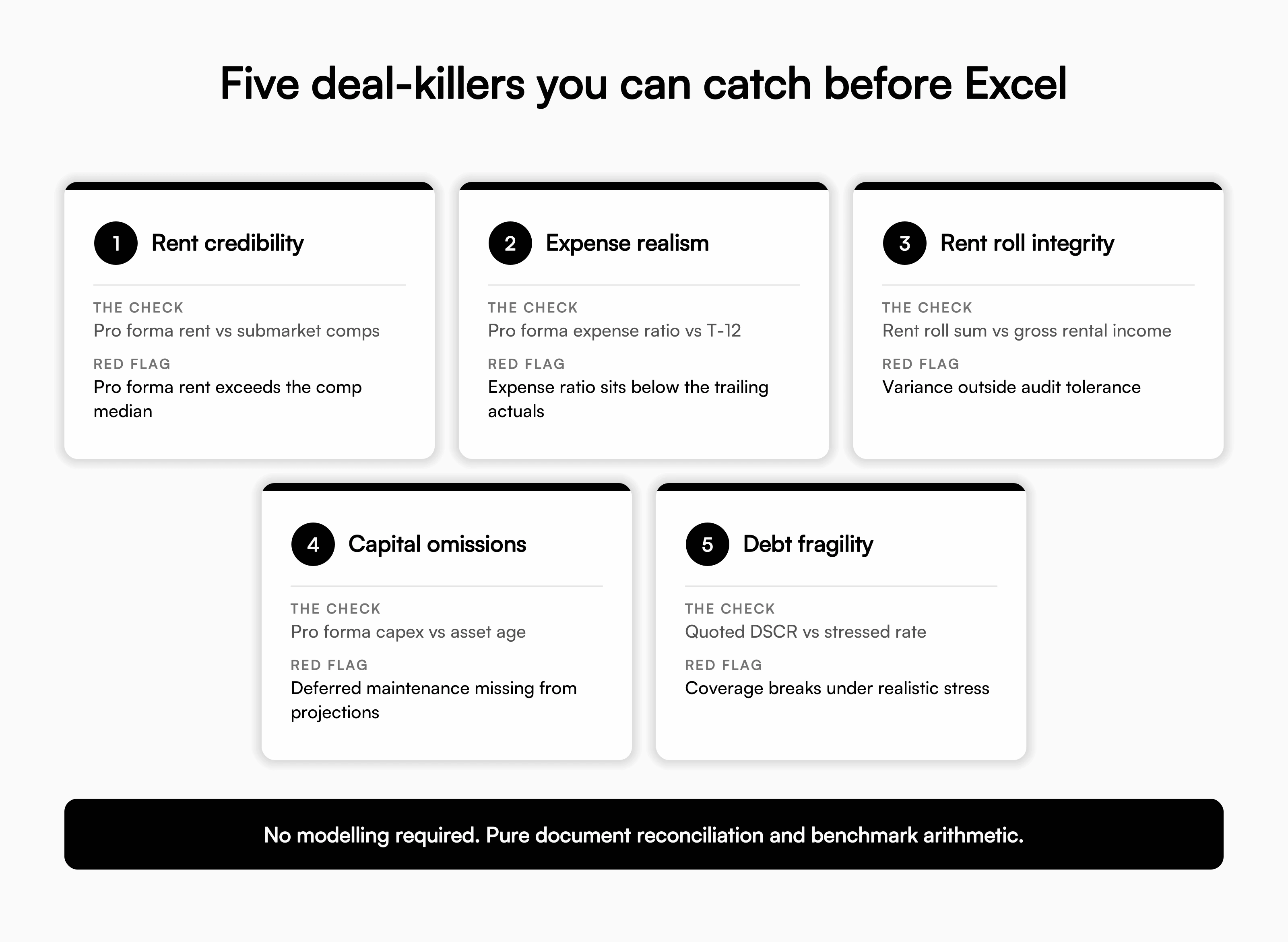
Note what these have in common. None requires a finished model. None requires judgment. All five are arithmetic run against documents you already hold, which makes them exactly the work to hand to an agent.
Not a model. A one-page deal-killer report, delivered before the analyst commits the afternoon, reading roughly like this:
Pro forma rent of $1,850 sits above the submarket comp median of $1,690, with the three closest comparables at $1,640, $1,700 and $1,725. Pro forma expense ratio of 32% sits below the T-12 actual of 41%. In-place rents on the rent roll sum to $2.41m against T-12 gross rental income of $2.38m, a variance worth a question to the broker. Every figure carries a document and page reference.
An analyst reads that in three minutes and either kills the deal or knows exactly which three questions to ask. That is the product. Building the model faster is a different and less valuable one.
A second-order effect worth naming. A broker circulating an OM on Monday sees LOIs land within days. A team that moves from OM to a credible view in hours rather than a week is bidding on deals while the slower team is still modelling. Deal underwriting speed and accuracy are not separate goals; being early is part of being right.
Document work, normalisation and cross-checking. Not valuation judgment. Being precise about that boundary is what separates a system that survives IC scrutiny from one that gets switched off in month three.
The mature capability. From an OM, rent roll and T-12, an agent reliably pulls unit mix and count, in-place rent by unit type, lease expiry schedule, concessions, other income lines, trailing operating expenses by category, real estate taxes, insurance, management fee basis and stated capital items.
Harder than extraction and worth more. Three cross-checks matter most: do the leases match the rent roll, does the rent roll match the T-12, and does the OM narrative match either. Discrepancies between source documents are where fatal problems hide, and reconciling a hundred-tenant property by hand is precisely the work that gets skipped when three other deals are live.
Pressure-testing broker assumptions against market data. An agent can establish that the OM's rent growth assumption sits above every comparable in the submarket, which is a fact, and leave the judgment about whether that is defensible to the person who answers for it.
AI underwriting automation platforms can populate your existing template. The distinction between a useful system and a dangerous one is whether generated formulas are structurally correct: a year-two NOI that references year one through a growth formula, not a hardcoded number that silently stops updating when an assumption changes.
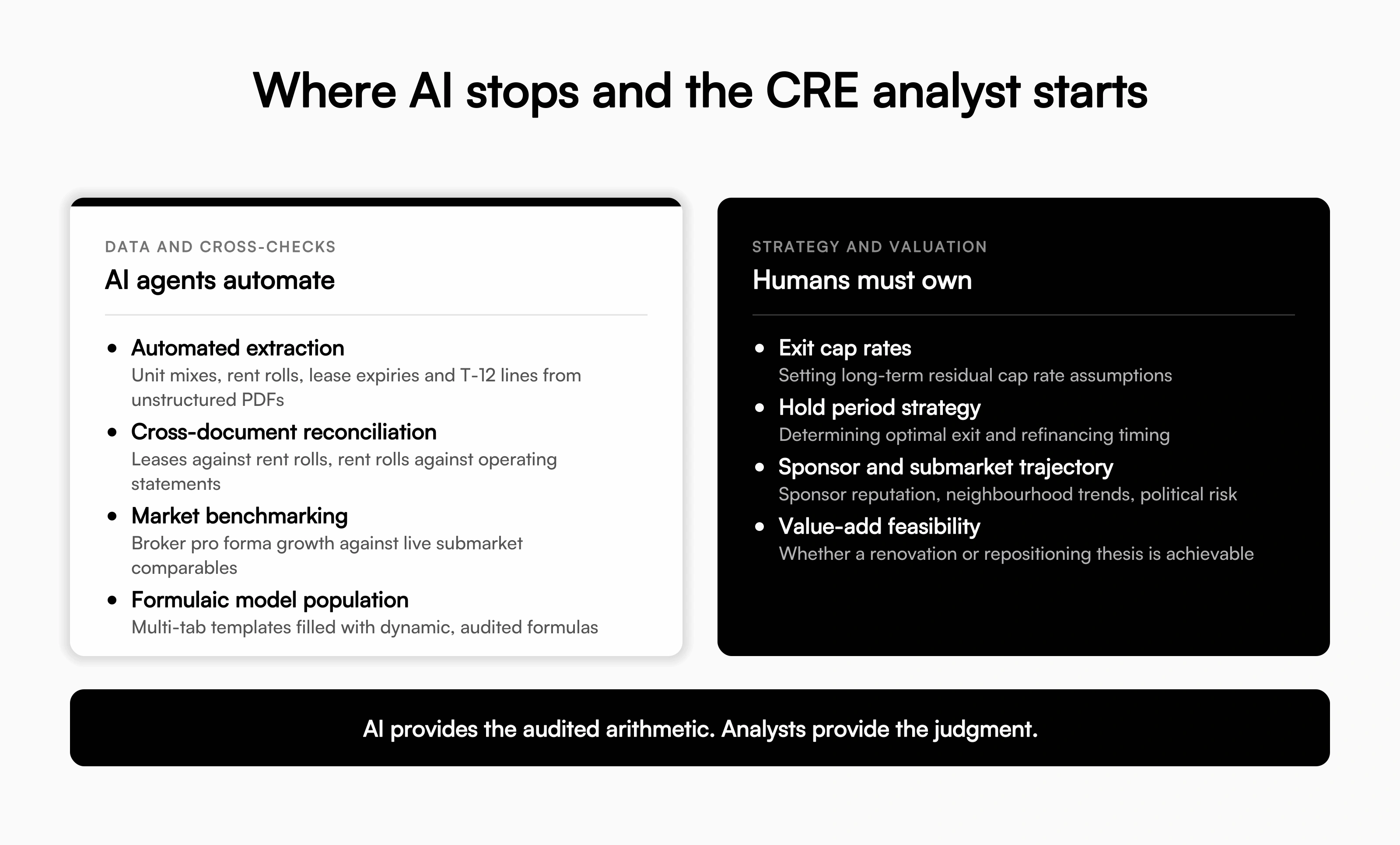
Set the exit cap. Choose the hold period. Judge sponsor quality or submarket trajectory. Decide whether a value-add thesis is credible. Anything where the answer is a view rather than a calculation stays with the person whose name goes on the recommendation.
Provenance. Every number traceable to the document and page it came from, in one click.
A misplaced decimal in a rent roll extraction changes an acquisition decision. The control is not a higher accuracy claim, it is the ability to check. When an IC member asks where the $4.2 million operating expense figure came from, the answer must be a location in a source document, not an assertion about model quality.
Every place the source documents disagree, with both figures side by side. Analysts read it in three minutes and it changes the questions they take to the broker. Often more valuable than the model itself, and almost nobody ships it.
Underwriting gets rebuilt every time an assumption moves. Track which assumption changed, who changed it and what it did to the return, so the IC conversation is about the decision rather than about which version of the spreadsheet is current.
A fourteen-tab model refined over hundreds of deals encodes real institutional knowledge. Systems that replace it with their own format lose an argument they did not need to have. The best AI tools for underwriting CRE deals populate the model you already trust.
The market for AI commercial real estate underwriting tools splits by seat rather than by quality, so compare inside a category. Equity-side acquisitions and loan underwriting are different products with different vendors, and buying across that line is the most common procurement mistake here.
Buy when your workflow matches a vendor's template, which is most teams. Build when the workflow is the differentiator: mixed asset classes no template covers, a proprietary model you will not abandon, or kill criteria specific enough that generic screening produces noise rather than signal.
The honest test is whether you can describe your underwriting process in a way a vendor's demo already handles. If yes, buy. If the demo needs three exceptions before it fits, that is a custom AI agent development conversation, and it should start by mapping the process rather than by writing code.
Here is what cuts against everything above, and the risk nobody in this category discusses openly.
False negatives at the top of the funnel are invisible. When an agent wrongly advances a bad deal, you find out during underwriting and you fix the rule. When an agent wrongly kills a good deal, nothing happens. The deal disappears, someone else buys it, and no feedback ever reaches your system. You cannot measure an error you never observe.
That has a specific consequence for tuning. A screening agent optimized to reduce analyst hours will over-kill, because over-killing is free in the metrics and expensive in reality. Three corrections work: route borderline cases to a human rather than to a pass, accept a lower automation rate at the margin, and sample killed deals periodically to check whether the rule has drifted.
The teams doing this well track something most do not, which is how many deals they killed that later traded at or above their own underwriting. It is an uncomfortable report and it is the only honest measure of whether the screening layer is working.
Codiste builds underwriting and deal-ops agents for real estate investment teams, starting with a map of your actual process rather than a demo of ours. If your analysts are spending afternoons on deals that were never going to close, our AI agent development services begin by finding out where the hours go.

CTO & Co-Founder | Codiste
Nishant builds where ambitious ideas meet production reality. As CTO & Co-Founder at Codiste, he has helped ship 150+ AI systems. Through The CTO Story, he gets technical leaders talking about what rarely makes the slide deck: the trade-offs, failures, and decisions behind what actually ships.


Every great partnership begins with a conversation. Whether you're exploring possibilities or ready to scale, our team of specialists will help you navigate the journey.