
Artificial Intelligence
February 20, 2025

Building a single AI agent is easy. Building a multi-agent AI system that doesn't hallucinate itself into a loop is the real challenge. The world of multi-agent AI frameworks has changed from experimental research projects to strong, production-grade engines as we go toward 2026.
If you are an AI architect or a developer in charge of managing complicated workflows, you need more than simply a library. You are looking for the best multi-agent framework that balances developer ergonomics with enterprise-scale reliability. Whether you need the role-playing simplicity of CrewAI, the conversational depth of Microsoft AutoGen, or the stateful precision of LangGraph, choosing the right LLM agent architecture is the most critical decision you will make this year.
In this guide, we break down the best multi-agent LLM framework options available today, comparing them across performance, ease of use, and production readiness to help you build smarter, more autonomous systems.
The shift from "prompting" to "agentic workflows" represents the biggest leap in LLM utility since the release of GPT-4. We are no longer asking a single model to do everything. Instead, we are designing a multi agent ai framework where specialized agents—researchers, writers, coders, and critics—work in tandem.
This change is happening because of a simple fact: specialized agents work better than generalist models. By using a dedicated AI agent orchestration layer, you can break down a massive task into manageable micro-tasks. This lowers the cost of tokens, cuts down on mistakes, and lets people step in at important points.
When evaluating the best multi-agent AI framework, you must look beyond GitHub stars. You need to consider how the framework handles state, how it manages "handoffs" between agents, and how easily it integrates with your existing data stack.
Pro Tip:
These frameworks aren't mutually exclusive competitors — they're complementary tools. LangGraph often serves as the orchestration backbone while delegating specific subtasks to CrewAI agents or AutoGen conversations, leveraging each framework's strengths simultaneously.
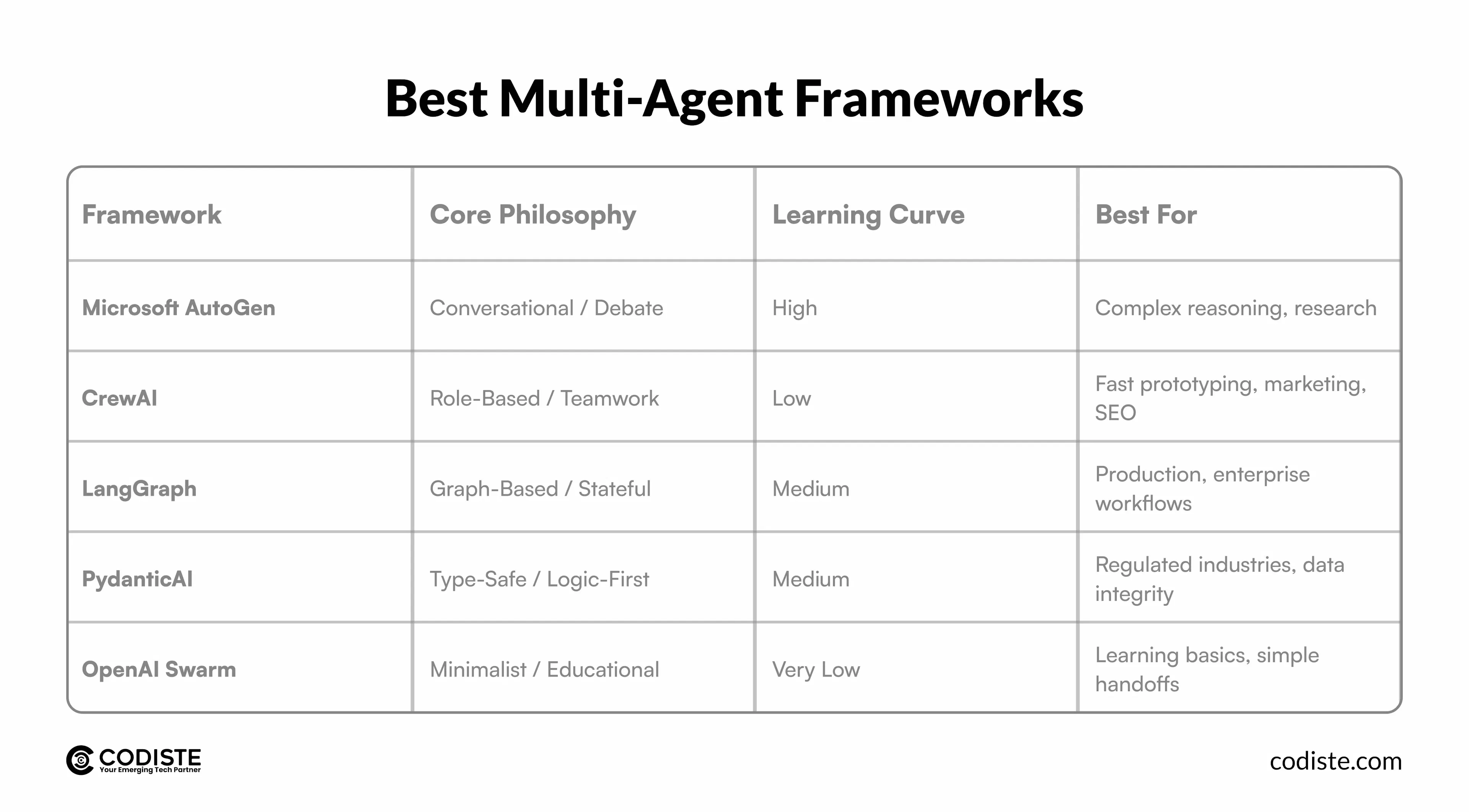
Originally a research heavyweight, Microsoft AutoGen has evolved into one of the best multi-agent frameworks for developers who need high degrees of customization. It treats agent interaction as a conversation, making it ideal for brainstorming, complex reasoning, and iterative problem-solving.
The primary appeal of Microsoft AutoGen lies in its flexibility. It supports diverse conversation patterns, including 1-on-1 chats, group chats, and hierarchical structures. AutoGen is hard to beat if your use case calls for agents to "debate" a solution before showing it to a user.
However, be prepared for a steeper learning curve. AutoGen’s procedural style means you often have to manually define the orchestration logic, which can become cumbersome for simple linear tasks.
If you want to get a multi-agent AI system up and running in minutes rather than days, CrewAI is often cited as the best multi-agent framework for Python. It is built on a "role-playing" philosophy where you define a crew of agents, assign them specific roles (e.g., "Senior Research Analyst"), and give them a series of tasks.
CrewAI excels at simplicity. It uses a declarative style that makes it feel more like leading a team of people than writing complicated code. It automatically handles the "handoff" between agents, making sure that the Output Agent always has the information it requires from the Research Agent.
The CrewAI vs AutoGen debate usually comes down to "Control vs. Speed." CrewAI is significantly faster to prototype with and offers better out-of-the-box "process" management (sequential, consensual, or hierarchical). AutoGen, while more complex, offers more granular control over the internal "thought" process of each agent.
For enterprise-grade applications, LangGraph has emerged as a powerhouse. Built by the LangChain team, it addresses the "black box" problem of many agent frameworks. Instead of letting agents wander freely, LangGraph allows you to define workflows as a directed graph.
What makes LangGraph a contender for the best agent framework is its persistence layer. It can save the state of a conversation at every node. If an agent fails or requires a human to approve a budget, the system can "pause" and "resume" without losing progress. This is non-negotiable for BOFU (Bottom of Funnel) applications where reliability is more important than creativity.
A new entrant in the best multi agent ai framework race is PydanticAI. Developed by the team behind the Pydantic data validation library, this framework is designed for developers who value type safety and "clean code" above all else.
In a multi agent llm framework, data often gets lost or corrupted as it moves between agents. PydanticAI uses Python type hints to ensure that the data passed from Agent A to Agent B is exactly what is expected. This reduces runtime errors and makes debugging significantly easier. If you are building a multi-agent AI system for a highly regulated industry like finance or healthcare, the structural integrity of PydanticAI makes it a top-tier choice.
When choosing the best agent framework for your specific needs, don't just look at the current feature list. Consider the long-term scalability of your LLM agent architecture.
Autonomous agents are great until they aren't. The best multi-agent framework should allow a human to step in, review an agent's work, and provide feedback before the process continues. This is a standard feature in LangGraph and is increasingly well-supported in CrewAI.
Privacy and cost are major concerns. Frameworks that allow you to swap GPT-4 for local models like Llama 3 or DeepSeek via Ollama or Hugging Face are superior. This "model-agnostic" approach prevents vendor lock-in and allows for hybrid architectures where a "cheap" local model handles simple tasks while an "expensive" model handles the final reasoning.
You cannot fix what you cannot see. Ensure your chosen framework integrates with observability tools like LangSmith or Arize Phoenix. To understand why a certain decision was made, you need to look at the "Chain of Thought" for each agent.
The best multi-agent LLM framework isn't just a toy; it’s a revenue driver. This is how businesses are employing these platforms now:
There is no one-size-fits-all method for choosing the best multi-agent framework. CrewAI is the best option if you prefer quickness and a natural "team" feel. If you need a robust, stateful system that can handle the complexities of a modern enterprise, LangGraph offers the precision you require. For those deeply embedded in research or the Microsoft stack, Microsoft AutoGen remains a powerful, if complex, ally.
The future of AI is not a better chatbot; it is a more efficient workforce of agents. By choosing the right best multi agent llm framework, you are setting the foundation for a system that doesn't just talk, but actually gets work done.
Are you prepared to use high-performance agentic workflows to revolutionize your development process? At Codiste, we focus on making AI solutions that are personalized to your specific company needs and can grow with you. Whether you are looking to implement a complex multi-agent AI system or optimize your existing LLM architecture, our experts are here to help you lead the market.



Every great partnership begins with a conversation. Whether you're exploring possibilities or ready to scale, our team of specialists will help you navigate the journey.