
Artificial Intelligence
February 20, 2025

Strategic ROI: Using generative AI business solutions is a strategic must deal with unstructured data and speed up decision-making.
The year 2026 marks a definitive shift in the corporate world. We have moved past the era of "AI as a toy" into the era of Generative AI business applications acting as the central nervous system of the modern enterprise. If 2023 was about the magic of a chat box, 2026 is about Generative AI in business, driving autonomous decision-making and real-time operational pivots.
Some Facts: For every $1 invested in generative AI, companies see an average return of $3.70, with financial services leading all industries at 4.2x ROI.
For many leaders, the "future" is no longer a roadmap item; it is a competitive necessity. From the way global logistics chains self-correct to how generative AI in fintech predicts market volatility before it happens, the applications are as diverse as they are disruptive. This article looks at the most important Generative AI use cases that are changing the way smart companies think about efficiency, ROI, and growth.
By now, most enterprises have integrated basic automation. However, the true power of Generative AI business models lies in their ability to handle unstructured data. In the past, software needed a rigid set of rules. Today, Generative AI in business applications understands context, intent, and nuance.
We are seeing a massive transition toward generative AI architecture that is "Agentic." This means that the AI can figure out what people want on its own. It watches a supply chain, recognizes that there is a delay in the Suez Canal, and automatically comes up with three alternate shipping routes and fresh cost-benefit analyses. This is the core of the generative AI business decision-making applications benefits: moving from reactive to proactive management.
Many businesses are still stuck in the "Copilot" phase, where AI is a sidekick. The winners in 2026 are building Generative AI in business layers that act as autonomous departments. If you don't think about how generative AI for businesses could link your CRM, ERP, and financial forecasting tools all at once, you're missing out on at least 30% of your operational efficiency.
Some Facts - Despite widespread adoption, 70–85% of AI initiatives still fail to meet expected outcomes, and 42% of companies abandoned most AI initiatives in 2025, up from 17% in 2024.
To understand the applications of generative AI, we need to look at how different industries use these models to solve problems that have been around for a long time, such as feeding data by hand, fraud, and burnout in the medical field.
The financial sector was among the first to move from experimentation to enterprise-wide deployment. Today, generative AI in fintech is much more than a customer service bot.
The generative AI application in healthcare is arguably the most human-centered. By 2026, "Ambient Clinical Intelligence" will have become the major focus.
AI in logistics has become the best way to make transferring products more efficient.
You cannot achieve high-level ROI with off-the-shelf, general-purpose models alone. The shift in 2026 is toward specialized generative AI platforms.
Successful Generative AI app development now relies on a hybrid model. Sensitive information, like patient records or financial ledgers, stays on private servers. Heavy processing, on the other hand, happens on scalable generative AI for business clouds. This ensures both speed and security.
To ensure your AI doesn't "hallucinate" (make things up), businesses are using Retrieval-Augmented Generation (RAG). By connecting your Generative AI in business applications to a private vector database of your company’s own documents, you ensure that every answer the AI gives is grounded in your specific business facts.
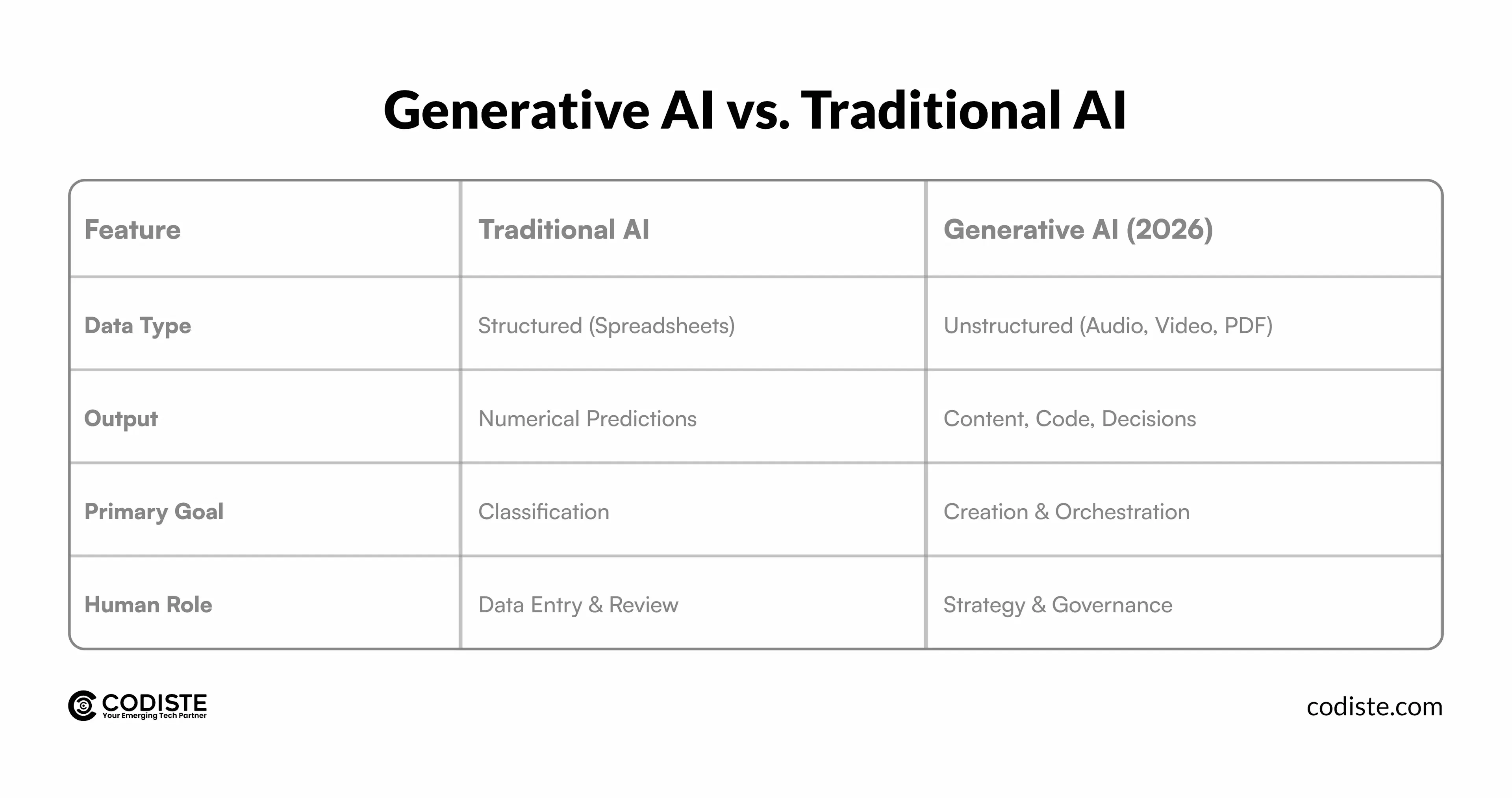
Adopting Generative AI in business is no longer about following a trend; it is about rewriting your operational DNA. The companies that will lead the next decade are those that view generative AI business applications as more than just a cost-cutting tool. They view it as a way to unlock human creativity by removing the burden of the mundane.
Whether you are looking to implement AI-Driven Credit Scoring in a fintech startup or want to streamline patient journeys through generative AI in healthcare, the foundation is the same: clean data, secure architecture, and a focus on solving real human pain points. The business applications of generative AI are limited only by the strategic vision of the leaders who deploy them.
Pro Tip: Top AI performers invest 70% of AI resources in people and processes not just technology. The model is the easy part. Change management is where most deployments stall.
At Codiste, we specialize in turning these "future" concepts into today's reality. We help you navigate the complexities of Generative AI app development and integrate generative AI for business layers that deliver measurable, high-impact ROI. Don't just watch the shift, drive it.
Contact Codiste today to schedule a consultation on how to leverage Generative AI business applications to dominate your industry.



Every great partnership begins with a conversation. Whether you're exploring possibilities or ready to scale, our team of specialists will help you navigate the journey.