
Artificial Intelligence
March 01, 2025

Choose an AI agent consulting company based on the problem blocking your progress. Large firms suit complex enterprise programmes, while specialists often fit startups, mid-sized businesses and focused implementation work.
Evaluate the actual delivery team, data readiness, testing methods, governance and ongoing support. Compare total costs over three years, and define measurable success before starting. A convincing demonstration is only the beginning; the partner must help you operate the system reliably.
A convincing AI demonstration can leave a business with a difficult question: who can turn it into something people actually use? Choosing an AI agent consulting company starts with understanding what is blocking progress, whether that is unclear priorities, unreliable data, complex integration or a lack of engineering capacity.
This guide explains how to match an AI consulting partner to your business needs and evaluate its services, costs and delivery approach. For founders and business leaders, the decision reaches beyond the initial build. It shapes how a system operates, who takes responsibility when it fails and whether your organisation can measure the results.
The strongest choice depends on your scale, readiness and operational requirements. Before comparing proposals or company reputations, identify the kind of support your situation demands.
Firms package services differently. Compare the work and deliverables behind each label. A proposal may combine strategy, development and support, but these address different needs. Understanding their boundaries helps you judge what the engagement will actually deliver and what your own team must contribute.
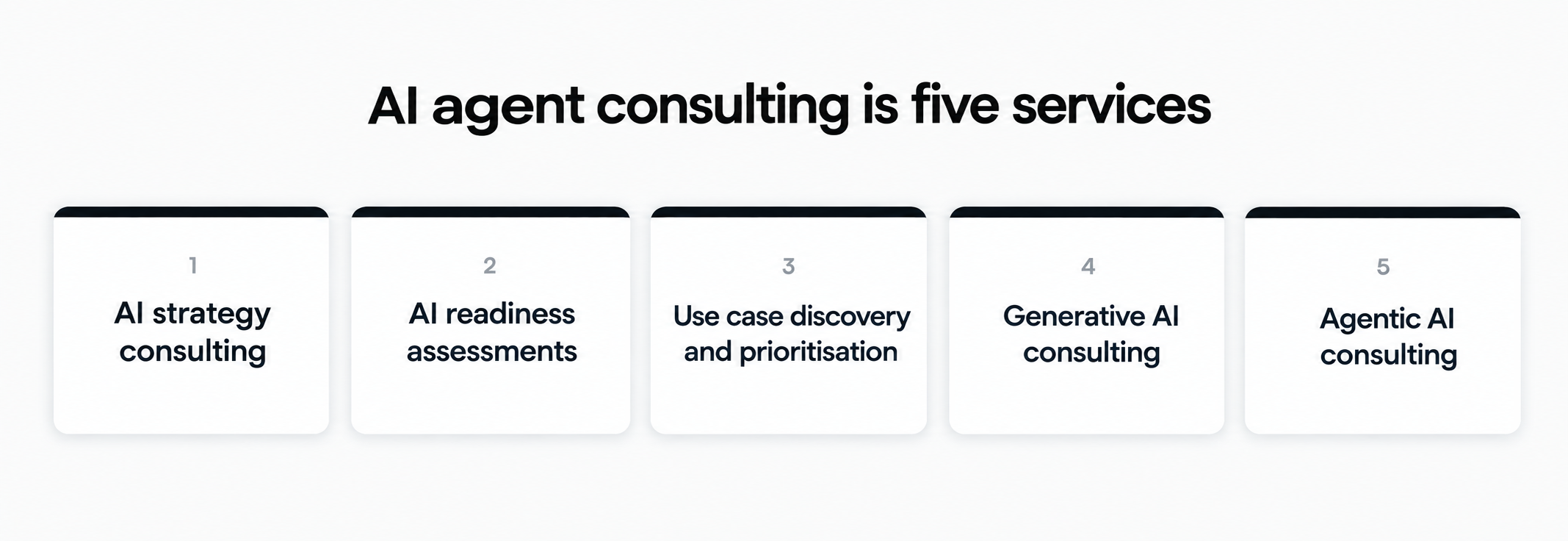
Responsible AI and governance addresses policy, bias, explainability, privacy, security, regulatory mapping and monitoring. Relevant frameworks include ISO/IEC 42001, the certifiable AI management system standard; the NIST AI Risk Management Framework; and the EU AI Act where applicable. None was designed for autonomous agents, and all require evidence of functioning oversight.
Consider Accenture and IBM Consulting. The challenge is rarely technical capability alone. A partner must staff a multi-year programme across geographies, navigate procurement, manage change for tens of thousands of employees and remain available in year three.
Accenture, IBM Consulting, Infosys and Cognizant serve large organisations; LeewayHertz and Codiste offer mid-market options. Production quality depends on retrieval, evaluation, security review and cost control at scale. Ask specifically how the firm evaluates its systems.
Consider BCG X, EY and Cognizant, alongside specialists Codiste and LeewayHertz. Agentic work is younger than generative AI, with sharper differences between firms. Examine failure handling: graceful degradation, tested human fallback, model version management and traces that reconstruct decisions months later.
Specialist AI development companies are almost always the better fit. Global integrators target larger engagements, and small accounts receive junior staffing. Prioritise senior involvement, a quick start and continuity between the people selling and delivering the work.
Consider McKinsey and QuantumBlack or BCG. When senior leaders disagree about what to automate, more engineering capacity will not resolve the problem. A capable development partner can still execute the wrong brief.
Options include specialist engineering firms and BCG X, IBM Consulting, Infosys, Cognizant, Codiste and LeewayHertz. Evaluate testing, observability, integration, costs and handover. Most enterprise AI programmes stall here, where focused firms usually outperform larger ones. A useful handover leaves your own team able to operate the system. Examine that requirement alongside evaluation suites and integration depth, because delivery includes what happens after the external development team leaves.
Define the business problem and measure the metric you want to improve. Assess internal AI maturity honestly: first-time adopters need different support from teams already operating production systems.
Then investigate technical expertise through specific questions about evaluation, retrieval and model deprecation. Seek case studies matching your industry, data maturity and scale. Establish whether the firm implements its recommendations or hands them over. Either arrangement can work, provided the responsibility is clear before the engagement begins. Generic AI credentials reveal little about these practical capabilities.
Review data handling, model access, audit logging and post-engagement data arrangements. Understand the engagement model and how scope changes affect it. Compare three-year economics: the initial build typically represents a minority of costs after integration, inference, governance tooling and maintenance.
Meet the actual delivery team, especially at large firms. Define KPIs using baselines from your systems. For an unproven use case, agree on a proof of concept with success criteria and a decision point. Finally, name the internal owner accountable eighteen months later; a consultant cannot supply that ownership.
There is no meaningful single average. Senior strategy and offshore engineering day rates can differ by an order of magnitude.
Costs depend on complexity, staffing and seniority, duration, models, infrastructure, data readiness, integration, security, regulatory obligations, custom development and maintenance. Data readiness is particularly easy to underestimate: accurate quotes require inspecting the inputs.
Published vendor and directory comparisons place global systems integrators at around $200 to $400 or more per hour, with substantial project minimums. Mid-market and specialist partners typically range from $125 to $250 per hour, with more flexible fixed-price or managed-service arrangements. Some specialists publish minimum engagements around $30,000. These figures are orientation, not independent research; confirm them directly.
Fortune Business Insights projects the AI consulting services market at roughly $11.9bn in 2026, reaching $73.9bn by 2034 at approximately 25.6% CAGR. The US market alone is estimated above $15bn. Gartner has placed the largest firms' combined share above 60% of global AI consulting revenue.
Match the commercial model to the work: fixed-price discovery for bounded assessments, time-boxed proofs of concept, or time and materials for uncertain scope. Dedicated teams suit augmentation when you provide architecture. Retainers support optimisation and maintenance, while global integrators handle enterprise transformation programmes. Outcome-based arrangements are growing; McKinsey reported around a quarter of its 2025 fees from them.
Delivery should connect business discovery to ongoing operation. The sequence matters because later work depends on the decisions and evidence established earlier. A readiness assessment may reveal that data or infrastructure needs attention before development can proceed. Allow the roadmap to reflect those constraints.
A scoped use case typically takes eight to eighteen weeks from discovery to production. Multi-agent systems in regulated workflows more often require six to nine months, including governance evidence and security review.
Brand recognition reduces career risk but does not guarantee the assigned team. Similarly, focusing on models distracts from outcomes: models rarely differentiate a programme and usually represent its smallest cost line. The people delivering the engagement, their integration experience and the operational support they provide deserve closer scrutiny than the sophistication of the demonstration.
Data quality problems often emerge around week six. Unclear processes, missing KPI baselines and governance postponed until approval create further obstacles. Automating inconsistency simply reproduces it faster. Compliance objections can require architectural changes, making late corrections expensive. Without a recorded starting point, even a successful deployment cannot demonstrate how much performance improved.
Buying strategy without implementation capability, or implementation without strategic clarity, can leave expensive documents. A proof of concept also requires substantial engineering before production. Without an internal owner eighteen months later, even a well-built system deteriorates.
Agentic AI leads demand. Gartner forecasts task-specific agents in 40% of enterprise applications by the end of 2026, up from under 5% in 2025. Consulting is shifting towards orchestration, permissions and audit trails.
Governance influences purchasing. Enterprise procurement increasingly requests ISO/IEC 42001 certification. The NIST AI Risk Management Framework has become a de facto maturity benchmark.
Outcome-based pricing is spreading. McKinsey's roughly 25% share of 2025 fees illustrates the shift. Contracts must define results precisely when payment depends on them.
Consulting teams are changing. Generative AI handles research and presentation work traditionally assigned to junior analysts. BCG expanded headcount towards AI engineers, while McKinsey reduced staffing by around 10%.
Evaluation is a named deliverable. Buyers increasingly request test suites, scoring rubrics and named owners for repeat evaluations. These demonstrate whether a firm can deliver operational systems.
These editorial judgements reflect published capabilities, disclosed practice scale and documented work. They are not benchmark scores. Use the comparison to guide a shortlist, then investigate the proposed team and its experience with your particular constraints.
The right AI consulting partner fits your organisation's immediate constraint and can support the system after launch. Evaluate firms through delivery evidence, realistic lifetime costs and clear accountability, with the same attention you give their strategic recommendations.
As agents take on more actions and governance becomes part of purchasing decisions, the quality of implementation matters beyond the demonstration. Your next step is to write a brief that names one business problem, records its current performance and defines the evidence a partner must provide. Use that brief to compare proposals on equal terms. Choose the team you can trust with the system when the presentation is over.
Talk with our AI agent consulting team to discuss your business problem, assess your requirements, and define the right approach for implementation.



Every great partnership begins with a conversation. Whether you're exploring possibilities or ready to scale, our team of specialists will help you navigate the journey.