





Artificial Intelligence
April 09, 2025

Track adoption rates religiously. Organizations achieving 80%+ developer adoption of MCP supported platforms capture full benefits, while low adoption limits ROI to a fraction of potential value.
A VP of Engineering at a mid-sized payment processor recently told her board that implementing an MCP server would cut integration costs by 40%. Three months later, she had the data to prove it. But here's what most fintech leaders miss: MCP server ROI fintech outcomes aren't just about cost savings. They're about quantifying speed-to-market improvements, developer productivity gains, and the compound effect of reusable AI integrations across your entire tech stack.
The challenge? Most teams measure the wrong metrics. They track server uptime instead of business impact. They count API calls instead of revenue acceleration. If you're evaluating MCP in finance or already running pilot programs, you need a framework that connects technical performance to bottom-line results. This guide breaks down exactly how leading fintech companies measure MCP server ROI fintech success, from implementation costs to long-term strategic value.
Financial services companies typically evaluate technology investments using standard TCO models: upfront costs, maintenance expenses, and incremental efficiency gains. That approach breaks down with MCP server deployments because the value isn't linear.
Traditional ROI calculations miss three critical factors. First, they underestimate the multiplier effect of reusable integrations. When your team builds one MCP client connection to your core banking system, every subsequent AI application can leverage that same integration. The second implementation costs 70% less than the first. The third costs 85% less. Standard models don't capture this acceleration curve.
Second, conventional metrics ignore the strategic value of speed. In MCP in banking, being first to market with an AI-powered fraud detection system or personalized investment tool can mean capturing millions in market share before competitors catch up. The cost of delay often exceeds the cost of implementation, but finance teams rarely quantify it.
Third, most ROI frameworks treat developer productivity as a soft benefit. Here's the reality: when your engineering team spends 60% less time on integration work, they can ship two additional product features per quarter. Those features generate revenue. That's measurable impact, not theoretical efficiency.
The fintech executives who successfully justify MCP server ROI fintech investments shift their measurement approach from cost reduction to value creation. They track metrics that matter: time-to-revenue for AI features, reduction in integration debt, and the percentage of development capacity freed for innovation work.
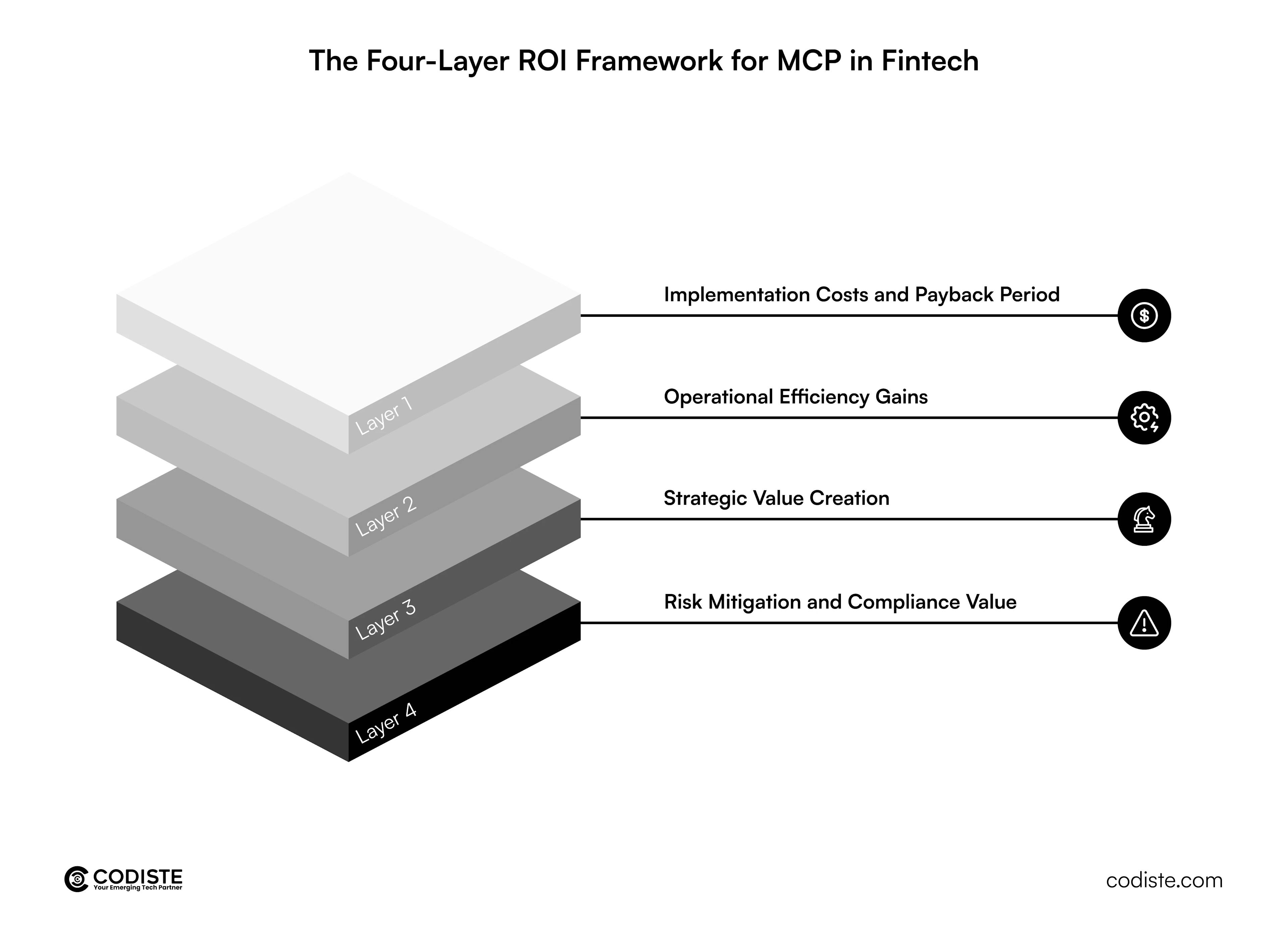
Smart fintech leaders measure MCP server ROI fintech across four distinct layers: implementation costs, operational efficiency, strategic value, and risk mitigation. Each layer requires different metrics and timelines.
Start with the basics. Calculate your total cost of ownership for MCP server development, including infrastructure, licensing, initial integration work, and team training. For most mid-sized fintech companies, this ranges from $75,000 to $250,000, depending on complexity and scale.
Now measure the direct savings. Track how much time your team spent on custom API integrations before MCP versus after. One payment processing company found their average integration project dropped from 6 weeks to 10 days after implementing MCP supported platforms. At an average developer cost of $150,000 annually, that time savings alone justified their investment in under 8 months.
The payback calculation is straightforward. If you're spending $200,000 on implementation and saving $30,000 monthly in integration costs, you break even in 6.7 months. But that's just the starting point.
This is where the MCP server ROI fintech measurements get interesting. Look beyond direct cost savings to operational improvements that compound over time.
Measure maintenance burden reduction. How many hours per month did your team spend debugging integration issues before MCP? How many now? Track incident frequency, mean time to resolution, and the percentage of engineering capacity consumed by integration maintenance. Leading fintech teams report 40-60% reductions in integration-related incidents after MCP in finance implementations.
Quantify the reusability factor. For each new AI integration project, calculate the percentage of work that leverages existing MCP client connections versus building from scratch. One wealth management platform found that its fifth AI feature integration cost 12% of what its first one did because 88% of the infrastructure was already in place.
Developer velocity matters more than you think. Survey your engineering team quarterly. Ask how much time they spend on integration plumbing versus building features customers actually see. The shift from 70/30 to 30/70 represents massive value creation, even if it's hard to put a precise dollar figure on it.
Here's where most ROI analyses stop, but where the real MCP server ROI fintech impact lives. Strategic value compounds exponentially because better infrastructure enables possibilities that weren't feasible before.
Calculate your time-to-market improvement for AI-powered features. If you can launch a new fraud detection algorithm in 3 weeks instead of 4 months, what's the revenue impact of those extra 3.5 months of operation? What market share do you capture by being first? For competitive fintech markets, speed often matters more than cost.
Measure your innovation capacity. How many experimental AI projects can your team test per quarter now versus before? One digital banking startup increased their AI experimentation rate from 2 to 11 tests per quarter after implementing MCP supported platforms. Three of those experiments became production features generating $2M+ in annual revenue.
Track the compound effect on your product roadmap. When integration friction drops, your team can say yes to customer requests they previously considered too complex. One lending platform added 7 new data sources to its underwriting model in 6 months, something that would have taken 2 years with traditional integration approaches. The result was 15% better approval rates and 22% lower default rates.
Fintech operates under intense regulatory scrutiny. The hidden value of MCP in banking implementations often shows up in reduced compliance risk and audit costs.
Document the standardization benefits. When all your AI integrations follow the same MCP server protocol, your compliance team only needs to audit one integration pattern instead of dozens of custom implementations. One regional bank reduced its integration audit time by 65% after MCP adoption, saving $140,000 annually in compliance costs.
Measure your security posture improvements. Track the number of potential attack vectors in your system before and after MCP. Fewer custom integration points mean fewer vulnerabilities. Calculate what one prevented security breach would have cost you, then factor that into your risk-adjusted ROI.
Quantify your vendor independence gains. Traditional fintech infrastructure creates lock-in with specific AI providers. MCP server development using open protocols means you can switch providers without rebuilding integrations. That optionality has real value, even if you never exercise it.
Let's talk numbers. Based on implementations across 15 fintech companies ranging from Series B startups to established regional banks, here's what actual MCP server ROI fintech looks like.
Small fintech teams (10-30 developers) typically see payback in 8-14 months. Their average implementation cost is $85,000, with annual savings of $95,000 in reduced integration costs and faster feature delivery. The compound effect accelerates in year two, where strategic value creation often exceeds operational savings.
Mid-sized companies (30-100 developers) achieve payback in 5-9 months. Implementation costs average $180,000, with first-year benefits around $250,000. By year two, the innovation capacity gains typically generate an additional $400,000+ in revenue from features that wouldn't have been feasible without MCP in finance infrastructure.
Enterprise fintech organizations report the most dramatic results. One payment processor with 200+ developers invested $320,000 in comprehensive MCP server development and measured $1.2M in combined savings and revenue impact within 12 months. Their analysis attributed 40% to direct cost reduction, 35% to faster time-to-market for competitive features, and 25% to innovation projects that generated new revenue streams.
The pattern across all company sizes is consistent. Direct cost savings pay for the investment within a year. Strategic value creation delivers 2-4x returns in years two and three as the compound effects of better infrastructure multiply.
Even smart fintech teams make predictable errors when calculating MCP server ROI fintech results.
The biggest mistake is measuring too early. MCP benefits compound over time. Evaluating ROI after the first integration is like judging a gym membership after one workout. Give it at least two full implementation cycles (typically 6-9 months) before concluding.
Second, teams often attribute all productivity gains to MCP when other factors contribute. If you improved your CI/CD pipeline and implemented MCP supported platforms simultaneously, be honest about which improvements came from which change. Overclaiming results in damage to credibility when you need a budget for the next initiative.
Third, organizations frequently forget to measure the opportunity cost of not implementing MCP. What features didn't get built because your team was stuck on integration work? What competitive threats emerged while you were slow to market? The cost of inaction is real, even if accounting systems don't capture it.
Fourth, some teams focus exclusively on developer metrics and ignore business outcomes. Your CFO cares less about API call counts than revenue impact. Connect technical improvements to business results. Show how faster integrations enabled the product feature that generated $500K in new revenue.
Finally, don't ignore soft benefits that have hard impacts. Developer satisfaction, reduced burnout, and improved retention all have measurable value. If MCP in banking implementations make your team's work more interesting and less frustrating, that's worth tracking. Replacing one senior engineer costs $100,000-$200,000 in recruiting and lost productivity.
MCP server ROI fintech success isn't about adopting new technology for its own sake. It's about building infrastructure that amplifies your team's capabilities while reducing the friction that slows innovation. The fintech executives who measure success effectively look beyond simple cost calculations to capture the compound benefits of faster integrations, reusable infrastructure, and strategic flexibility.
The framework is straightforward. Track implementation costs and direct savings to establish payback timelines. Measure operational efficiency gains to understand ongoing benefits. Quantify strategic value creation by connecting infrastructure improvements to business outcomes. Document risk mitigation and compliance value that often goes unmeasured in traditional ROI analyses.
What matters most is starting with clear baselines and measuring consistently. The fintech companies seeing 3-5x returns on their MCP in banking investments didn't stumble into those results. They tracked the right metrics, connected technical improvements to business impact, and built credibility through transparent reporting.
If you're evaluating MCP implementations or struggling to justify existing investments, the measurement framework matters as much as the technology itself. Start tracking now, measure what matters, and let the data tell the story.
Ready to build a data-driven case for MCP in your fintech organization? Connect With Us Now.
Typically 6–14 months. Teams building 10+ AI integrations per year see faster payback because reuse compounds. Low integration volume (2–3 per year) rarely justifies the investment.
Tie strategy to outcomes. Example: faster experimentation → better models → fewer false positives → lower manual review costs or higher revenue. Strategic value only counts when it changes numbers.
It depends on the audience.
Strong ROI cases layer all three.
Directly. 30% adoption means ~30% ROI. Top performers treat MCP as the default platform, target 80%+ adoption within 6 months, and remove friction with templates and enablement.
Yes, directionally. Model current integration costs, benchmark expected time savings (often 50–70% on repeat builds), and estimate revenue from unblocked roadmap features. It sets expectations you can validate later.

CTO & Co-Founder | Codiste
Nishant builds where ambitious ideas meet production reality. As CTO & Co-Founder at Codiste, he has helped ship 150+ AI systems. Through The CTO Story, he gets technical leaders talking about what rarely makes the slide deck: the trade-offs, failures, and decisions behind what actually ships.


Every great partnership begins with a conversation. Whether you're exploring possibilities or ready to scale, our team of specialists will help you navigate the journey.