Days 1 to 5
Inside the work
Your engineer joins your standups, gets read access, maps one workflow end to end, and inspects the real data behind it, not the sample set.
Codiste engineers work inside your systems, permissions and release process to take AI from prototype to production. Start with a two-week free trial: no fee, no contract, keep whatever we build.











Unlike vendors who work from a requirements document, an FDE starts at your desk, watching how your team actually works. The solution fits your real workflow from day one.
Instead of passing work between scoping, coding, and deployment teams, one engineer builds it, deploys it, and connects it to the systems you already use. Nothing gets lost in handoffs.
While most projects end with a handover call and unread documents, an FDE walks your team through what was built, what to watch for, and how to report issues clearly.
You do not need to sign anything to find out whether this works. An engineer joins your team for two weeks, builds against your real systems, and demos on day 10. Then you decide.
Days 1 to 5
Your engineer joins your standups, gets read access, maps one workflow end to end, and inspects the real data behind it, not the sample set.
Days 6 to 9
They build a functioning slice of that workflow against your actual systems, with the permissions and failure paths it will meet in production.
10
You see it run. Continue into a scoped engagement, or stop there. No notice period, no invoice, no conversation you have to get out of.
The scoping document, the baseline measurements, and all code written during the two weeks stay with you. The IP was yours from day one.
Every engagement starts with the same free two weeks. What follows depends on how much is already built and how long you need the capacity.
 2 weeks
We map one workflow, inspect your data, and come back with a scoped build plus a working slice you can run.
 4 to 8 weeks
One AI workflow taken from a demo that works on clean data to a live release inside your systems.
 3, 6 or 12 months
A forward-deployed engineer inside your team, your repo and your standups. Continuous capacity for whatever ships next.
Four other ways to get AI into production, and where each one costs you time, ownership or control.
Handover is not a final email. These are the deliverables named in the engagement, and they belong to you whether we continue past the trial or not.
Your organisation, from the first commit
The test cases we judged quality against
Wired to your stack, not ours
Release, rollback and recovery steps
Written for your engineers, not for us
Live, recorded, with your team
A forward-deployed engineer is a software engineer who works directly with a client’s team to understand a business problem, build a solution, and deploy it in the client’s operating environment.
FDE stands for forward-deployed engineer. The role combines hands-on engineering with close involvement in how the software is used.
In the FDE model, discovery continues as the engineer builds. User feedback, system limitations, and production behaviour inform the next decision.
Codiste applies Forward-Deployed Engineering to AI products and workflows. Your embedded AI engineer works with your technical and business teams to connect model behaviour with the integrations, controls, and user experience the application needs.
Technology earns its place by helping the system perform. We assess the quality, response time, running cost, and data requirements of your use case before recommending the architecture. We build around your existing environment and select additional tools where the workflow requires them.
The first two weeks are the free trial. Everything after it is scoped from what those two weeks actually found.
Weeks 1 to 2 · Free
We speak with the people doing the job and review the systems supporting it. Together, we identify the bottleneck, establish a baseline, and agree what improvement would make the engagement worthwhile.

Weeks 3 to 6
Your engineer works with the relevant stakeholders and follows the agreed development and review process. Regular demonstrations make progress visible and bring real feedback into the build while changes are still inexpensive.

Weeks 5 to 8
We evaluate representative tasks, difficult inputs, permissions, and failure paths. Quality matters alongside response time, cost per completed task, and the amount of human intervention the workflow still needs.

Week 8 onward
We plan a controlled rollout, review behaviour in use, and address the issues it reveals. Documentation and knowledge transfer cover deployment, troubleshooting, and future changes, with ongoing support defined in the engagement.

Identify which workflow to build first and how it will connect with the systems you already run. Discuss your data access, permissions, and project scope with Codiste.
A useful AI application needs a deliberate path from a user’s request to a system’s response. For workflows that take actions, we design that path around explicit permissions and validation. The four controls beneath the path apply at every stage of it.
The request path
A user asks, from inside your product, with their identity attached.
What they may see and do is resolved before any model runs.
Only the records they are cleared for reach the model.
The model reasons over that context and proposes an action.
Application logic checks the proposal, then the system acts.

Connecting a data source does not give every user unrestricted access to its contents.

Consequential actions can require explicit confirmation or review before execution.

Missing information, failures and uncertain results get a response the user can understand.

Your team can trace errors and investigate changes in behaviour from the records kept.
Add an assistant, document workflow, or conversational interface to an existing product. Your FDE connects the AI behaviour to authentication, product data, and the experience customers already know.
Give support teams a workflow that retrieves relevant context, prepares responses, and performs approved actions. Measure resolution time and escalation quality alongside answer accuracy.
Connect lead intake with qualification, scheduling, and CRM updates. Design around current availability, consent requirements, and the point at which a salesperson should take over.
Extract agreed fields, validate them against business rules, and route exceptions for review. Track processing time, corrections, and the proportion of documents that still need manual work.
Bring engineering support into portfolio companies with different products and constraints. Establish shared delivery practices while keeping each company’s data, permissions, and product decisions separate.
Every industry carries its own systems, permissions and rules.
Our engineers work inside them, so what gets built fits the way the business already runs.
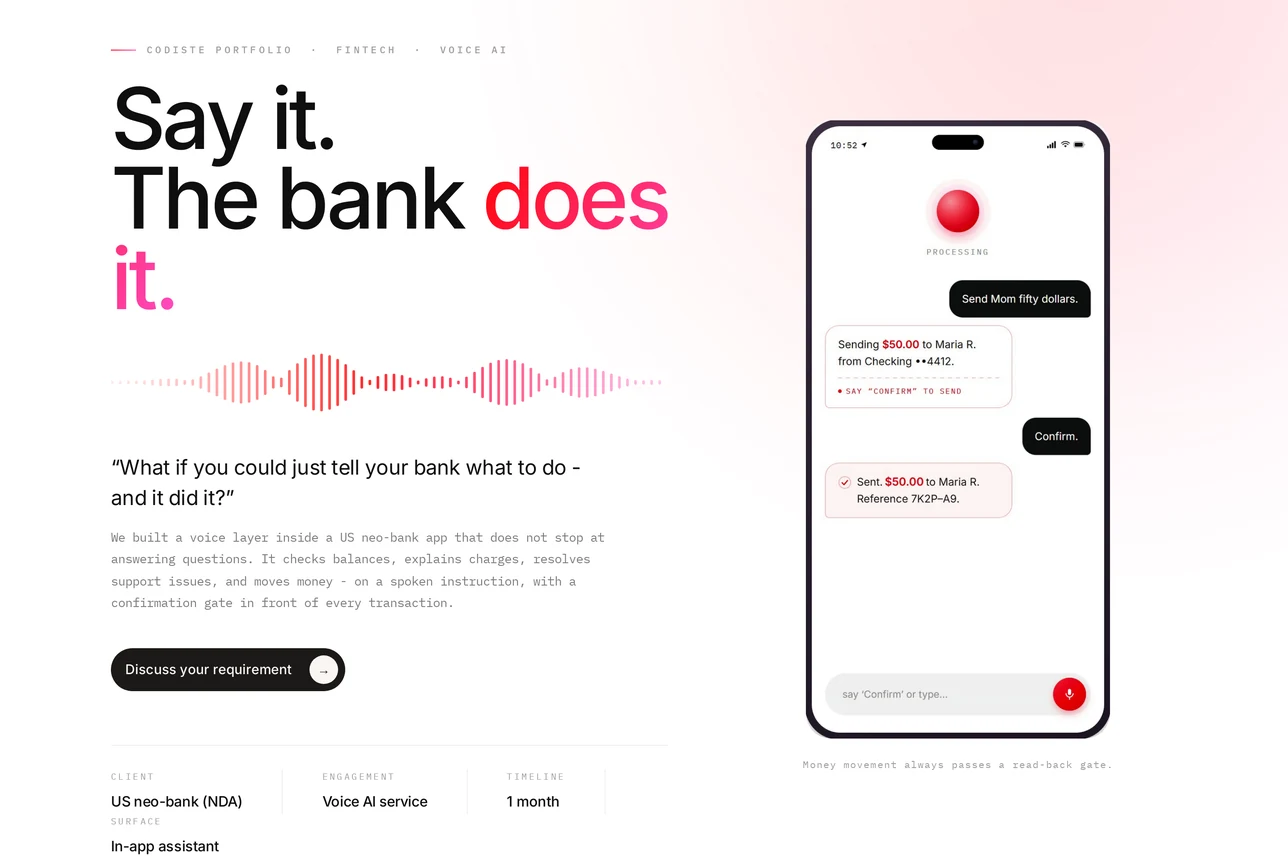
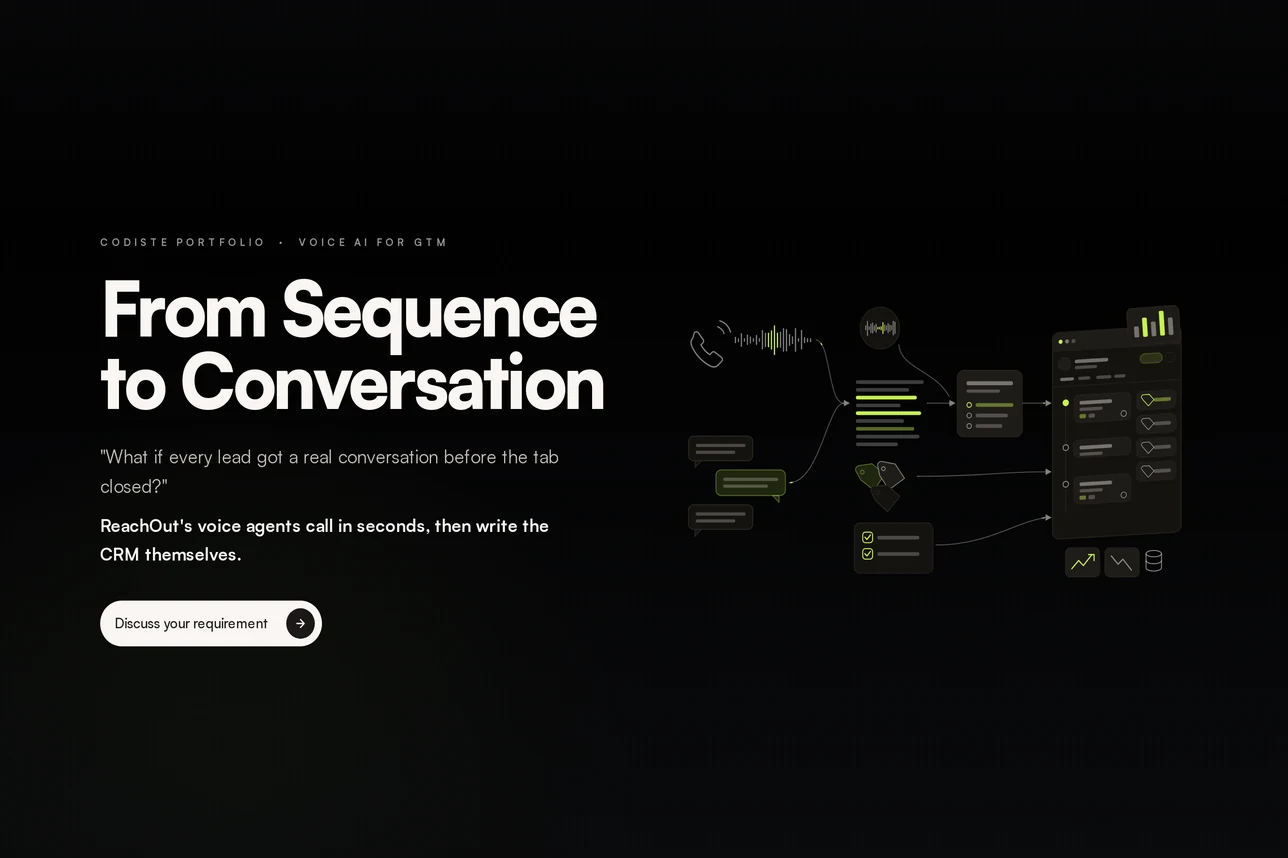
Codiste’s portfolio shows how AI capabilities connect with applications, live data, and operational controls.
Choosing a forward-deployed engineering agency means choosing the people who will make technical decisions close to your business. You need to understand how they work, what they can deliver, and how your team will judge the result.
Our published work spans voice interfaces, CRM workflows, financial applications, and personalised content. That experience matters when a feature depends on several systems working together.
We define the workflow and its acceptance criteria before expanding the build. Each release has a clear purpose: less manual processing, better enquiry handling, or a capability customers can use.
Handover covers how the solution is deployed, monitored, and changed. We agree the deliverables, ownership terms, and support so your team can plan what happens after launch.
Two weeks, no fee, no contract. If it is not working by day 10, you keep the scoping document and we part ways.
Every month an AI feature sits in demo, your team keeps doing the work by hand. An embedded engineer works inside your systems, your permissions, and your release process until the workflow runs without them.