AI Agents for AdTech DSP Ops: Bid Strategy Diagnostics in Real Time

AI Agents for AdTech DSP Ops: Bid Strategy Diagnostics in Real Time

Author : Nishant Bijani
Artificial Intelligence
Read time:11 minsUpdated:August 17, 2026

TL;DR

  • A DSP places a bid in under 100 milliseconds. The trader steering it works from a dashboard built on yesterday's log data. The auction runs in real time, the correction arrives tomorrow, and the budget spends through the gap.
  • The cost of the gap. The ANA put wasted programmatic spend at $26.8 billion in Q2 2025, roughly 15% of it flowing to made-for-advertising sites. Juniper estimated digital ad fraud drained about $84 billion.
  • Why reports miss it. The waste is thousands of small leaks, not one big one: MFA domains, bid duplication, invalid traffic, bid rules that were right last month. Each sits below the threshold a daily report makes obvious.
  • What agents do differently. They watch win rate, clearing price, pacing, supply-path quality and overbidding on every line item instead of the few a trader has time for, then hand back a reason rather than a number that moved.
  • The failure mode. An agent acting on unsettled signal will pause a converting line item on a dip and call it optimization. Diagnose continuously, gate automation behind confidence thresholds, keep a person on anything that moves real budget.
  • When it is not worth it. One bad placement is a five-minute query. Real-time diagnostics earns its cost when the number of things to watch exceeds what a team can watch, and when a one-day delay costs more than the pipeline.
  • One line: catch the placement bleeding at 2 p.m. and stop it at 2:01, instead of reading about it tomorrow.
A demand-side platform decides whether to bid on an impression, and how much to pay, in under 100 milliseconds. It makes that decision millions of times a second, across roughly 90% of all display advertising, which now trades programmatically. The machine runs in real time.

The people steering it do not. They optimize bid strategy from a dashboard that refreshed this morning, built on log data from yesterday. So the auction moves at the speed of light and the correction arrives by mail. That lag is not a reporting inconvenience. It is where the budget quietly bleeds out.

The useful way to picture a live campaign is a patient in intensive care. The vitals change by the second. A real ICU watches them continuously and acts the moment a number goes wrong. Most DSP operations, by contrast, read yesterday’s bloodwork over coffee and wonder why the patient looks pale. Bid strategy diagnostics in real time is the bedside monitor programmatic never had, and AI agents are what make it affordable to run.

Why is DSP bid optimization always one step behind?

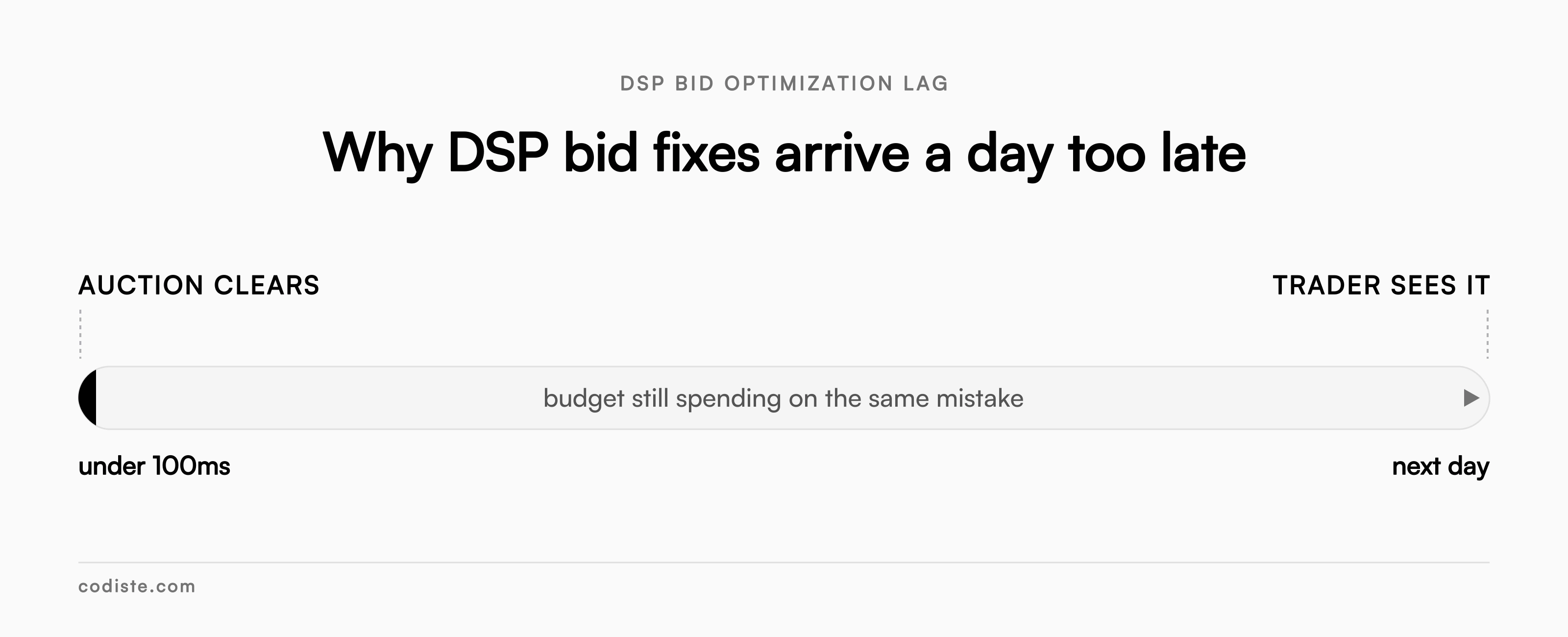
Because the auction clears in milliseconds while the feedback loop runs in hours. A trader sees that a line item overspent or underperformed only after the reporting pipeline has batched, processed, and surfaced it, by which point the money is gone and the next day’s budget is already committing the same mistake.
Why is DSP bid optimization always one step behind?

The gap is structural, the same shape in every seat:

  • Auctions are instant, reports are batched. Bids resolve under 100ms; most optimization data lands on an hourly or daily cadence.
  • Dashboards describe the past. A chart tells you a placement bled yesterday. It cannot tell you the placement bleeding right now.
  • Humans cannot watch every line item. A mid-size account runs thousands of placement-by-audience combinations at once. No trader can monitor them all live.
  • Signal arrives noisy and late. Conversions attribute hours after the click, so by the time performance looks real, the window to act on it has closed.
The result is a permanent one-day delay between a problem starting and a person seeing it. Across a quarter, that delay is not a rounding error. It is a line on the P&L.

What does "bid strategy diagnostics in real time" actually mean?

It means an always-on agent watching the live bid stream and its outcomes, explaining why performance is moving while it is still moving, and either flagging a human or acting within the same few minutes instead of the next day. Diagnosis first, then intervention, both in the loop rather than after it.

A diagnostic agent is not the DSP’s built-in bidding algorithm. That algorithm decides the price. The agent watches the algorithm and the market around it, and asks a different question: is this strategy still doing what we think it is doing? Concretely, it keeps eyes on the things a trader would check if a trader could check them every second, at once, forever:

  • Win rate and clearing price. Sudden shifts mean the market changed or a competitor did.
  • Pacing. A campaign burning its budget by noon is failing quietly, not loudly.
  • Supply-path quality. Which exchanges and domains the spend is actually reaching.
  • Overbidding. Paying far above the clearing price on impressions that would have won for less.

Read more

How much programmatic spend is actually wasted?

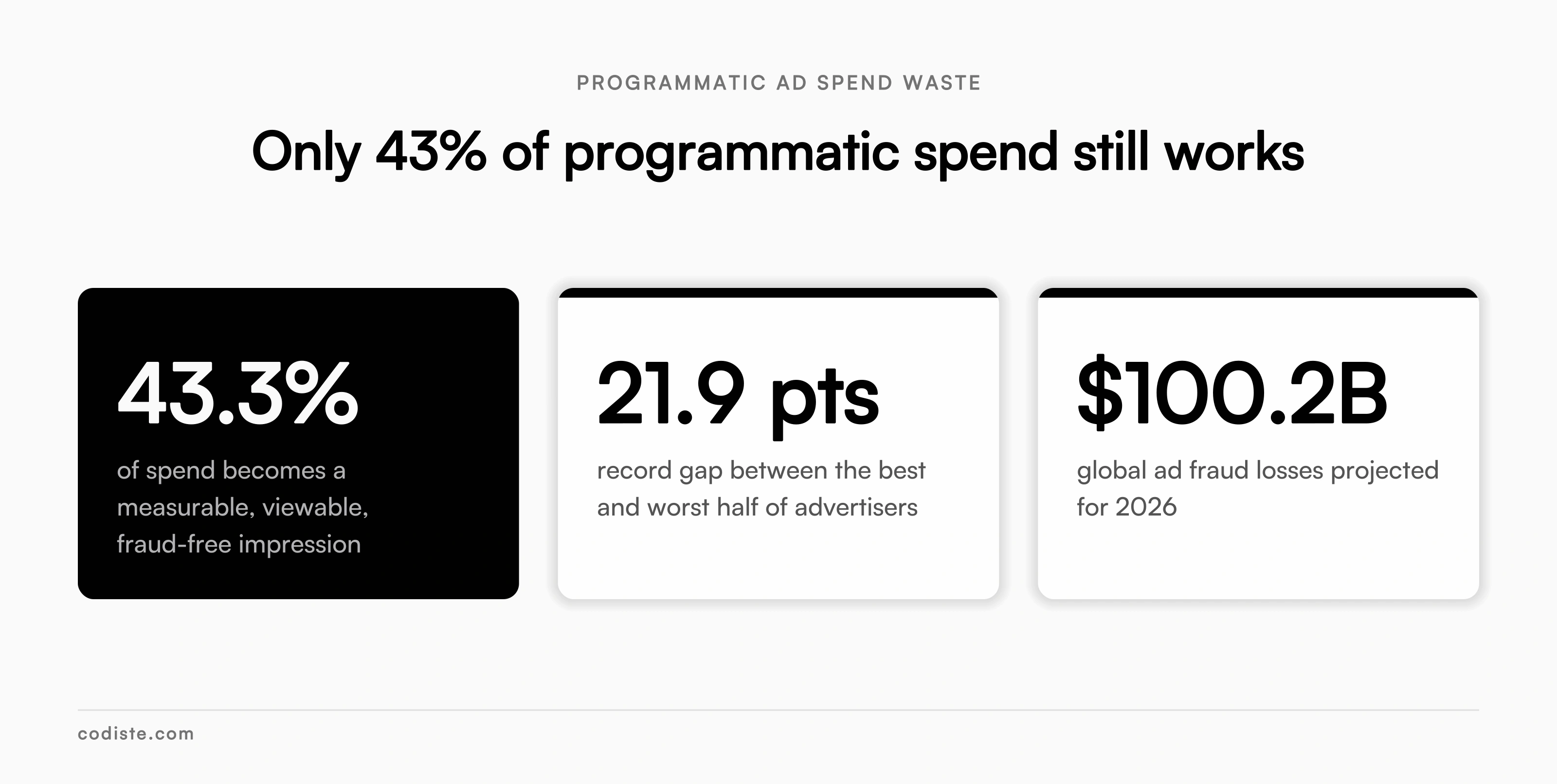
More than most boards would tolerate if they could see it in real time. The ANA's Q1 2026 Programmatic Transparency Benchmark found that just 43.3% of programmatic spend produces an impression that is measurable, viewable, fraud-free and off made-for-advertising pages. The rest leaks between the DSP and the consumer. And the loss is no longer evenly spread: the strongest half of advertisers convert 54% of spend into quality impressions, the weakest half 32.1%, a record 21.9-point gap. Juniper Research puts global ad fraud above $100 billion for 2026.
How much programmatic spend is actually wasted?

Those losses are not one big leak. They are thousands of small ones, each below the threshold a daily report makes obvious:

  • Made-for-advertising domains. Cheap impressions that clear easily and convert almost never, quietly eating pacing budget.
  • Bid duplication. The same impression arriving through several supply paths, so you compete against yourself and pay more.
  • Invalid traffic. Bots and fraud that look like performance until the attribution settles and the conversions evaporate.
  • Stale strategy. A bid rule that was right last month steadily overpaying this month because the market moved and nobody re-checked.
Every one of those is diagnosable in the bid stream as it happens. None of them is visible fast enough in a report built the morning after.

How AI agents diagnose bids in real time

They run three kinds of watch at once, continuously, on every line item rather than a sampled few. Each maps to a class of leak above.

An anomaly agent learns the normal band for win rate, CPM, and pace on each segment and raises a flag the moment a metric leaves it, with a plain-language reason attached instead of a raw alert. A supply-quality agent scores the domains and paths the spend is reaching and marks the made-for-advertising and duplicated inventory the moment it starts absorbing budget. A value agent compares what you paid against what the impression would have cleared for and surfaces systematic overbidding a human would never catch at auction speed.

A concrete case makes the difference obvious. A retargeting line item starts winning far more often at 11 a.m. because a single made-for-advertising domain flooded the exchange with cheap inventory. Batch reporting shows the spike as a win-rate improvement and a lower CPM, which looks like a good day, and the truth only surfaces a week later when conversions never arrive. A diagnostic agent sees the win-rate jump, ties it to one low-quality domain, and flags it before lunch. Same event, two very different bills.

The point is not more dashboards. It is a shorter distance between a leak opening and someone knowing, with the reason already worked out.

DimensionBatch reportingReal-time diagnostic agent
Feedback latencyHours to a full daySeconds to minutes
What it catchesYesterday’s loss, after the factThe leak while it is happening
CoverageSampled top line itemsEvery line item, continuously
OutputA number on a chartA diagnosis with a reason
ActionManual, next-day changeFlag or auto-throttle in the loop

Where this goes wrong, and how to keep it from thrashing

Real-time control without guardrails is worse than a slow report. An agent acting on every twitch in a noisy signal will pause a converting line item on a momentary dip, chase attribution that has not settled, and turn normal variance into a stream of needless changes. Speed amplifies bad judgment as readily as good.

The fix is to separate diagnosis from intervention. Let the agent diagnose freely and continuously, but gate any automated action behind a confidence threshold and a cooldown, and keep a human on anything that moves real budget. Act automatically only on the unambiguous waste, a known fraud domain, a made-for-advertising site, a duplicated path, and route the judgment calls to a person with the reason already attached.

And a blunter caution: if your problem is one bad placement, a query finds it in five minutes and you do not need an agent at all. Real-time diagnostics earns its infrastructure cost when the number of things to watch exceeds what a team can watch, and when the cost of a one-day delay is larger than the cost of the pipeline. Below that line, you are paying for telemetry on a bicycle.

Conclusion

A DSP places a bid in under 100 milliseconds. Most teams find out it was the wrong bid the next morning. Everything in that interval is spending.

That interval is where the ANA's $26.8 billion went in a single quarter, drained in amounts too small for a next-day report to make obvious. Domains that clear cheap and convert never. Duplicated paths that turn you into your own competitor. Bid rules that were correct last quarter and are overpaying now.

Agents shorten the interval to minutes, and they arrive with the reason already worked out. That second part is what a dashboard has never done.

Speed alone is not the win. An agent acting on unsettled signal will pause a converting line item on a momentary dip and call it optimization. Diagnose continuously, automate only the unambiguous waste, keep a person on anything that moves real budget.

The test for any vendor is simple. Showing you waste sooner is a faster dashboard. Telling you why it is happening while it is still happening is the bedside monitor.

Codiste builds real-time diagnostic agents for programmatic stacks: continuous, explainable, and gated so they catch the waste without thrashing the campaign. Start Your AI Agent Project

FAQs

What is real-time bid strategy diagnostics in AdTech? +
It is continuous, automated monitoring of a DSP’s live bid stream and outcomes that explains why campaign performance is changing as it changes, and flags or corrects issues within minutes. It replaces next-day dashboard review with in-the-loop diagnosis, so waste is caught while it is happening rather than after the budget is spent.
Why is DSP bid optimization usually so slow to react? +
Because auctions clear in under 100 milliseconds while reporting pipelines batch data on an hourly or daily cadence. A trader sees a problem only after it has already spent a day’s budget. The machine runs in real time; the human feedback loop does not, and that gap is where most programmatic waste hides.
Can AI agents actually reduce wasted programmatic ad spend? +
They can cut the categories of waste that are diagnosable in the bid stream: made-for-advertising domains, bid duplication, invalid traffic, and systematic overbidding. The ANA found $26.8 billion in wasted programmatic spend in Q2 2025, with about 15% going to made-for-advertising sites, most of it the kind of small, continuous leak agents are built to catch.
How is a diagnostic agent different from the DSP’s own bidding algorithm? +
The DSP algorithm sets the bid price. A diagnostic agent watches that algorithm and the market around it and asks whether the strategy is still working, catching drift, anomalies, and quality problems the bidder itself is not designed to flag. One decides the price; the other audits the outcome in real time.
Do AI agents replace media traders and ad ops teams? +
No. They automate the continuous watching no human can do at auction speed, and hand traders diagnoses with reasons attached. People still own strategy and any budget-moving decision. Agents remove the impossible monitoring load, not the judgment.
What is the risk of real-time automated bidding controls? +
Overreaction. An agent acting on noisy, unsettled signal can thrash, pausing good line items on momentary dips. The safeguard is to separate diagnosis from action: diagnose continuously, but gate automated intervention behind confidence thresholds and human review, automating only unambiguous waste like known fraud domains.
Nishant Bijani
Nishant Bijani
CTO & Co-Founder | Codiste
Nishant is a dynamic individual, passionate about engineering and a keen observer of the latest technology trends. With an innovative mindset and a commitment to staying up-to-date with advancements, he tackles complex challenges and shares valuable insights, making a positive impact in the ever-evolving world of advanced technology.
Relevant blog posts
Top 10 Real Estate Use Cases of Generative AI in 2026
Artificial Intelligence
April 18, 2024

Top 10 Real Estate Use Cases of Generative AI in 2026

How AI Agents Are Changing the Future of Digital Marketing?
Artificial Intelligence
February 21, 2025

How AI Agents Are Changing the Future of Digital Marketing?

AI in Credit Scoring: Why Traditional Models Are Failing Today's Borrower
Artificial Intelligence
September 26, 2025

AI in Credit Scoring: Why Traditional Models Are Failing Today's Borrower

Talk to Experts About Your Product Idea

Every great partnership begins with a conversation. Whether you're exploring possibilities or ready to scale, our team of specialists will help you navigate the journey.

Contact Us

Phone