





Artificial Intelligence
November 03, 2023

AI is changing every field, and human resources is no different. Generative AI is giving HR professionals new ways to think about work, talent, roles, and skills.
Companies are using AI-powered HR solutions to handle hiring quickly because they get more resumes than ever before. The numbers tell a strong story.
The market for AI in HR is expanding quickly. Experts predict that by 2027, it will amount to USD 17.61 billion.
HR executives are saying the following:
This article talks about how generative AI is changing the HR industry. We'll also give you expert advice on how to make it work.
Modern workplaces are being transformed by the collaboration of generative AI and HR. Companies using human resource AI don't just optimize operations; they build cultures of continuous improvement and employee focus.
Let's explore the top six generative AI hr use cases and their practical applications.
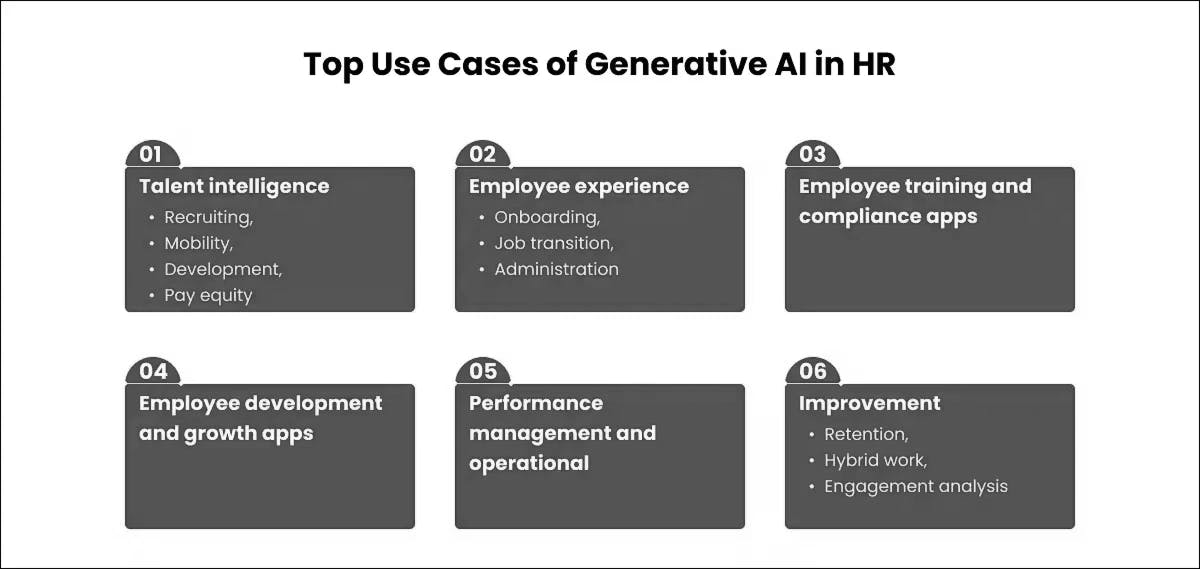
Generative AI for HR uses smart algorithms to look at huge amounts of data. This provides valuable insights into talent intelligence.
Key applications include:
AI systems can look at performance metrics to predict which applicants will do well. Pay equity algorithms make sure that everyone is paid fairly and help create workplaces that are diverse and welcoming.
HR specialists can design specialized training programs and spot skill gaps. As a result, talent management becomes more data-driven and strategic.
Gen AI in HR transforms employee experiences by streamlining onboarding, job transitions, and daily administration.
Benefits include:
HR professionals can focus on making employees' experiences more meaningful by automating routine tasks. AI helps match employees with jobs that fit their skills and career goals when they change jobs.
In human resources, generative AI is essential for training and compliance. It guarantees regulatory compliance while tailoring educational experiences.
AI programs look at data on how well employees are doing their jobs to suggest personalized training modules. These address specific skill gaps effectively.
Compliance apps powered by AI automate certification tracking and documentation. This reduces the risk of non-compliance significantly.
AI use cases in hr empower employees in their professional journey. The technology finds opportunities for personal development and recommends career paths that fit personal goals.
AI-driven mentorship programs match employees with mentors based on how well they get along. This encourages a culture of always learning.
Personalized development plans help employees learn the skills they need to move up in their careers. The result is a workforce that is more engaged and skilled.
AI applications in human resources enhance performance management by providing real-time feedback and operational insights.
Performance metrics are analyzed by the technology to deliver timely feedback. This allows for continuous improvement instead of yearly evaluations.
AI also finds problems with operations and suggests ways to make them better. This makes everyone in the organization more productive.
Generative AI for human resources tackles critical challenges including:
AI algorithms optimize hybrid work models, ensuring seamless collaboration between in-office and remote teams. Wellbeing apps offer personalized recommendations for healthy work-life balance.
AI-driven analytics evaluate factors impacting employee retention. This allows proactive measures to preserve top talent.
The incorporation of AI-powered hr solutions has become vital for companies staying competitive. Here are the transformative benefits of generative AI for hr professionals.
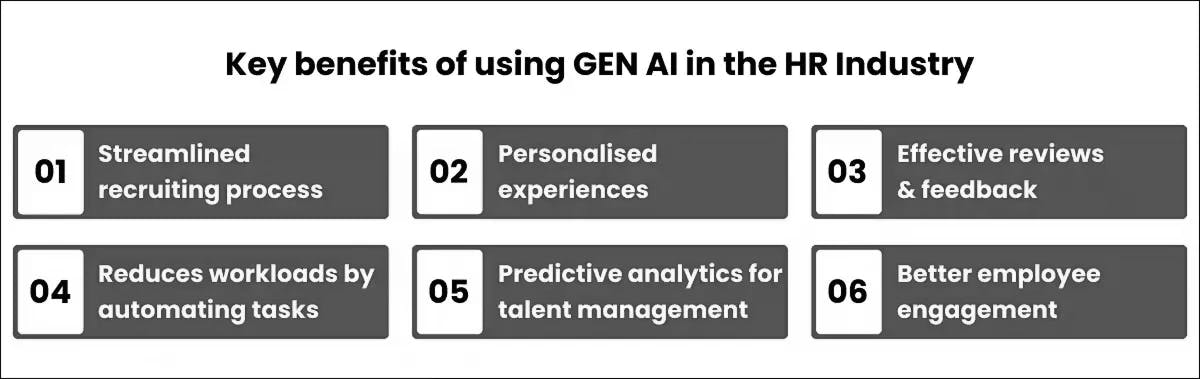
AI revolutionizes recruitment by automating time-consuming tasks. Sophisticated algorithms can:
Automated candidate matching ensures only the most qualified individuals reach HR experts. This allows focus on strategic decision-making rather than manual tasks.
Onboarding sets the tone for an employee's journey. AI in hr examples show how data analytics personalizes onboarding by understanding:
Tailored onboarding routes help new hires integrate faster into company culture. This fosters a sense of belonging from day one.
Traditional performance reviews are often biased and time-consuming. Generative AI brings efficiency and objectivity to performance management.
By analyzing peer feedback, individual contributions, and project outcomes, AI provides comprehensive evaluations. This enables HR experts to offer constructive feedback and make informed decisions about promotions or training.
AI excels at automating routine tasks, freeing HR professionals for strategic work. Automation covers:
This not only improves efficiency but also reduces errors. HR departments can operate with higher accuracy and precision.
One outstanding feature of AI in hr analytics is predictive analysis. By examining historical data and trends, AI can forecast:
This forward-looking approach enables proactive talent management strategies.
Human resource AI contributes to enhanced engagement through personalized experiences. It facilitates communication and identifies factors impacting job satisfaction.
This personalized approach makes employees feel valued and appreciated. The result is higher motivation and productivity.
Implementing generative AI in HR offers many benefits. However, organizations must address several challenges to ensure success.
According to Harvard Business School, 88% of HR executives have found that AI tools reject qualified candidates in significant numbers. Here are the key challenges to consider.
The reliability of generative AI varies significantly across different models. Stanford University research shows AI truthfulness is often less than 40%.
Key factors affecting reliability:
AI system accuracy depends heavily on datasets. If data doesn't reflect current information, the system's reliability falls.
AI trained by humans can inherit human biases. When AI models learn from datasets, they may assimilate biases unintentionally.
Cambridge University research confirms that AI systems can develop unconscious biases around:
These biases can impact the entire recruitment process. There's no guarantee AI eliminates human flaws; it may replicate them.
AI systems rely on massive datasets for training. As AI-generated data and user access increase, data leakage risks escalate.
Data security and privacy concerns have become global issues. Millions of users now access AI systems, making protection critical.
AI algorithms for resume screening and evaluation often operate as "black boxes." This creates doubts about:
Transparency is crucial for building candidate trust and addressing HR challenges effectively.
Implementing AI in human resources can create apprehension among employees. Common concerns include:
HR professionals must proactively communicate the purpose, benefits, and limitations of AI systems. Clear communication fosters acceptance and trust.
As AI technology evolves rapidly, HR leaders must keep pace with requirements and capabilities. Here are three key focus areas for effective implementation.
HR professionals should distinguish reality from myth before adopting new AI solutions.
Essential steps:
Understanding what AI can and cannot do prevents unrealistic expectations.
HR professionals need clear explanations of what AI implementation means for their workforce.
Key focus areas:
Partner with senior executives to identify AI talent strategies. This ensures smooth talent transformation among employees.
Evaluate the risks and advantages AI brings to HR functions. Consider the impact on:
Critical priorities:
HR guidance should clearly communicate what information should remain private.
Having the right AI in your Human Resources department will modernize your HR landscape. It empowers HR professionals to gain insights and make informed decisions about workforce productivity.
With AI applications in human resources, organizations can maximize human capital potential. They can establish a competitive advantage in today's innovative business landscape.
If you're considering generative AI for your HR function, approach a reputed AI development company like Codiste.
Codiste is a trustworthy AI development company offering comprehensive AI services. We build automated tools and software solutions for businesses of all sizes to enhance operational efficiency.
Hire professional AI developers from Codiste to access enterprise-grade AI solutions. We help detect patterns and automate business processes to improve growth. Contact us now to get started!

CTO & Co-Founder | Codiste
Nishant builds where ambitious ideas meet production reality. As CTO & Co-Founder at Codiste, he has helped ship 150+ AI systems. Through The CTO Story, he gets technical leaders talking about what rarely makes the slide deck: the trade-offs, failures, and decisions behind what actually ships.


Every great partnership begins with a conversation. Whether you're exploring possibilities or ready to scale, our team of specialists will help you navigate the journey.