ai agents for treasury and finance

AI Agents for Fintech Treasury Ops: Cash Forecasting, Liquidity Alerts, FX Hedging Decisions

Author : Nishant Bijani
Artificial Intelligence
Read time:9 minsUpdated:August 19, 2026

TL;DR

  • Treasury runs on tools that cannot watch. 77% of organisations still run cash positioning primarily on Excel, while 73% of treasurers rank forecasting as their top priority and more than 60% call it their hardest task.
  • The week goes to assembly, not analysis. 46% of finance team time is spent on data collection and validation, and 59% of treasury teams cite data quality as their primary accuracy challenge. The maths is rarely the problem; the stale inputs are.
  • Three workflows, one shape. Cash forecasting, liquidity monitoring and FX exposure are all continuous-attention problems interrupted by judgement calls. Agents take the attention, people keep the calls.
  • Forecasting: invoice-level payment probability instead of terms-based guesses, with a 30 to 50% short-term accuracy gain per McKinsey research, and every forecast line carrying its confidence and drivers.
  • Liquidity: every account watched continuously, drifting balances flagged with a projected crossing date, covenant headroom tracked as a live number rather than a quarter-end discovery.
  • One line: agents take the continuous watching, humans keep the judgement calls, and in treasury the audit trail is not a feature, it is the product.
Every treasury team has a version of the same morning. Log into five bank portals, export the balances, paste them into the spreadsheet, chase two subsidiaries, and produce a cash position that describes yesterday. By the time the forecast is assembled, the thing it forecasts has already moved.

This is not a fringe workflow. Strategic Treasurer found 77% of organisations still run cash positioning primarily on Excel, and in AFP's 2025 Treasury Benchmarking Survey, 73% rank cash forecasting as their top priority while more than 60% call it their most challenging task. The most important job in the function runs on the weakest tooling.

AI agents fit treasury unusually well, for a structural reason. Treasury is continuous monitoring of many accounts, entities and currencies, punctuated by decisions that need judgement. Software is good at the first part. People are good at the second. Most treasury stacks force people to do both, and the monitoring eats up the week.

Why is the treasury still run on spreadsheets, and what does it cost?

Because the spreadsheet works right up until the moment it matters. It handles the routine week fine. It cannot see across five banks in real time, catch a covenant drifting toward its limit on a Friday, or explain why the forecast missed. The cost hides in three places:
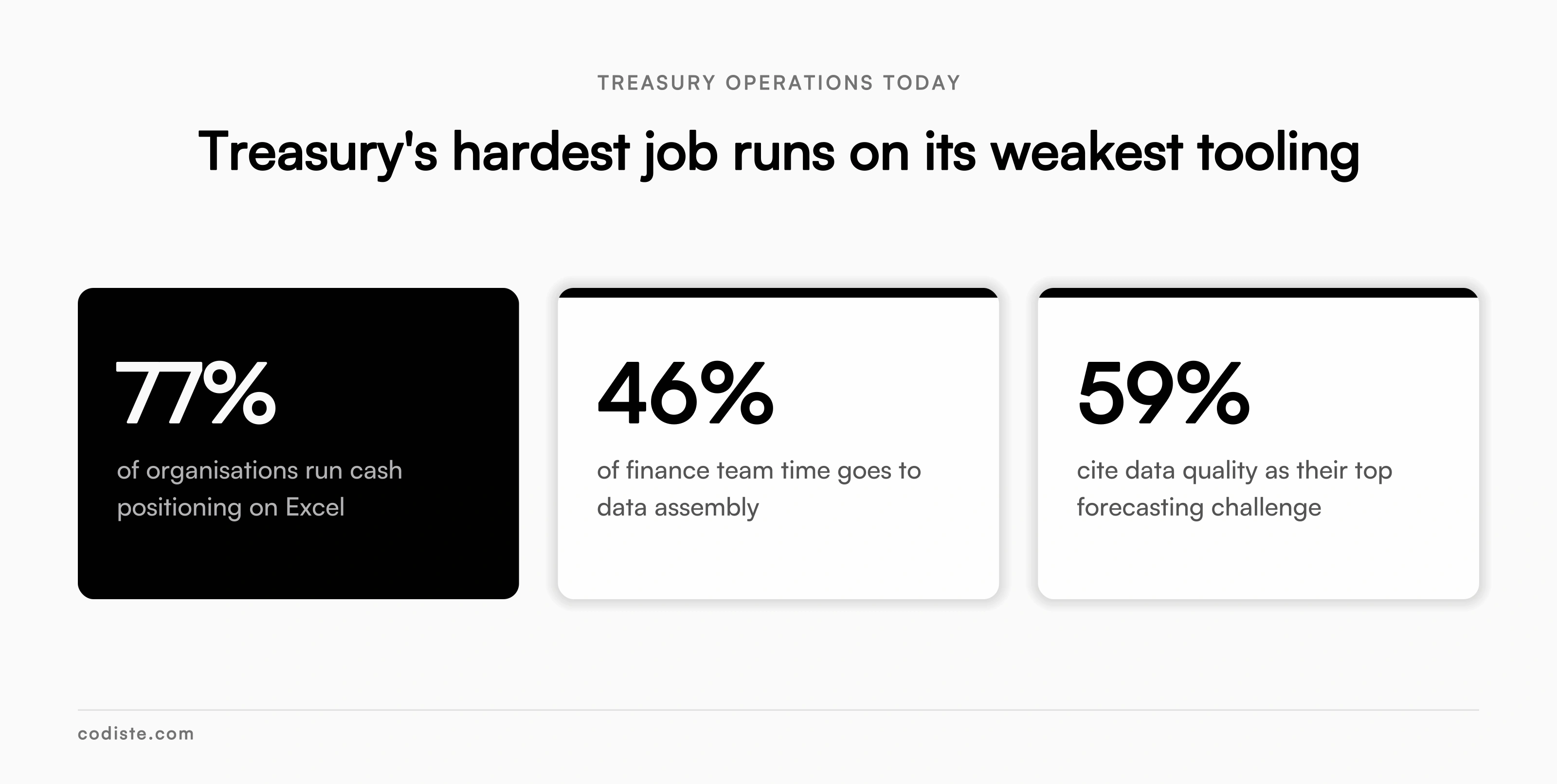
  • Half the team's time goes to assembly. FP&A Trends research puts 46% of finance team time on data collection and validation rather than analysis.
  • The inputs are the accuracy ceiling. AFP found 59% of treasury teams cite data quality and availability as their primary forecasting challenge. The maths is rarely the problem; the stale ERP snapshot underneath it is.
  • Fragmentation keeps growing. Half of mid-market businesses now work with three or more banks, and the share of organisations calling forecasting easy has halved since 2018, from 28% to 14%, while 68% report management expectations rising.
Treasury's hardest job runs on its weakest tooling

Rising expectations, worsening inputs, flat headcount. That squeeze is why 46% of treasury teams are actively evaluating AI.

What do AI agents actually do in treasury operations?

Three jobs. An AI agent in treasury continuously reads your bank, ERP and market data, maintains a live picture, and either acts within tight limits or brings a recommendation to a human with the reasoning attached. It is not a chatbot over your TMS, and it does not move money on its own judgement.
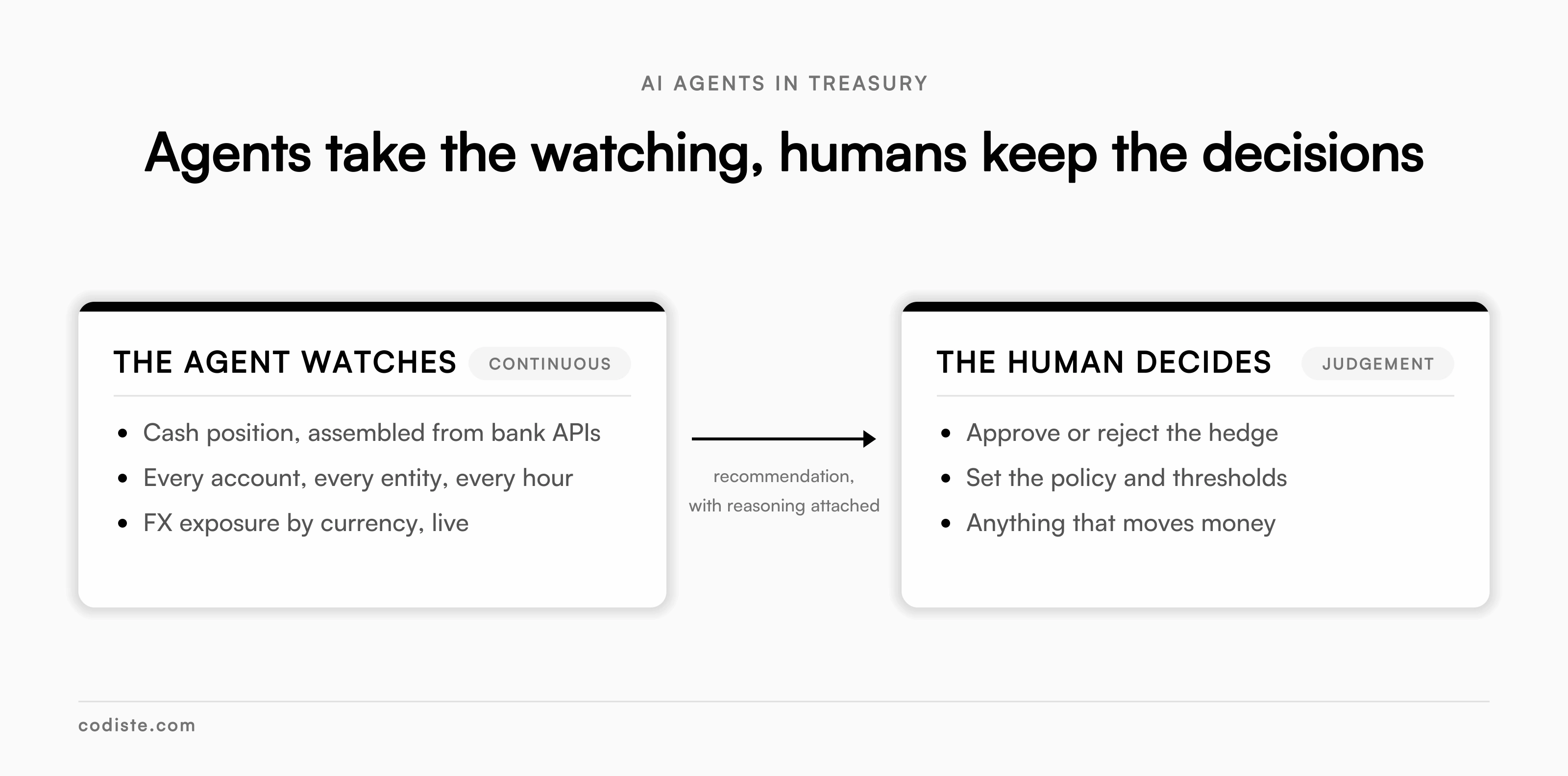
Agents take the watching, humans keep the decisions

Cash forecasting: from weekly assembly to standing accuracy

A forecasting agent connects to bank APIs and the ERP directly, so the position assembles itself. Then it does what spreadsheets structurally cannot: it learns payment behaviour at invoice level, which customer pays on day 34 regardless of terms, which subsidiary submits late, what seasonality does to collections, and assigns each open receivable a payment probability instead of assuming terms are destiny.

McKinsey research puts the machine learning gain at 30% to 50% better short-term accuracy over manual methods, and a tighter forecast means smaller idle buffers, so cash held as insurance can work instead. The production detail that matters: every forecast line carries its confidence and drivers, because a forecast that cannot explain its own variance will not survive its third bad week.

Liquidity alerts: from morning discovery to standing watch

Liquidity problems are rarely surprises in the data. They are surprises in the noticing. The balance was drifting for nine days; nobody was looking at that account on those days. A liquidity agent watches every account, entity and facility continuously and flags:

  • Balances drifting toward thresholds. With the projected crossing date attached, rather than the bare fact of the drift.
  • Covenant headroom as a live number. Distance and trajectory tracked continuously instead of discovered at quarter end.
  • Anomalies against learned patterns. A payment run double its usual size, an inflow that missed its usual day, cash concentrating in one bank beyond policy. The agent knows the rhythm, so it notices the missed beat.
Each alert carries the reason and a recommended action, which is what separates a monitoring agent from a fourth dashboard. The value is the watching, done on every account, by something that does not go home at six.

FX hedging decisions: recommendation, not execution

FX is where the money is largest and where autonomy should be smallest. MillTech's Q1 2026 survey found 96% of firms with unhedged exposures took losses, averaging £908,000 per quarter, with 14% losing between £1 million and £4.9 million. The pain underneath those numbers is visibility: you cannot hedge what you have not measured, and exposure data lives scattered across ERP entries, intercompany positions and forecasts in a dozen entities.

That aggregation is what an agent does well. It maintains net exposure by currency and entity as invoices post, flags every pair below your policy hedge ratio, runs scenario maths on live positions, and packages a hedge recommendation with reasoning for a human to approve or reject. The trade stays with the treasurer. A model can be wrong about direction; it should never be wrong about what your exposure is, and that half of FX risk is pure data work.

WorkflowSpreadsheet realityWith an AI agent
Cash positionAssembled each morning from portalsAssembles itself from bank and ERP APIs
Forecast accuracyTerms-based guesses, stale inputsInvoice-level probability, 30% to 50% better
Liquidity monitoringChecked when someone looksEvery account watched, reasons attached
Covenant headroomQuarter-end calculationLive number with projected breach date
FX exposureMonthly aggregation across entitiesContinuous net position by currency and entity
Hedging decisionsMade on incomplete exposure dataRecommended with reasoning, executed by humans

Why do treasury AI projects fail, and what makes one auditable?

Treasury is the wrong place to learn AI governance by accident. Three problems account for most failures. The data was not ready and the agent amplified it: EuroFinance found 37% of treasurers name poor underlying data as their top barrier to trusting AI forecasts, and an agent on fragmented inputs produces confident numbers built on them. Plausible-but-wrong outputs burned trust early: one wrong forecast with no explanation trail, and the team quietly returns to Excel. And nobody could answer the auditor: who approved this, on what data, under which policy version?

The engineering answers are unglamorous and they are the actual product. Every number carries its sources and confidence. Every recommendation logs the policy applied and the human who dispositioned it. Autonomy is tiered: aggregate and alert freely, recommend within policy, execute nothing that moves money without a named approver. In treasury, governance is not the compliance tax on the project. It is the project.

And the blunt caution. One entity, two bank accounts, a single currency: you do not need an agent layer, and a disciplined spreadsheet with bank feeds will serve you at a fraction of the cost. Agents earn their infrastructure when the accounts, entities and currencies exceed what a team can watch.

Read more:

How should a fintech team start?

  • Baseline your numbers. Forecast variance by week, hours spent on position assembly, manual touchpoints. Most teams have measured none of the three.
  • Connect the data first. Bank APIs, ERP, TMS. The aggregation layer is most of the value and most of the work.
  • Run forecasting in shadow mode for a quarter. Measured against the existing spreadsheet before anything depends on it.
  • Turn on liquidity alerts once the data is trusted. Low risk, high visibility, builds the team's confidence.
  • Add FX recommendations last, execution never. A standing rule, not a temporary one.
Build versus buy: Kyriba, HighRadius and the TMS vendors sell strong general-purpose modules. Teams with unusual flows, marketplace float, client money segregation, crypto treasury, need agents built against their own ledger and policy logic, which is where an AI agent development partner beats a thirteenth SaaS subscription.

Conclusion

The morning routine is the tell. If your treasury team starts the day logging into portals and pasting balances, the constraint is not analytical talent. It is that the most watching-intensive function in finance runs on tools that cannot watch.

The three workflows share one shape: continuous attention interrupted by judgement calls. Agents take the attention, people keep the calls. Get that split right and the numbers follow, forecast accuracy up 30% to 50%, drift caught days earlier, hedges decided on complete exposure for the first time. Get the governance wrong and none of it survives the first audit.

Codiste builds AI agent systems for fintech treasury operations where every forecast, alert and hedge recommendation carries its data sources, its confidence and an audit trail your examiners can replay.

FAQs

How does AI enhance liquidity decision-making in treasury? +
By collapsing the gap between something changing and someone noticing. An agent watches every account continuously, flags drifting balances with a projected crossing date, tracks covenant headroom live, and attaches a reason to every alert. The decision stays human; it gets made days earlier.
How do intelligent agents manage treasury workflows? +
They run the continuous layer: aggregating positions from bank and ERP APIs, learning payment behaviour at invoice level, maintaining live FX exposure, and monitoring anomalies. Humans keep approvals, hedging decisions and policy. The architecture is tiered autonomy: aggregate and alert freely, recommend within policy, execute nothing that moves money.
What AI agents are available for treasury tasks? +
Treasury platforms like Kyriba and HighRadius ship AI modules inside their suites, TMS vendors are adding agent features, and custom agent systems are built against a company's own ledger and policies, which suits fintechs with flows a general module does not model, such as marketplace float or client money segregation.
How does AI support anomaly detection in treasury? +
The agent learns each account's normal rhythm and flags deviations the moment they occur. Because the baseline is learned per account rather than set as a static rule, it catches the drift a fixed threshold misses and skips the false alarms a crude rule fires.
Should AI execute FX hedges autonomously? +
No, and treat vendors suggesting it with caution. Automate exposure visibility, aggregation, policy-gap detection and scenario maths, and package recommendations for human approval. MillTech found 96% of firms with unhedged exposures took losses averaging £908,000 a quarter, so the value is real, but it comes from better-informed human decisions, not from removing the human.
Nishant Bijani
Nishant Bijani
CTO & Co-Founder | Codiste
Nishant is a dynamic individual, passionate about engineering and a keen observer of the latest technology trends. With an innovative mindset and a commitment to staying up-to-date with advancements, he tackles complex challenges and shares valuable insights, making a positive impact in the ever-evolving world of advanced technology.
Relevant blog posts
Top 10 Real Estate Use Cases of Generative AI in 2026
Artificial Intelligence
April 18, 2024

Top 10 Real Estate Use Cases of Generative AI in 2026

How AI Agents Are Changing the Future of Digital Marketing?
Artificial Intelligence
February 21, 2025

How AI Agents Are Changing the Future of Digital Marketing?

AI in Credit Scoring: Why Traditional Models Are Failing Today's Borrower
Artificial Intelligence
September 26, 2025

AI in Credit Scoring: Why Traditional Models Are Failing Today's Borrower

Talk to Experts About Your Product Idea

Every great partnership begins with a conversation. Whether you're exploring possibilities or ready to scale, our team of specialists will help you navigate the journey.

Contact Us

Phone