





Artificial Intelligence
June 12, 2024

A merchant applies for £40,000 of working capital.
The bank sees a company incorporated twenty-six months ago, one set of filed accounts, a director with a 680 credit score, no property, and a request equal to roughly a fifth of stated annual revenue. On those inputs the answer is no, and it is not an unreasonable no. The bank is working from the only data it has.
The vertical SaaS platform that business has run on for three years sees something else entirely. It sees 4,200 completed jobs. It sees average invoice value rising 18% year on year. It sees a 61% repeat customer rate, days-to-payment tightening from 34 to 21, a cancellation rate below the platform median, and a booking calendar already 70% committed for the next six weeks.
Same borrower. Same week. One of those is a credit file and the other is a business.
That gap is the entire commercial case for embedded lending fintech, and the reason embedded AI agents have become interesting in this category. It is also, in most embedded lending solutions we see, completely wasted.
Because they are underwriting the wrong artefact, and they know it.
Biz2Credit's Small Business Lending Index puts big bank approval rates for small business loan applications at roughly 13% to 15%, a figure that has held stable for eighteen months. Small banks land around 18% to 20%.
Alternative and online lenders reach 25% to 30%. The reasons cited for decline repeat: insufficient time in business, thin credit file, limited collateral, revenue judged inadequate against the request.
Notice that every one of those is a proxy. Time in business is a proxy for durability. Collateral is a proxy for recovery. A credit score is a proxy for behaviour. Banks use proxies because proxies are what they can obtain about a business they have no operational visibility into.
A platform does not need proxies. It has the underlying behaviour the proxies were invented to estimate. That is a structural advantage, and it is the only durable one in this category, because interest rates and funding partners are commodities and platform data is not.
Bain expects embedded B2B lending to scale from roughly $12 billion in 2021 to between $50 and $75 billion by 2026, around 15% of the total small business loan market. The demand is not in question. What separates platforms that capture it from platforms that add a lending tab is whether they use the data they already own.
This table is the argument. Every row on the left is a bank proxy; every row on the right is what a platform observes directly.
Comparison of Bank and Platform Credit Assessment Data
The bottom row deserves attention. Customer concentration is one of the strongest predictors of small business distress and it is almost invisible to a traditional lender. A platform can see that 54% of a merchant's revenue comes from three accounts, and that one of them has not booked in ninety days. No filed account will ever tell a bank that.
The common pattern in embedded lending infrastructure projects: the platform integrates an embedded credit API for fintech partners, builds a clean application flow, and passes across a form containing business name, requested amount, stated revenue and a director's details.
The partner then underwrites on the same proxies the bank used, and declines the same merchants, inside a better interface. The platform has bought distribution and given away its edge.
If the integration does not carry platform-observed behavioural data into the decision, it is a referral link with better styling.
Three things, and only one of them is deciding.
This is where an AI agent for embedded systems work earns its place. Platform data is heterogeneous and messy: job notes, cancellation reasons, invoice line items, customer messages, dispute threads. Traditional decisioning needs structured fields, so most of this is discarded at ingestion. An agent can read it, extract what is decision-relevant, and normalise it into features a credit model can consume, which is the practical difference between using 12 signals and using 200.
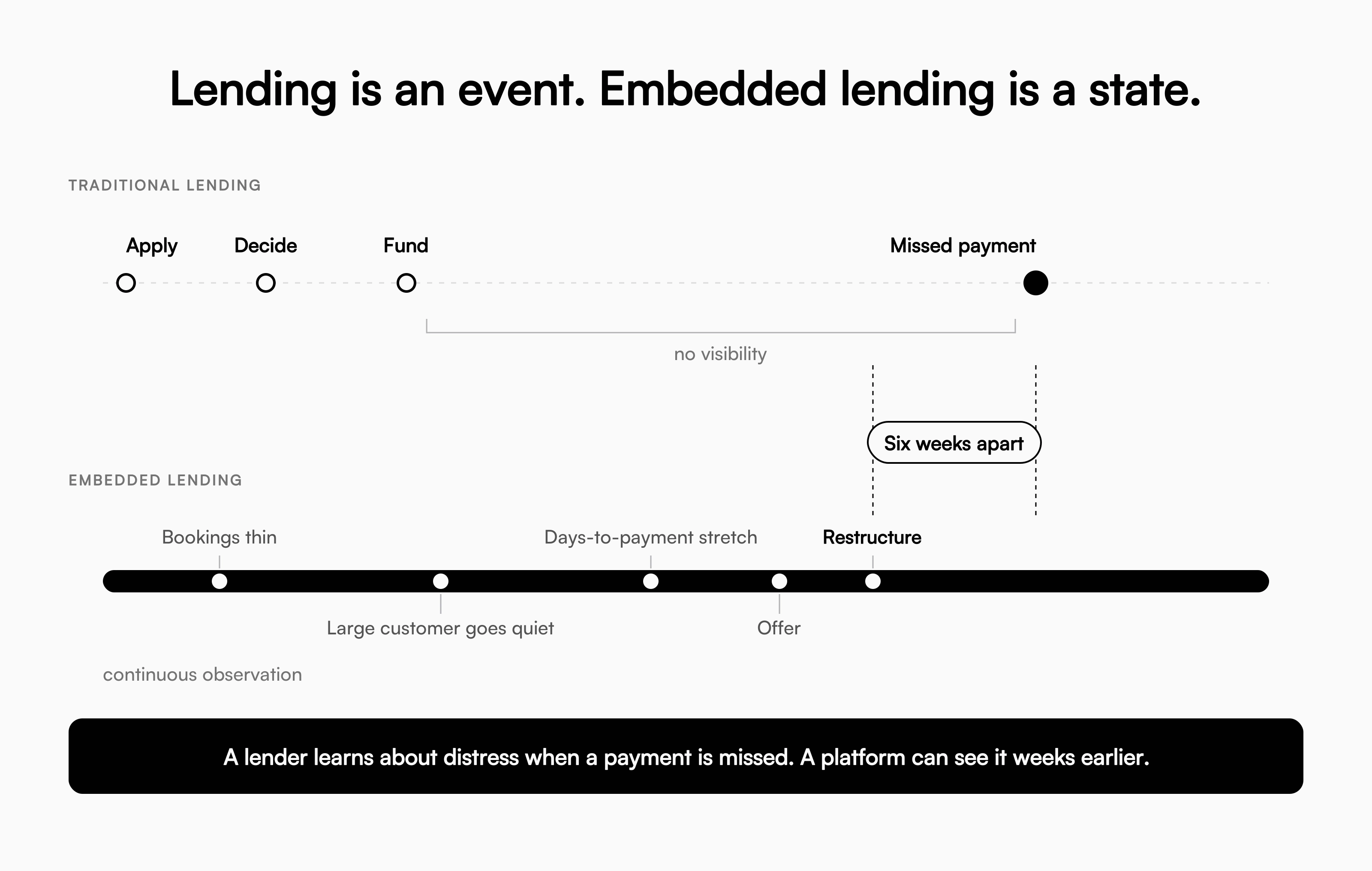
This is the reframe that matters. Traditional lending is an event: apply, decide, fund. Embedded lending's real advantage is that the platform is already watching, so the question changes from "should we approve this application" to "which merchants can we responsibly offer capital to right now."
Embedded credit monitoring on the servicing side works the same way. A lender learns about distress when a payment is missed. A platform can see bookings thinning, a large customer going quiet, or days-to-payment stretching, weeks earlier. That window is the difference between restructuring and recovery.
The most valuable thing an agent does here is not underwriting at all. A merchant who has just won a contract requiring stock they cannot fund is a different borrower from the same merchant three weeks later. The platform can see the trigger. An in-app approval offered at the moment of need converts at a completely different rate from a financing option sitting in a menu, and it is better lending, because the use of funds is identifiable.
Set risk appetite. Own the credit policy. Make the final decision on a marginal file without a human in the loop. Anything that determines whether a business gets money should be explainable by a person who can defend it, for reasons the next section makes concrete.
Here is where most agent-driven loan decisioning projects meet reality, and it is better to meet it during architecture than during an examination.
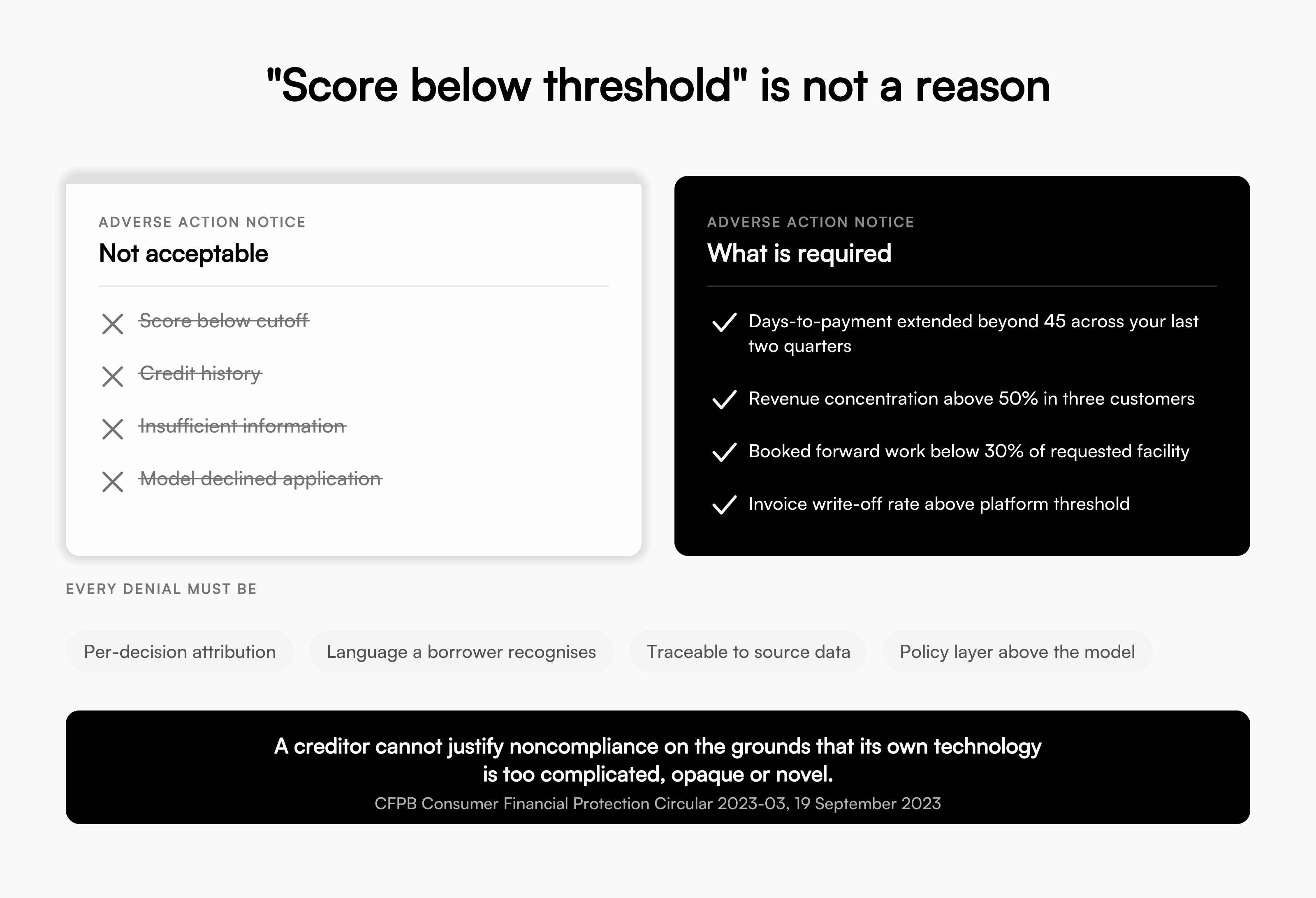
Under the Equal Credit Opportunity Act and Regulation B, a creditor taking adverse action must give the applicant a statement of specific reasons indicating the principal reasons for that decision. In September 2023 the CFPB issued Circular 2023-03, building on earlier 2022 guidance, addressing exactly what happens when the decision involves AI or complex models.
The Bureau's position is unambiguous. Creditors may not rely on the checklist of sample reasons in Regulation B if those reasons do not specifically and accurately identify the principal reasons for the decision. They may not rely on overly broad or vague reasons that obscure the actual basis. And, in the CFPB's framing, a creditor cannot justify noncompliance on the grounds that its own technology is too complicated, opaque or novel.
Translated into engineering requirements, that means four things.
Two scoping notes. Regulation B covers business credit as well as consumer credit, with modified notification provisions depending on applicant size, so a platform serving small businesses is not outside it. And in most BaaS and lending-as-a-service arrangements the licensed lender is the creditor of record, not the platform.
Four questions, in the order that saves the most rework.
The modular fintech stack embedded lending pattern separates five layers so any one can be replaced without rebuilding the others: the data layer holding your platform signals, the decisioning layer applying policy and models, the capital layer supplying funds, the servicing layer handling repayment and collections, and the experience layer inside your product.
The reason to insist on modularity is unglamorous. Funding partners change. Capital appetite shifts with rates. Platforms that fused decisioning to a single partner's API have rebuilt the whole stack to change lender, and it is a two-quarter project nobody planned for.
By making the product harder to leave, and by catching problems early enough to fix them.
The retention effect is documented, and embedded analytics for lending is what makes it visible: cohort behaviour, partner performance and default vintages sit in the same system as the operational data. Based on public disclosures from platforms operating these products, a customer using two embedded finance products is roughly three times less likely to churn than a customer on software alone. Satisfaction data points the same way: an Adyen and BCG survey found 72% of small businesses using embedded lending reported high satisfaction, against 56% of microbusinesses using traditional credit tools, a gap of sixteen points.
The mechanism is not mysterious. A merchant with a working capital facility inside your platform has their operations, their cash flow and their financing in one place. Migrating means refinancing.
The second effect matters more for credit quality. Continuous monitoring turns a servicing function into an early warning system. A platform that can see a borrower's revenue thinning six weeks before a missed payment can restructure rather than pursue. That is better for the merchant and materially better for loss rates, and it is only possible because the lender and the operating system are the same product.
Here is the part that cuts against the whole proposition, and against our interest in building these systems.
Approval rate is the easiest metric in embedded lending to move and the most dangerous one to optimise. A platform under pressure to show lending traction can lift approvals immediately by loosening policy, and the consequences arrive two to four quarters later in a cohort nobody is looking at any more. Every incentive in the first year points at volume, and the feedback that would correct it arrives after the roadmap has moved on.
There is a sharper version of this specific to platforms. Your borrower is also your customer. A bank that declines a business loses an application. A platform that lends into a business that then fails loses a subscription, a reference and often a chunk of goodwill among that merchant's peers, who are all also your customers. The blast radius of bad lending is larger for you than for a bank, and it lands on the software business rather than the credit book.
Which suggests a discipline most platforms skip: track cohort performance by approval vintage from the first month, and hold the person who owns lending revenue accountable for defaults twelve months out rather than originations this quarter. If nobody owns that number, the system will drift toward yes.
Codiste builds decisioning and credit-monitoring agents for fintech platforms, starting with the data you already hold rather than the data a lender's form asks for. If your embedded lending is declining merchants you can see are healthy, our AI agent development services start by mapping the signals your integration is currently throwing away.

CTO & Co-Founder | Codiste
Nishant builds where ambitious ideas meet production reality. As CTO & Co-Founder at Codiste, he has helped ship 150+ AI systems. Through The CTO Story, he gets technical leaders talking about what rarely makes the slide deck: the trade-offs, failures, and decisions behind what actually ships.


Every great partnership begins with a conversation. Whether you're exploring possibilities or ready to scale, our team of specialists will help you navigate the journey.